. 2010 Nov;31(11):1223-32.
doi: 10.1002/humu.21349. Epub 2010 Oct 7.

MicroSNiPer: a web tool for prediction of SNP effects on putative microRNA targets

Affiliations

MicroSNiPer: a web tool for prediction of SNP effects on putative microRNA targets

Maxim Barenboim et al. Hum Mutat. 2010 Nov.

Abstract

MicroRNAs are short, approximately 22 nucleotide noncoding RNAs binding to partially complementary sites in the 3'UTR of target mRNAs. This process generally results in repression of multiple targets by a particular microRNA. There is substantial interest in methods designed to predict the microRNA targets and effect of single nucleotide polymorphisms (SNPs) on microRNA binding, given the impact of microRNA on posttranscriptional regulation and its potential relation to complex diseases. We developed a web-based application, MicroSNiPer, which predicts the impact of a SNP on putative microRNA targets. This application interrogates the 3'-untranslated region and predicts if a SNP within the target site will disrupt/eliminate or enhance/create a microRNA binding site. MicroSNiPer computes these sites and examines the effects of SNPs in real time. MicroSNiPer is a user-friendly Web-based tool. Its advantages include ease of use, flexibility, and straightforward graphical representation of the results. It is freely accessible at http://cbdb.nimh.nih.gov/microsniper.


Figures

Figure 1
Figure 1
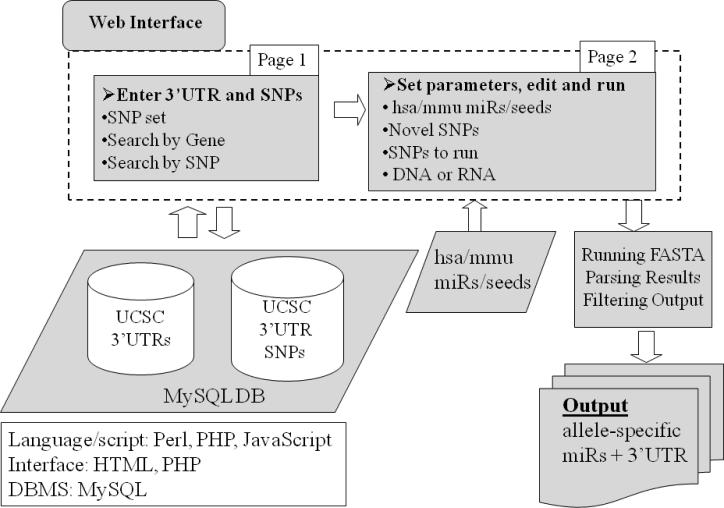
The schematic pipeline of MicroSNiPer. The web interface consists of the opening screen (Page 1) where manual or automatic selection of the 3'UTR sequence and of a particular set of SNPs is chosen. The 3'UTR and the SNPs within the sequence is loaded from a MySQL database. The sequence and SNPs are passed to the subsequent launching page (Page 2) where the 3'UTR can be edited, novel SNPs can be added, and sets of miRNAs can be chosen. On page 2, the application is launched.
Figure 2
Figure 2
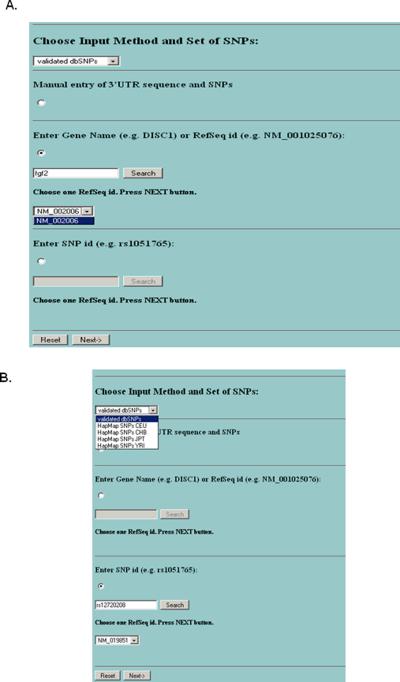
The initial screen of MicroSNiPer. The user can specify the input method (either manual or from database), a set of SNPs (either validated dbSNPs or HapMap SNP sets). If user use MySQL database he/she can search the database either by gene name or by SNP (rs number). (A) Input by gene name. (B) Input by SNP rs# with a subsequent search of RefSeq IDs.
Figure 3
Figure 3
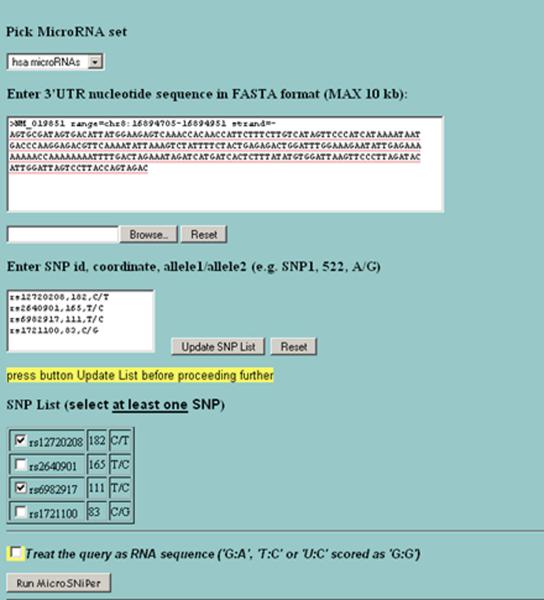
The second screen of MicroSNiPer. The user chooses a miRNA sets (`hsa' - human, `mmu' – mouse full miRNA or seed sets), edits the 3'UTR. The user can add novel SNPs in the format `SNP id, position, alleles', update the SNP list to include SNPs of interest, and set the wobbling complementary pairs, i.e. the program treats the query as RNA sequences with additional complementarity.
Figure 4
Figure 4
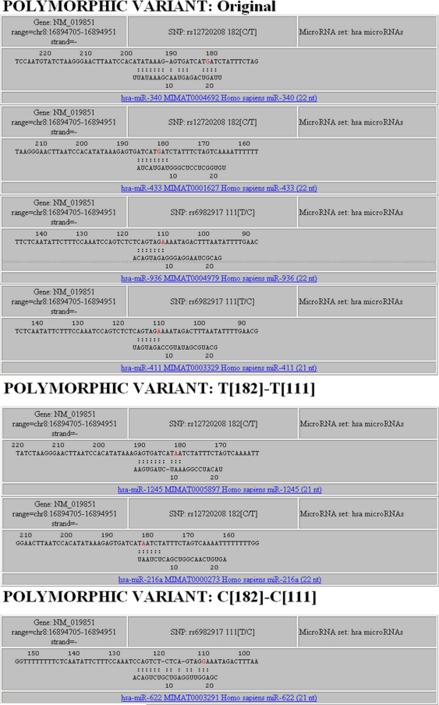
The output display showing the microRNA-binding sites. The SNPs in the overlapping region are presented on actual page in red. Information about the SNP, rs numbers, position on the 3'UTR and alleles is shown. The 3'UTR sequence and the allele in the sequence are presented in reverse complement.
Figure 5
Figure 5
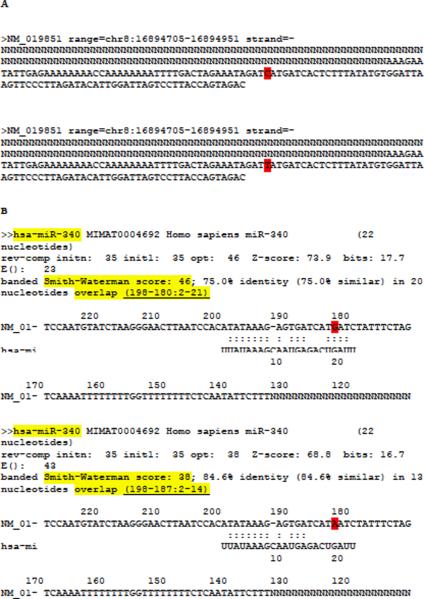
MicroSNiPer pre-processing of FGF20 input sequence before running with FASTA program and its FASTA output. (A) Two FGF20 input sequences in separate files generated with SNP rs12720208 in position 182[C/T]. (B) Two FASTA program output files corresponding to each input file, respectively. The 3'UTR sequence and the alternative alleles are complementary to the input 3'UTR sequence. The FGF20 3'UTR sequence is masked upstream with `N'. The alternative alleles are highlighted in red. MicroSNiPer builds a unique lookup key (highlighted with light yellow background) composed of the miRNA name, the banded Smith-Waterman score, and the coordinates of the overlap.
Figure 6
Figure 6
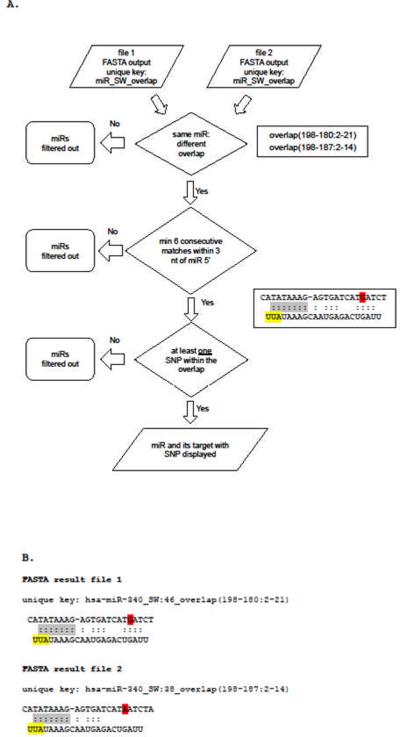
Process of selection of miRNAs and miRTS for MicroSNiPer output. (A) Flowchart of the selection procedure by MicroSNiPer. The FASTA output indicates the coordinates of the base-pair binding interval (overlap) in the 3'UTR sequence. A change in either the overlap, indicating a shift in the 3'UTR target site, or a mismatch arising from the alternative allele, is used to filter the FASTA result file. Six contiguous matches starting from the first to the third nucleotide on the 5'-end of the miRNA is required. MicroSNiPer selects only those miRNA-target alignments which have a SNP located within the target site. MicroSNiPer outputs only those miRNAs/seeds where the alignment has been shifted due to a change in the alleles. (B) Features used for selection: minimum of 6 consecutive matches (grey) within 3 nucleotides of miRNA 5'-end (yellow); at least one SNP (red) within the overlap. MicroSNiPer builds a unique lookup key composed of the miRNA name, the banded Smith-Waterman score, and the coordinates of the overlap (key1: hsa-miR-340_SW: 46_overlap (198-180:2-21) and key2: hsa-miR-340_SW:38_overlap (198-187:2-14)). FASTA `result file 2' is filtered out because the SNP is not in the overlap.
Figure 7
Figure 7
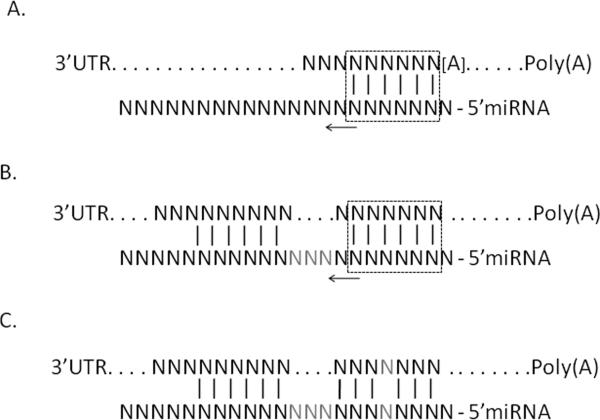
Generalized types of miRNA target sites. (A) Canonical and marginal sites together with (B) 3'-supplementary sites comprise approximately 99% of experimentally validated target sites; (C) 3'-compensatory sites lacking 5'-miRNA seed comprise ~1% of known sites. Rectangles mark minimum length of contiguous seed match (6 base pairs); arrows show possible extension of a seed match; grey `N' denotes non-complementary nucleotides between stretches of matching nucleotides; [A] denotes either unbound `A' or any other nucleotide (modified from Figure 1 [Bartel, 2009]).

References

    1. Abelson JF, Kwan KY, O'Roak BJ, Baek DY, Stillman AA, Morgan TM, Mathews CA, Pauls DL, Rasin MR, Gunel M, et al. Sequence variants in SLITRK1 are associated with Tourette's syndrome. Science. 2005;310(5746):317–20. - PubMed
    1. Adams BD, Furneaux H, White BA. The micro-ribonucleic acid (miRNA) miR-206 targets the human estrogen receptor-alpha (ERalpha) and represses ERalpha messenger RNA and protein expression in breast cancer cell lines. Mol Endocrinol. 2007;21(5):1132–47. - PubMed
    1. Bao L, Zhou M, Wu L, Lu L, Goldowitz D, Williams RW, Cui Y. PolymiRTS Database: linking polymorphisms in microRNA target sites with complex traits. Nucleic Acids Res. 2007;35(Database issue):D51–4. - PMC - PubMed
    1. Barenboim M, Guo Y, Jamison DC. A laboratory information management system (LIMS) for small-scale single nucleotide polymorphism detection. Biophysics. 2003;48(SUPPLEMENT1):S90–S96.
    1. Bartel DP. MicroRNAs: target recognition and regulatory functions. Cell. 2009;136(2):215–33. - PMC - PubMed

Publication types