


A biobehavioral home-based intervention and the well-being of patients with dementia and their caregivers: the COPE randomized trial
- PMID: 20810376
- PMCID: PMC4091681
- DOI: 10.1001/jama.2010.1253
A biobehavioral home-based intervention and the well-being of patients with dementia and their caregivers: the COPE randomized trial
Abstract
Context: Optimal treatment to postpone functional decline in patients with dementia is not established.
Objective: To test a nonpharmacologic intervention realigning environmental demands with patient capabilities.
Design, setting, and participants: Prospective 2-group randomized trial (Care of Persons with Dementia in their Environments [COPE]) involving patients with dementia and family caregivers (community-living dyads) recruited from March 2006 through June 2008 in Pennsylvania.
Interventions: Up to 12 home or telephone contacts over 4 months by health professionals who assessed patient capabilities and deficits; obtained blood and urine samples; and trained families in home safety, simplifying tasks, and stress reduction. Control group caregivers received 3 telephone calls and educational materials.
Main outcome measures: Functional dependence, quality of life, frequency of agitated behaviors, and engagement for patients and well-being, confidence using activities, and perceived benefits for caregivers at 4 months.
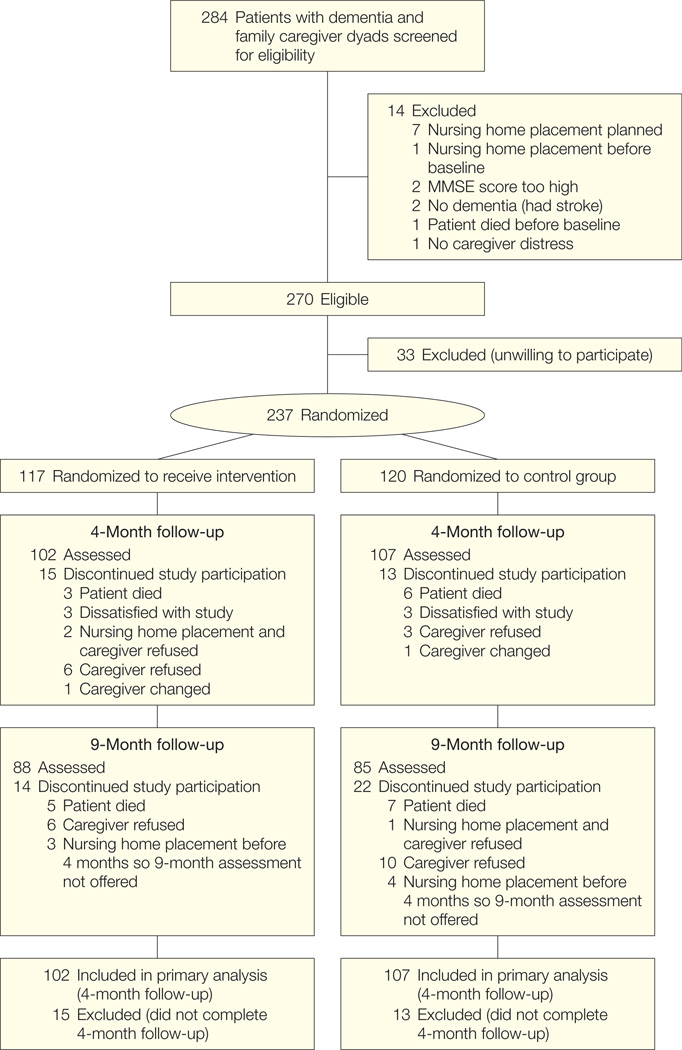
Results: Of 284 dyads screened, 270 (95%) were eligible and 237 (88%) randomized. Data were collected from 209 dyads (88%) at 4 months and 173 (73%) at 9 months. At 4 months, compared with controls, COPE patients had less functional dependence (adjusted mean difference, 0.24; 95% CI, 0.03-0.44; P = .02; Cohen d = 0.21) and less dependence in instrumental activities of daily living (adjusted mean difference, 0.32; 95% CI, 0.09-0.55; P = .007; Cohen d = 0.43), measured by a 15-item scale modeled after the Functional Independence Measure; COPE patients also had improved engagement (adjusted mean difference, 0.12; 95% CI, 0.07-0.22; P = .03; Cohen d = 0.26), measured by a 5-item scale. COPE caregivers improved in their well-being (adjusted mean difference in Perceived Change Index, 0.22; 95% CI, 0.08-0.36; P = .002; Cohen d = 0.30) and confidence using activities (adjusted mean difference, 0.81; 95% CI, 0.30-1.32; P = .002; Cohen d = 0.54), measured by a 5-item scale. By 4 months, 64 COPE dyads (62.7%) vs 48 control group dyads (44.9%) eliminated 1 or more caregiver-identified problems (chi(2/1) = 6.72, P = . 01).
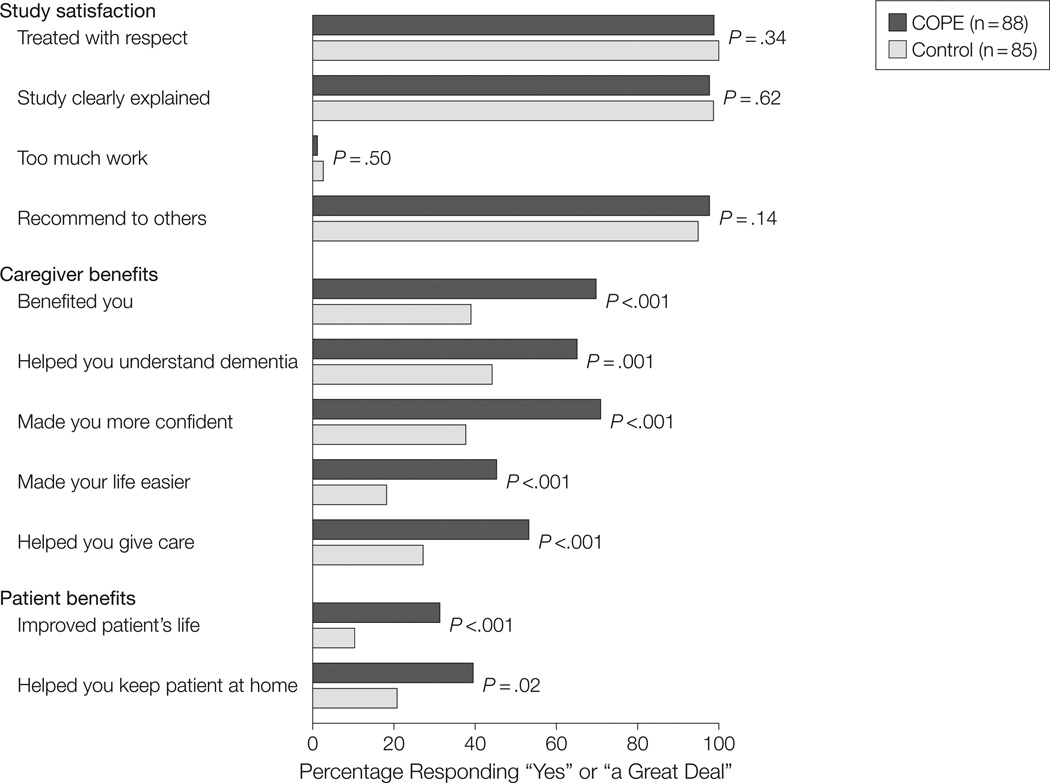
Conclusion: Among community-living dyads, a nonpharmacologic biobehavioral environmental intervention compared with control resulted in better outcomes for COPE dyads at 4 months. Although no group differences were observed at 9 months for patients, COPE caregivers perceived greater benefits.
Trial registration: clinicaltrials.gov Identifier: NCT00259454.
Figures
Comment in
-
Well-being of patients with dementia and their caregivers after a biobehavioral home-based intervention.JAMA. 2010 Dec 8;304(22):2482-3; author reply 2483-4. doi: 10.1001/jama.2010.1789. JAMA. 2010. PMID: 21139108 No abstract available.
-
ACP Journal Club. A biobehavioral intervention improved caregiver well-being and some measures of functioning in patients with dementia.Ann Intern Med. 2010 Dec 21;153(12):JC6-4. doi: 10.7326/0003-4819-153-12-201012210-02004. Ann Intern Med. 2010. PMID: 21173405 No abstract available.
-
Home-based biobehavioural intervention reduces dependence, increases engagement of patients with dementia in the short term and improves care giver well-being and confidence.Evid Based Nurs. 2011 Apr;14(2):39-40. doi: 10.1136/ebn.14.2.39. Evid Based Nurs. 2011. PMID: 21421968 No abstract available.
References
-
- 2010 Alzheimer’s disease facts and figures. Alzheimer’s Association. http://www.alz.org/documents_custom/report_alzfactsfigures2010.pdf. Accessed August 4, 2010. - PubMed
-
- Atchison TB, Massman PJ, Doody RS. Baseline cognitive function predicts rate of decline in basic-care abilities of individuals with dementia of the Alzheimer’s type. Arch Clin Neuropsychol. 2007;22(1):99–107. - PubMed
-
- Hill J, Fillit H, Thomas SK, Chang S. Functional impairment, healthcare costs and the prevalence of institutionalisation in patients with Alzheimer’s disease and other dementias. Pharmacoeconomics. 2006;24(3):265–280. - PubMed
-
- Soto ME, Andrieu S, Gillette-Guyonnet S, Cantet C, Nourhashemi F, Vellas B. Risk factors for functional decline and institutionalisation among community- dwelling older adults with mild to severe Alzheimer’s disease: one year of follow-up. Age Ageing. 2006;35(3):308–310. - PubMed
-
- Spillman BC, Long SK. Does high caregiver stress predict nursing home entry? Inquiry. 2009;46(2):140–161. - PubMed
