. 2010 Oct;20(10):1451-8.
doi: 10.1101/gr.109553.110. Epub 2010 Sep 1.

Comprehensive annotation of the transcriptome of the human fungal pathogen Candida albicans using RNA-seq

Affiliations

Comprehensive annotation of the transcriptome of the human fungal pathogen Candida albicans using RNA-seq

Vincent M Bruno et al. Genome Res. 2010 Oct.

Abstract

Candida albicans is the major invasive fungal pathogen of humans, causing diseases ranging from superficial mucosal infections to disseminated, systemic infections that are often lifethreatening. We have used massively parallel high-throughput sequencing of cDNA (RNA-seq) to generate a high-resolution map of the C. albicans transcriptome under several different environmental conditions. We have quantitatively determined all of the regions that are transcribed under these different conditions, and have identified 602 novel transcriptionally active regions (TARs) and numerous novel introns that are not represented in the current genome annotation. Interestingly, the expression of many of these TARs is regulated in a condition-specific manner. This comprehensive transcriptome analysis significantly enhances the current genome annotation of C. albicans, a necessary framework for a complete understanding of the molecular mechanisms of pathogenesis for this important eukaryotic pathogen.


Figures

Figure 1.
Figure 1.
Representative signal tracks of RNA-seq data. Data are from C. albicans strain SC5314 grown in YPD. (A) Strand-specific representation of expression in the genomic region surrounding the ACT1 locus. Red or blue boxes above the signal tracks represent Candida Genome Database (CGD) annotated features. The red line represents transcription from the positive strand. The blue line represents transcription from the negative strand. (B) Strand nonspecific representation of transcription in the genomic region immediately surrounding the centromere on chromosome 2 (CEN2).
Figure 2.
Figure 2.
Intron identification and validation. (A, B) Signal tracks representing an example of a known, previously annotated, intron (A) and a novel intron (B) identified using our RNA-seq data. Red and dark blue bars represent annotated ORFs according to the Candida Genome Database (CGD). Light blue bars represent RNA-seq–driven annotations, which include ORF plus 5′ and 3′ untranslated regions (UTRs). Introns are depicted as two colored bars (exons) connected by a bent gray line. (C) Validation of introns by RT-PCR. Each panel represents a different novel intron being assayed by a different pair of oligonucleotides flanking the intron. The left lane in each panel is a PCR product derived from genomic DNA. The right lane in each panel is a PCR product derived from cDNA.
Figure 3.
Figure 3.
Re-annotation of orf19.6013 due to discovery of two novel introns. (A) Alignment of the new amino acid sequence (which results from the discovery of new introns) for orf19.6013 to its homolog in C. dubliniensis. Red letters represent new translation that results from considering the new introns. (B) Schematic representation of re-annotation set against the Candida Genome Database (CGD) GBrowse. Shaded areas represent novel introns. Red bars represent annotated CGD ORFs. Pink lines represent new coding sequence resulting from the novel introns.
Figure 4.
Figure 4.
Identification of novel transcriptionally active regions (TARs). Signal tracks for examples of novel transcripts that are present in a region of chromosome 1 that has several annotated features (A) and a region on chromosome 7 that does not have any annotated features (B). Red and dark blue bars represent annotated ORFs according to the Candida Genome Database (CGD). Light blue bars represent RNA-seq–driven annotations, which include ORF plus 5′ and 3′ untranslated regions (UTRs). Introns are depicted as two colored bars (exons) connected by a bent gray line.
Figure 5.
Figure 5.
Cluster analysis of gene expression based on log ratio RPKM data. (A) Heat map depicting the results of cluster analysis of the log ratio RPKM data. (B) A cluster that is enriched in genes involved in “cellular amino acid biosynthetic process.” (C) A cluster that is enriched in genes involved in “intraspecies interaction between organisms.” (D) A cluster that is enriched in genes involved in “cellular cell wall organization or biogenesis.” Green represents lower expression, red represents high expression, column represent individual experiments, and rows represent transcriptional units.
Figure 6.
Figure 6.
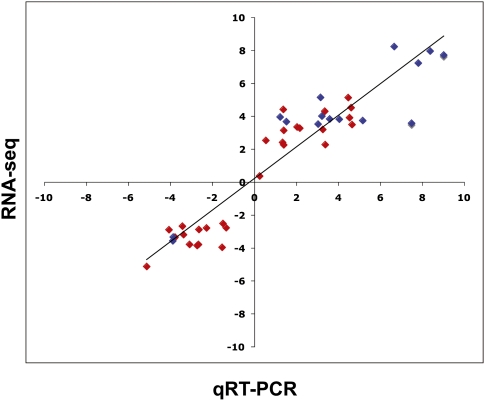
Verification of gene expression analysis by quantitative real-time PCR (qRT-PCR). Individual gene expression ratios (treated/untreated) were calculated using RPKM data generated by RNA-seq and plotted against calculations done for the same gene using qRT-PCR. Red diamonds represent novel transcripts. Blue diamonds represent annotated genes that were previously not known to be regulated under that particular condition. The Pearson correlation is 0.929.

References

    1. Arnaud MB, Costanzo MC, Shah P, Skrzypek MS, Sherlock G 2009. Gene Ontology and the annotation of pathogen genomes: The case of Candida albicans. Trends Microbiol 17: 295–303 - PMC - PubMed
    1. Babior BM, Kipnes RS, Curnutte JT 1973. Biological defense mechanisms. The production by leukocytes of superoxide, a potential bactericidal agent. J Clin Invest 52: 741–744 - PMC - PubMed
    1. Bensen ES, Martin SJ, Li M, Berman J, Davis DA 2004. Transcriptional profiling in Candida albicans reveals new adaptive responses to extracellular pH and functions for Rim101p. Mol Microbiol 54: 1335–1351 - PubMed
    1. Bentley DR, Balasubramanian S, Swerdlow HP, Smith GP, Milton J, Brown CG, Hall KP, Evers DJ, Barnes CL, Bignell HR, et al. 2008. Accurate whole human genome sequencing using reversible terminator chemistry. Nature 456: 53–59 - PMC - PubMed
    1. Biswas S, Van Dijck P, Datta A 2007. Environmental sensing and signal transduction pathways regulating morphopathogenic determinants of Candida albicans. Microbiol Mol Biol Rev 71: 348–376 - PMC - PubMed

Publication types

MeSH terms