Comparative Study
. 2010 Sep 1;30(35):11815-25.
doi: 10.1523/JNEUROSCI.2234-10.2010.

Agrp neurons mediate Sirt1's action on the melanocortin system and energy balance: roles for Sirt1 in neuronal firing and synaptic plasticity

Affiliations
Comparative Study

Agrp neurons mediate Sirt1's action on the melanocortin system and energy balance: roles for Sirt1 in neuronal firing and synaptic plasticity

Marcelo O Dietrich et al. J Neurosci. .

Abstract

Sirt1 has been associated with various effects of calorie restriction, including an increase in lifespan. Here we show in mice that a central regulatory component in energy metabolism, the hypothalamic melanocortin system, is affected by Sirt1, which promotes the activity and connectivity of this system resulting in negative energy balance. In adult mice, the pharmacological inhibition of brain Sirt1 activity decreased Agrp neuronal activity and the inhibitory tone on the anorexigenic POMC neurons, as measured by the number of synaptic inputs to these neurons. When a Sirt1 inhibitor (EX-527) was injected either peripherally (i.p., 10 mg/kg) or directly into the brain (i.c.v., 1.5 nmol/mouse), it decreased both food intake during the dark cycle and ghrelin-induced food intake. This effect on feeding is mediated by upstream melanocortin receptors, because the MC4R antagonist, SHU9119, reversed Sirt1's effect on food intake. This action of Sirt1 required an appropriate shift in the mitochondrial redox state: in the absence of such an adaptation enabled by the mitochondrial protein, UCP2, Sirt1-induced cellular and behavioral responses were impaired. In accordance with the pharmacological results, the selective knock-out of Sirt1 in hypothalamic Agrp neurons through the use of Cre-Lox technology decreased electric responses of Agrp neurons to ghrelin and decreased food intake, leading to decreased lean mass, fat mass, and body weight. The present data indicate that Sirt1 has a central mode of action by acting on the NPY/Agrp neurons to affect body metabolism.


Figures

Figure 1.
Figure 1.
Sirt1 inhibition decreases ghrelin-induced c-fos expression in NPY/Agrp neurons. EX-527 (i.c.v., 1.5 nmol/mouse), a pharmacological inhibitor of Sirt1 (Napper et al., 2005; Pacholec et al., 2010), diminished the number of c-fos labeled NPY-GFP cells after ghrelin treatment (i.p.). a, Slices from the brain highlighting the ARC (in yellow) where the NPY-GFP and c-fos cells were counted (between bregma −1.50 mm to −1.70 mm). b, Histogram showing quantification of double-labeled NPY-GFP/c-fos cells in the ARC of mice injected with vehicle/EX-527 and vehicle/ghrelin. c–f, Representative pictures of double immunohistochemistry for GFP (DAB, brown) and c-fos (nickel DAB, black). White arrows indicate double-stained cells. n = 4–5 mice/group. *p < 0.05, **p < 0.01.
Figure 2.
Figure 2.
Sirt1 inhibition affects synaptic inputs and mitochondrial number in POMC neurons in the hypothalamus. In a, EX-527 (i.c.v.) was administered to wild-type adult mice at the beginning of the dark cycle and synaptic inputs were measured on POMC neurons 4 h later. EX-527 decreased the recruitment of inputs onto POMC neurons, mainly affecting symmetric, putatively inhibitory, inputs, and not asymmetric, putatively excitatory synapses. Data are mean ± SEM; n = 15–21 cells. b, Electrophysiological recordings showing decreased frequency of mIPSCs in POMC-GFP neurons treated with EX-527 (mean ± SEM, n = 12 cells). c–f, Sirt1 inhibition by EX-527 affects mitochondrial density in POMC neurons. Sirt1 inhibition increased mitochondrial density (c) and relative area (d) in POMC cells (mean ± SEM, n = 13–20 cells), without affecting indexes of mitochondrial morphology, specifically the cross-sectional mitochondrial area (e) and circularity (f) (data are median ± interquartile range, n > 500). *p < 0.05; **p < 0.01.
Figure 3.
Figure 3.
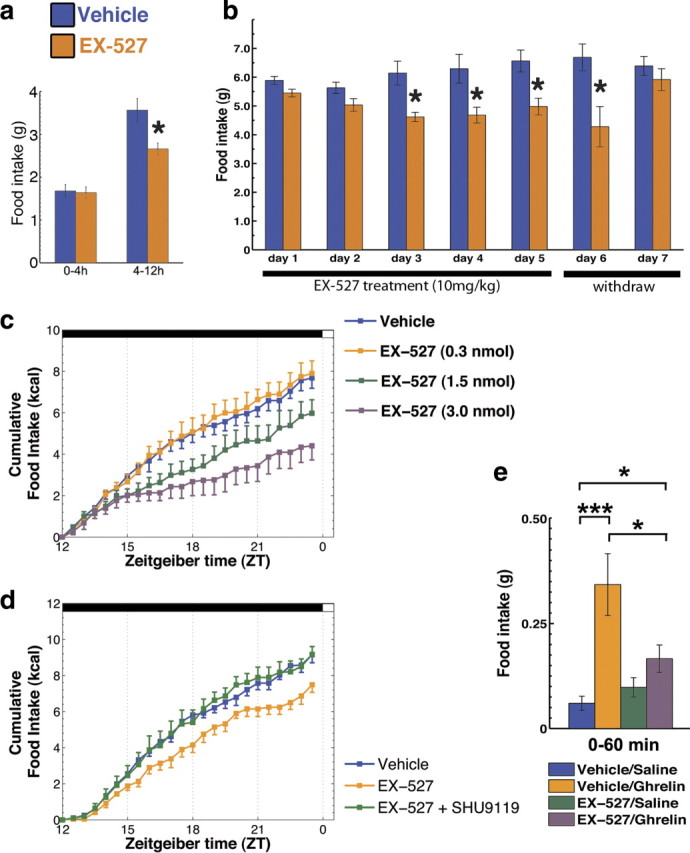
Inhibition of Sirt1 decreases food intake. a, Peripheral injection of a specific Sirt1 inhibitor, EX-527 (10 mg/kg), decreased the overnight food intake with no effect in the first 4 h (mean ± SEM, n = 5). b, Daily injection of EX-527 (10 mg/kg) just before the dark cycle produces a robust and consistent decrease in food intake (mean ± SEM, n = 4). c, Injection of EX-527 into the cerebral ventricles also inhibited food intake in a dose-dependent manner during the dark cycle (mean ± SEM, n = 4–7). d, SHU9119 (140 pmol, i.c.v.), a potent melanocortin receptor antagonist, counteracted the inhibitory effect of EX-527 on food intake (mean ± SEM, n = 4–6), highlighting the importance of downstream melanocortin signaling as an effector of Sirt1 inhibition on food intake. e, Brain Sirt1 inhibition by EX-527 (i.c.v.) blunted the orexigenic effect of the gut hormone ghrelin, which depends on redox adaptations in the NPY/Agrp neurons (Andrews et al., 2008) (mean ± SEM, n = 7–13 mice). *p < 0.05, **p < 0.01, ***p < 0.001. Scale bars, 50 μm.
Figure 4.
Figure 4.
The effect of Sirt1 inhibition on food intake is UCP2 dependent. Inhibition of brain Sirt1 by EX-527 (30–60 min before dark cycle, 1.5 nmol, i.c.v.) decreased food intake during the dark cycle in wild-type mice, but not in UCP2 KO mice (mean ± SEM, n = 5–12). *p < 0.05.
Figure 5.
Figure 5.
Agrp-Sirt1 KO mice have decreased food intake without concomitant adaptation in energy expenditure. a, Table showing the body weight at weaning and at 11 weeks old in male and female control and Agrp-Sirt1 KO mice. The KO mice gained less weight than controls, which was due mostly to decreased lean mass. Female Agrp-Sirt1 KO mice also showed a diminished fat tissue mass (mean ± SEM, data in grams). b–d, Data from metabolic chambers showing VO2, VCO2, and energy expenditure, respectively, adjusted for body mass (kg−0.75). There were no statistical differences at any of the time points analyzed. In e, data on ambulatory activity of the same mice in the metabolic chambers showing no statistical differences (mean ± SEM, n = 4–7). *p < 0.05.

References

    1. Andrews ZB, Liu ZW, Walllingford N, Erion DM, Borok E, Friedman JM, Tschöp MH, Shanabrough M, Cline G, Shulman GI, Coppola A, Gao XB, Horvath TL, Diano S. UCP2 mediates ghrelin's action on NPY/AgRP neurons by lowering free radicals. Nature. 2008;454:846–851. - PMC - PubMed
    1. Brachmann CB, Sherman JM, Devine SE, Cameron EE, Pillus L, Boeke JD. The SIR2 gene family, conserved from bacteria to humans, functions in silencing, cell cycle progression, and chromosome stability. Genes Dev. 1995;9:2888–2902. - PubMed
    1. Cakir I, Perello M, Lansari O, Messier NJ, Vaslet CA, Nillni EA. Hypothalamic Sirt1 regulates food intake in a rodent model system. PLoS One. 2009;4:e8322. - PMC - PubMed
    1. Chen D, Guarente L. SIR2: a potential target for calorie restriction mimetics. Trends Mol Med. 2007;13:64–71. - PubMed
    1. Chen D, Steele AD, Lindquist S, Guarente L. Increase in activity during calorie restriction requires Sirt1. Science. 2005;310:1641. - PubMed

Publication types

MeSH terms