


1, 2, 3, 4: infusing quantitative literacy into introductory biology
- PMID: 20810965
- PMCID: PMC2931680
- DOI: 10.1187/cbe.10-03-0033
1, 2, 3, 4: infusing quantitative literacy into introductory biology
Abstract
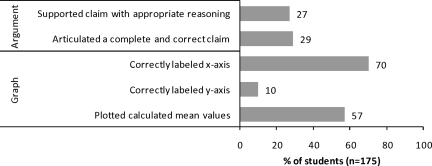
Biology of the twenty-first century is an increasingly quantitative science. Undergraduate biology education therefore needs to provide opportunities for students to develop fluency in the tools and language of quantitative disciplines. Quantitative literacy (QL) is important for future scientists as well as for citizens, who need to interpret numeric information and data-based claims regarding nearly every aspect of daily life. To address the need for QL in biology education, we incorporated quantitative concepts throughout a semester-long introductory biology course at a large research university. Early in the course, we assessed the quantitative skills that students bring to the introductory biology classroom and found that students had difficulties in performing simple calculations, representing data graphically, and articulating data-driven arguments. In response to students' learning needs, we infused the course with quantitative concepts aligned with the existing course content and learning objectives. The effectiveness of this approach is demonstrated by significant improvement in the quality of students' graphical representations of biological data. Infusing QL in introductory biology presents challenges. Our study, however, supports the conclusion that it is feasible in the context of an existing course, consistent with the goals of college biology education, and promotes students' development of important quantitative skills.
Figures



References
-
- American Association for the Advancement of Science. A Call to Action. Washington, DC: American Association for the Advancement of Science; 2009. [accessed 11 March 2010]. Vision and Change in Undergraduate Biology Education. http://visionandchange.org/
-
- Association of American Medical Colleges and Howard Hughes Medical Institute. Washington, DC, and Chevy Chase, MD: Association of American Medical Colleges and Howard Hughes Medical Institute; 2009. Scientific Foundations for Future Physicians: Report of the AAMC-HHMI Committee.
-
- Association of American of Colleges and Universities. Liberal education outcomes. Washington, DC: 2005.
-
- Barry C., Markle R., Wigtil C., Sundre D. Center for Assessment and Research Studies, James Madison University; 2007. [accessed 11 March 2010]. ClusterThree: The Natural World Cluster Assessment Results and Interpretation: Fall 2007 Assessment Results. www.jmu.edu/assessment/JMUAssess/Gened/cluster_%203_report_f07.pdf.
-
- Bialek W., Botstein D. Introductory science and mathematics education for 21st-century biologists. Science. 2004;303:788–790. - PubMed
Publication types
MeSH terms
LinkOut - more resources
Full Text Sources
