An intervention to reduce HIV risk behavior of substance-using men who have sex with men: a two-group randomized trial with a nonrandomized third group
- PMID: 20811491
- PMCID: PMC2927550
- DOI: 10.1371/journal.pmed.1000329
An intervention to reduce HIV risk behavior of substance-using men who have sex with men: a two-group randomized trial with a nonrandomized third group
Abstract
Background: Substance use during sex is associated with sexual risk behavior among men who have sex with men (MSM), and MSM continue to be the group at highest risk for incident HIV in the United States. The objective of this study is to test the efficacy of a group-based, cognitive-behavioral intervention to reduce risk behavior of substance-using MSM, compared to a randomized attention-control group and a nonrandomized standard HIV-testing group.
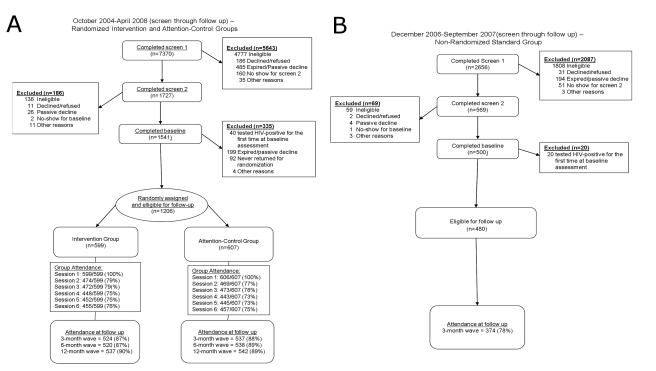
Methods and findings: Participants (n = 1,686) were enrolled in Chicago, Los Angeles, New York City, and San Francisco and randomized to a cognitive-behavioral intervention or attention-control comparison. The nonrandomized group received standard HIV counseling and testing. Intervention group participants received six 2-h group sessions focused on reducing substance use and sexual risk behavior. Attention-control group participants received six 2-h group sessions of videos and discussion of MSM community issues unrelated to substance use, sexual risk, and HIV/AIDS. All three groups received HIV counseling and testing at baseline. The sample reported high-risk behavior during the past 3 mo prior to their baseline visit: 67% reported unprotected anal sex, and 77% reported substance use during their most recent anal sex encounter with a nonprimary partner. The three groups significantly (p<0.05) reduced risk behavior (e.g., unprotected anal sex reduced by 32% at 12-mo follow-up), but were not different (p>0.05) from each other at 3-, 6-, and 12-mo follow-up. Outcomes for the 2-arm comparisons were not significantly different at 12-mo follow-up (e.g., unprotected anal sex, odds ratio = 1.14, confidence interval = 0.86-1.51), nor at earlier time points. Similar results were found for each outcome variable in both 2- and 3-arm comparisons.
Conclusions: These results for reducing sexual risk behavior of substance-using MSM are consistent with results of intervention trials for other populations, which collectively suggest critical challenges for the field of HIV behavioral interventions. Several mechanisms may contribute to statistically indistinguishable reductions in risk outcomes by trial group. More explicit debate is needed in the behavioral intervention field about appropriate scientific designs and methods. As HIV prevention increasingly competes for behavior-change attention alongside other "chronic" diseases and mental health issues, new approaches may better resonate with at-risk groups.
Trial registration: ClinicalTrials.gov NCT00153361. Please see later in the article for the Editors' Summary.
Conflict of interest statement
The authors have declared that no competing interests exist.
Figures
References
-
- Mansergh G, Flores S, Koblin B, Hudson S, McKirnan D, et al. Alcohol and drug use in the context of anal sex and other factors associated with sexually transmitted infections: results from a multi-city study of high-risk men who have sex with men in the USA. Sex Transm Infect. 2008;84:509–511. - PubMed
-
- Koblin BA, Husnik MJ, Colfax G, Huang Y, Madison M, et al. Risk factors for HIV infection among men who have sex with men. AIDS. 2006;20:731–739. - PubMed
-
- Colfax G, Vittinghoff E, Husnik MJ, McKirnan D, Buchbinder S, et al. Substance use and sexual risk: a participant- and episode-level analysis among a cohort of men who have sex with men. Am J Epidemiol. 2004;159:1002–1012. - PubMed
-
- Celentano DD, Valleroy LA, Sifakis F, MacKellar DA, Hylton J, et al. Associations between substance use and sexual risk among very young men who have sex with men. Sex Transm Dis. 2006;33:265–271. - PubMed
Publication types
MeSH terms
Associated data
Grants and funding
LinkOut - more resources
Full Text Sources
Medical
Research Materials
Miscellaneous