. 2011:2011:818979.
doi: 10.1155/2011/818979. Epub 2010 Aug 3.

Diagnosis and management of oropharyngeal Dysphagia and its nutritional and respiratory complications in the elderly

Affiliations

Diagnosis and management of oropharyngeal Dysphagia and its nutritional and respiratory complications in the elderly

Laia Rofes et al. Gastroenterol Res Pract. 2011.

Abstract

Oropharyngeal dysphagia is a major complaint among older people. Dysphagia may cause two types of complications in these patients: (a) a decrease in the efficacy of deglutition leading to malnutrition and dehydration, (b) a decrease in deglutition safety, leading to tracheobronchial aspiration which results in aspiration pneumonia and can lead to death. Clinical screening methods should be used to identify older people with oropharyngeal dysphagia and to identify those patients who are at risk of aspiration. Videofluoroscopy (VFS) is the gold standard to study the oral and pharyngeal mechanisms of dysphagia in older patients. Up to 30% of older patients with dysphagia present aspiration-half of them without cough, and 45%, oropharyngeal residue; and 55% older patients with dysphagia are at risk of malnutrition. Treatment with dietetic changes in bolus volume and viscosity, as well as rehabilitation procedures can improve deglutition and prevent nutritional and respiratory complications in older patients. Diagnosis and management of oropharyngeal dysphagia need a multidisciplinary approach.


Figures
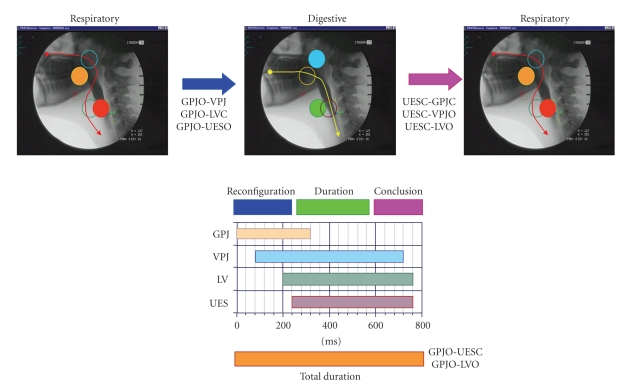
Figure 1
Figure 1
Configuration of the oropharynx during swallow response. Each phase of the response (reconfiguration, duration and conclusion) is defined by opening (O) or closing (C) events occurring at the glossopalatal junction (GPJ), velopharyngeal junction (VPJ), laryngeal vestibule (LV), and upper esophageal sphincter (UES).
Figure 2
Figure 2
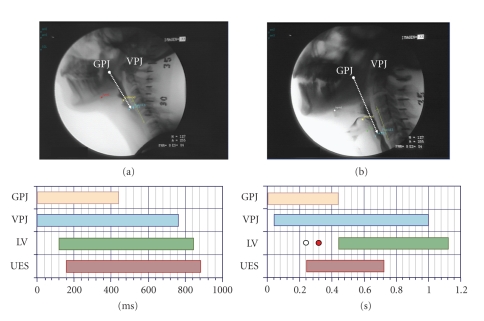
Videofluoroscopic pictures and oropharyngeal swallow response during the ingestion of a 5 mL nectar bolus in: (a) a healthy individual; (b) an older patient with neurogenic dysphagia and aspiration associated with stroke. An increased total duration of the swallow response may be seen, as well as a delayed closure of the laryngeal vestibule and delayed aperture of the upper sphincter. The white dot indicates the time when contrast penetrates into the laryngeal vestibule, and the red dot indicates passage into the tracheobronchial tree (aspiration). GPJ = glossopalatal junction, VPJ = velopalatal junction, LV = laryngeal vestibule, UES = upper esophageal sphincter.
Figure 3
Figure 3
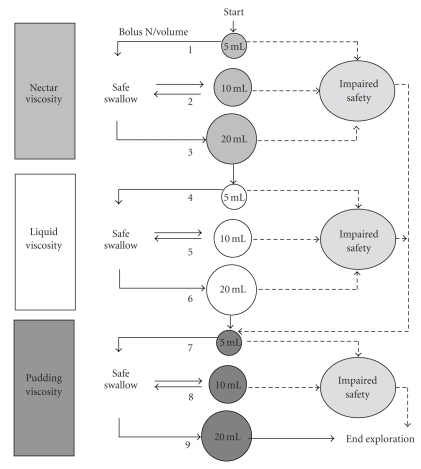
Algorithms of bolus volume and viscosity administration during V-VST. The strategy of the V-VST aims at protecting patients from aspiration by starting with nectar viscosity and volumes were increased from 5 mL, to 10 mL and 20 mL boluses in a progression of increasing difficulty. When patients completed the nectar series without major symptoms of aspiration (cough and/or fall in oxygen saturation ≥3%), a less “safe” liquid viscosity series was assessed also with boluses of increasing difficulty (5 mL to 20 mL). Finally, a more “safe” pudding viscosity series (5 mL to 20 mL) was assessed using similar rules. If the patient presents a sign of impaired safety at nectar viscosity, the series is interrupted, the liquid series is omitted, and a more safe pudding viscosity series is assessed. If the patient presents a sign of impaired safety at liquid viscosity, the liquid series is interrupted and the pudding series is assessed (Figure 1(C)).
Figure 4
Figure 4
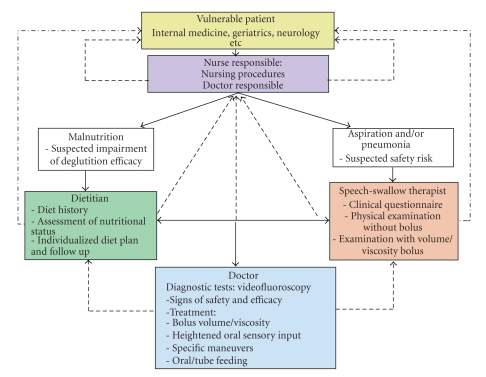
Algorithm for screening, diagnosis and treatment of oropharyngeal functional dysphagia at the Hospital de Mataró. Barcelona. Spain. Note the involvement of several professional domains of the dysphagia multidisciplinary team and the vertical and horizontal flows of information. The continuous black lines indicate the diagnostic screening strategy of patients at risk; the broken lines indicate flow of information on patient status, and broken dotted lines indicate therapeutic interventions.
Figure 5
Figure 5
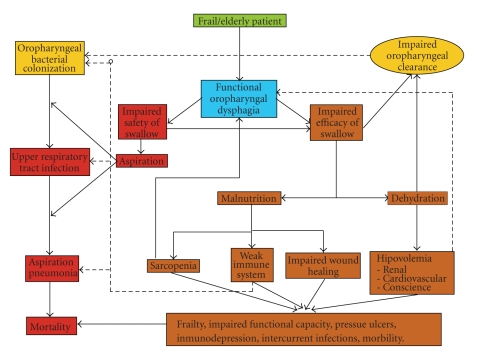
Pathophysiology of nutritional and respiratory complications associated to oropharyngeal dysphagia in elderly patients.
Figure 6
Figure 6
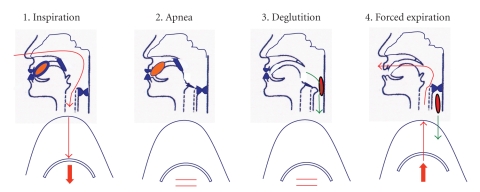
Diagrams showing the four steps of supraglottic swallow to protect the airway from aspiration. Commands for the patient are: (1) Take a deep breath, (2) Hold your breath, (3) Hold your breath while swallowing, (4) Cough immediately after you swallow.
Figure 7
Figure 7
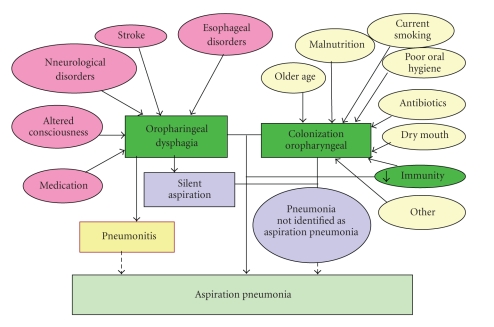
Risk factors for oropharyngeal colonization by respiratory pathogens and aspiration pneumonia in older people.

References

    1. Clavé P, Verdaguer A, Arreola V. Oral-pharyngeal dysphagia in the elderly. Medicina Clinica. 2005;124(19):742–748. - PubMed
    1. Clavé P, Terré R, de Kraa M, Serra M. Approaching oropharyngeal dysphagia. Revista Espanola de Enfermedades Digestivas. 2004;96(2):119–131. - PubMed
    1. Ekberg O, Hamdy S, Woisard V, Wuttge-Hannig A, Ortega P. Social and psychological burden of dysphagia: its impact on diagnosis and treatment. Dysphagia. 2002;17(2):139–146. - PubMed
    1. Robbins J, Langmore S, Hind JA, Erlichman M. Dysphagia research in the 21st century and beyond: proceedings from Dysphagia Experts Meeting, August 21, 2001. Journal of Rehabilitation Research and Development. 2002;39(4):543–547. - PubMed
    1. Flacker JM. What is a geriatric syndrome anyway? Journal of the American Geriatrics Society. 2003;51(4):574–576. - PubMed

LinkOut - more resources