


doi: 10.1155/2010/270832.
Epub 2010 Aug 2.
Sleep and metabolism: an overview
Affiliations
- PMID: 20811596
- PMCID: PMC2929498
- DOI: 10.1155/2010/270832
Item in Clipboard
Sleep and metabolism: an overview
Int J Endocrinol.
2010.
Abstract
Sleep and its disorders are increasingly becoming important in our sleep deprived society. Sleep is intricately connected to various hormonal and metabolic processes in the body and is important in maintaining metabolic homeostasis. Research shows that sleep deprivation and sleep disorders may have profound metabolic and cardiovascular implications. Sleep deprivation, sleep disordered breathing, and circadian misalignment are believed to cause metabolic dysregulation through myriad pathways involving sympathetic overstimulation, hormonal imbalance, and subclinical inflammation. This paper reviews sleep and metabolism, and how sleep deprivation and sleep disorders may be altering human metabolism.
Figures
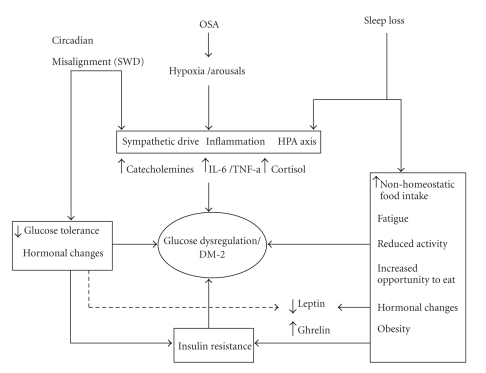
Schematic diagram of potential mechanism of glucose dysregulation/diabetes pathogenesis, secondary to sleep loss, sleep apnea, and circadian misalignment. The three main sleep disorders are listed at the top. Arrows point to possible pathophysiological alteration the disorders may induce. Some of the pathways are common to all the disorders and are listed together, that is, sympathetic drive, inflammation, and alteration of HPA axis. Sleep loss may in addition lead to changes like hormonal imbalance and reduced activity (listed on the box to the right of the diagram). Similarly circadian alteration may also cause insulin resistance and hormonal imbalance (shown in the box to the left). All these pathophysiological alterations eventually may lead to type II diabetes which is shown in the center. SWD: Shift work disorder.
References
-
- Webb WB, Agnew HW. Are we chronically sleep deprived? Bulletin of the Psychonomic Society. 1975;6:p. 47.
-
- National Sleep Foundation. Sleep in America Poll2003. Washington, DC, USA: National Sleep Foundation; 2003.
-
- National Center for Health Statistics. QuickStats: percentage of adults who reported an average of 66 h of sleep per 24-h period, by sex and age group -United States, 1985 and 2004. Morbidity and Mortality Weekly Report. 2005
-
- Siegel JM. Encarta Encyclopedia. 1999-present. Sleep.
-
- Ohayon MM, Carskadon MA, Guilleminault C, Vitiello MV. Meta-analysis of quantitative sleep parameters from childhood to old age in healthy individuals: developing normative sleep values across the human lifespan. Sleep. 2004;27(7):1255–1273. - PubMed
LinkOut - more resources
Full Text Sources
