. 2010 Aug 25;5(8):e12397.
doi: 10.1371/journal.pone.0012397.

Rapid identification of genetic modifications in Bacillus anthracis using whole genome draft sequences generated by 454 pyrosequencing

Affiliations

Rapid identification of genetic modifications in Bacillus anthracis using whole genome draft sequences generated by 454 pyrosequencing

Peter E Chen et al. PLoS One. .

Abstract

Background: The anthrax letter attacks of 2001 highlighted the need for rapid identification of biothreat agents not only for epidemiological surveillance of the intentional outbreak but also for implementing appropriate countermeasures, such as antibiotic treatment, in a timely manner to prevent further casualties. It is clear from the 2001 cases that survival may be markedly improved by administration of antimicrobial therapy during the early symptomatic phase of the illness; i.e., within 3 days of appearance of symptoms. Microbiological detection methods are feasible only for organisms that can be cultured in vitro and cannot detect all genetic modifications with the exception of antibiotic resistance. Currently available immuno or nucleic acid-based rapid detection assays utilize known, organism-specific proteins or genomic DNA signatures respectively. Hence, these assays lack the ability to detect novel natural variations or intentional genetic modifications that circumvent the targets of the detection assays or in the case of a biological attack using an antibiotic resistant or virulence enhanced Bacillus anthracis, to advise on therapeutic treatments.

Methodology/principal findings: We show here that the Roche 454-based pyrosequencing can generate whole genome draft sequences of deep and broad enough coverage of a bacterial genome in less than 24 hours. Furthermore, using the unfinished draft sequences, we demonstrate that unbiased identification of known as well as heretofore-unreported genetic modifications that include indels and single nucleotide polymorphisms conferring antibiotic and phage resistances is feasible within the next 12 hours.

Conclusions/significance: Second generation sequencing technologies have paved the way for sequence-based rapid identification of both known and previously undocumented genetic modifications in cultured, conventional and newly emerging biothreat agents. Our findings have significant implications in the context of whole genome sequencing-based routine clinical diagnostics as well as epidemiological surveillance of natural disease outbreaks caused by bacterial and viral agents.


Conflict of interest statement

Competing Interests: The authors have declared that no competing interests exist.

Figures

Figure 1
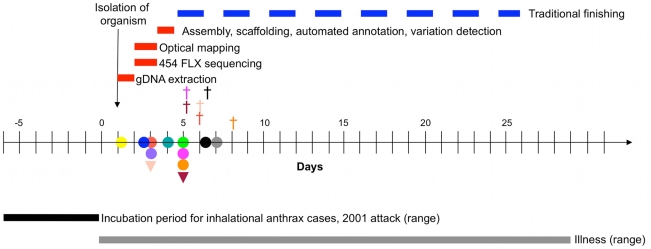
Figure 1. Estimated timelines of WGS and finishing in relation to anthrax disease progression in anthrax cases.
The anthrax disease progression and the results of antibiotic treatment in the first ten cases of the 2001 anthrax letter attack and two cases of anthrax-like disease caused by B. cereus in 1996 . Colored circles indicate when individual cases of inhalational anthrax from 2001 attack were started on antibiotic therapy and colored triangles indicate when 1996 B. cereus fatal pneumonia cases resembling anthrax were started on antibiotic therapy. The crosses indicate the time of death of 6 of the 12 patients. The bars in the top part of the top panel indicate the estimated timelines involved in obtaining WGS sequencing from the time the patient seeks medical care. Currently, there is no standard protocol or fixed time frame for genome finishing and the process varies from a few months to years depending on the complexity of the genome and approaches used.
Figure 2
Figure 2. Alignment of gerH region between 34F2 and gerH::ery mutant.
Screenshot of the gerH region of B. anthracis strains 34F2 and gerH::ery mutant by Artemis comparison tool (ACT)-based genome comparison. Blue bars indicate regions sharing significant matches using the BLAST alignment tool. The genome viewer tool shows the insertion of the erythromycin gene in the gerHA gene and a small deletion within gerHA gene downstream of the insertion.
Figure 3
Figure 3. Sanger-verified true positive variations as a function of percent concordance and coverage.
Validation of high quality variations in the genome sequences produced by GS Reference Mapper software. The graph shows the percentage of concordance among the reads covering a variant position as a function of depth of coverage. The graph indicates all the high-quality unique variations in the eight genomic sequences obtained in this work. Circles represent false positive variations while plus signs indicate true positive variations as determined by Sanger sequencing. Squares represent identity-by-descent (IBD) variations that were not verified by Sanger sequencing as they were expected to be present in the descendant strains. The various colors of the symbols represent different strains.
Figure 4
Figure 4. Proposed pipeline for rapid identification of genetic modifications in B. anthracis.
The three stages involved in genetic characterization of B. anthracis in a rapid response scenario. The first day is needed for isolation of the organism from the patient and extraction of genomic DNA. During the second day WGS will be performed using Roche 454 technology. The third day is needed to analyze the genome sequence data and figure out genetic modifications. The various bioinformatics tools used in this work are shown.

References

    1. Cowan S, Barrow G, Steel K, Feltham R. Cowan and Steel's manual for the identification of medical bacteria. In: Barrow G, Feltham R, editors. Cambridge, U. K: Cambridge University Press; 2003.
    1. Lipkin WI. Pathogen discovery. PLoS Pathog. 2008;4:e1000002. - PMC - PubMed
    1. Zwick ME, Kiley MP, Stewart AC, Mateczun A, Read TD. Genotyping of Bacillus cereus strains by microarray-based resequencing. PLoS One. 2008;3:e2513. - PMC - PubMed
    1. Van Ert MN, Easterday WR, Simonson TS, U'Ren JM, Pearson T, et al. Strain-specific single-nucleotide polymorphism assays for the Bacillus anthracis Ames strain. J Clin Microbiol. 2007;45:47–53. - PMC - PubMed
    1. Mardis ER. Next-generation DNA sequencing methods. Annu Rev Genomics Hum Genet. 2008;9:387–402. - PubMed

Publication types