


Hemoglobin-derived peptides as novel type of bioactive signaling molecules
- PMID: 20811967
- PMCID: PMC2976993
- DOI: 10.1208/s12248-010-9217-x
Hemoglobin-derived peptides as novel type of bioactive signaling molecules
Abstract
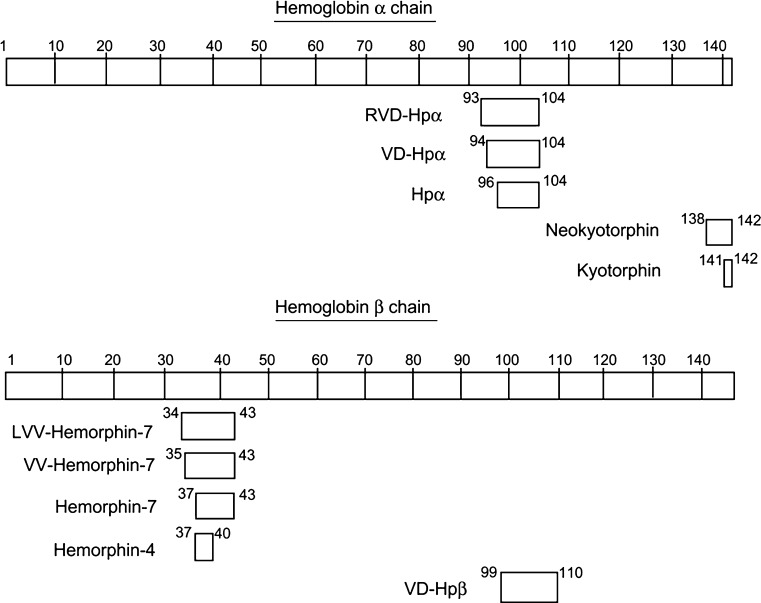
Most bioactive peptides are generated by proteolytic cleavage of large precursor proteins followed by storage in secretory vesicles from where they are released upon cell stimulation. Examples of such bioactive peptides include peptide neurotransmitters, classical neuropeptides, and peptide hormones. In the last decade, it has become apparent that the breakdown of cytosolic proteins can generate peptides that have biological activity. A case in point and the focus of this review are hemoglobin-derived peptides. In vertebrates, hemoglobin (Hb) consists of a tetramer of two α- and two β-globin chains each containing a prosthetic heme group, and is primarily involved in oxygen delivery to tissues and in redox reactions (Schechter Blood 112:3927-3938, 2008). The presence of α- and/or β-globin chain in tissues besides red blood cells including rodent and human brain and peripheral tissues (Liu et al. Proc Natl Acad Sci USA 96:6643-6647, 1999; Newton et al. J Biol Chem 281:5668-5676, 2006; Wride et al. Mol Vis 9:360-396, 2003; Setton-Avruj Exp Neurol 203:568-578, 2007; Ohyagi et al. Brain Res 635:323-327, 1994; Schelshorn et al. J Cereb Blood Flow Metab 29:585-595, 2009; Richter et al. J Comp Neurol 515:538-547, 2009) suggests that globins and/or derived peptidic fragments might play additional physiological functions in different tissues. In support of this hypothesis, a number of Hb-derived peptides have been identified and shown to have diverse functions (Ivanov et al. Biopoly 43:171-188, 1997; Karelin et al. Neurochem Res 24:1117-1124, 1999). Modern mass spectrometric analyses have helped in the identification of additional Hb peptides (Newton et al. J Biol Chem 281:5668-5676, 2006; Setton-Avruj Exp Neurol 203:568-578, 2007; Gomes et al. FASEB J 23:3020-3029, 2009); the molecular targets for these are only recently beginning to be revealed. Here, we review the status of the Hb peptide field and highlight recent reports on the identification of a molecular target for a novel set of Hb peptides, hemopressins, and the implication of these peptides to normal cell function and disease. The potential therapeutic applications for these Hb-derived hemopressin peptides will also be discussed.
Figures
References
Publication types
MeSH terms
Substances
Grants and funding
LinkOut - more resources
Full Text Sources
Other Literature Sources
Miscellaneous
