. 2010 Oct;11(10):758-64.
doi: 10.1038/embor.2010.130. Epub 2010 Sep 3.

Role of the RNA/DNA kinase Grc3 in transcription termination by RNA polymerase I

Affiliations

Role of the RNA/DNA kinase Grc3 in transcription termination by RNA polymerase I

Priscilla Braglia et al. EMBO Rep. 2010 Oct.

Abstract

Transcription termination by RNA polymerase I in Saccharomyces cerevisiae is mediated by a 'torpedo' mechanism: co-transcriptional RNA cleavage by Rnt1 at the ribosomal DNA 3'-region generates a 5'-end that is recognized by the 5'-3' exonuclease Rat1; this degrades the downstream transcript and eventually causes termination. In this study, we identify Grc3 as a new factor involved in this process. We demonstrate that GRC3, an essential gene of previously unknown function, encodes a polynucleotide kinase that is required for efficient termination by RNA polymerase I. We propose that it controls the phosphorylation status of the downstream Rnt1 cleavage product and thereby regulates its accessibility to the torpedo Rat1.


Conflict of interest statement

The authors declare that they have no conflict of interest.

Figures
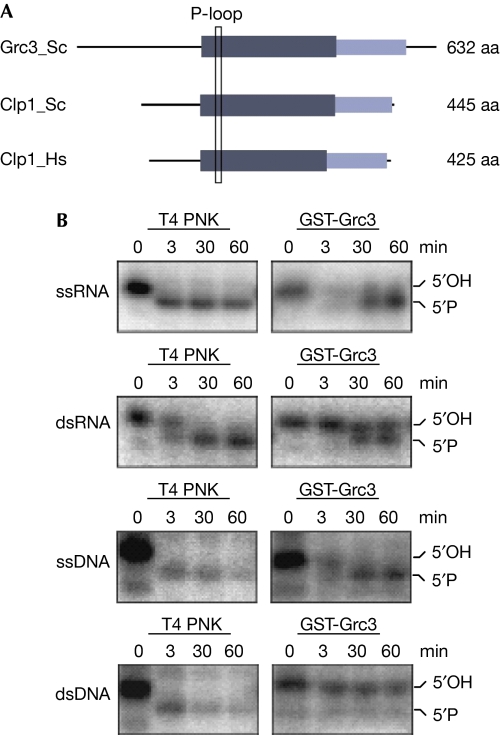
Figure 1
Figure 1
Grc3 is a polynucleotide kinase. (A) Domain architecture of Clp1 and Grc3. The Clp1 domain architecture is derived from Noble et al (2007) and was transferred to Grc3 using an alignment. The central kinase domain is depicted in dark grey, the carboxy-terminal domain in light grey. Location of the P-loop/Walker A box is indicated with a rectangle. (B) Kinase assays of glutathione-S-transferase (GST)-tagged Grc3. Purified Grc3 was incubated with the indicated substrates (single- or double-stranded RNA or DNA) for the indicated time. Grc3 is active on RNA or single-stranded DNA substrates. T4 polynucleotide kinase (PNK) was assayed in parallel as a control. Phosphorylation was monitored by electrophoresis. aa, amino acid; ds, double-stranded; Hs, Homo sapiens; Sc, Saccharomyces cerevisiae; ss, single-stranded.
Figure 2
Figure 2
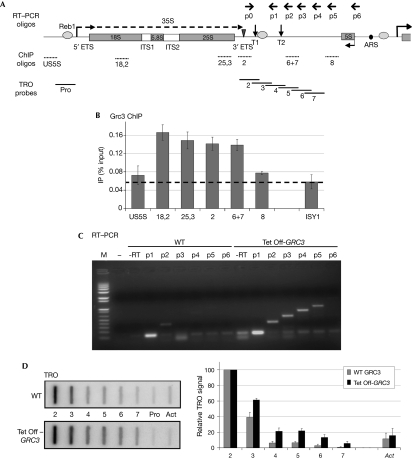
Grc3 depletion results in defective transcription termination by RNA polymerase I. (A) Schematic of a Saccharomyces cerevisiae rDNA repeat. In addition to the sequence encoding 18S, 5.8S and 25S rRNA (grey rectangles), the Pol I transcription unit includes ETSs and ITSs; the 35S primary transcript is shown as a dashed arrow. Grey ovals denote binding sites for Reb1, the triangle denotes the Rnt1 cleavage site and vertical arrows indicate T1 and T2 terminator elements. 5S rDNA, transcribed by Pol III in the opposite orientation, and ARS are shown. Primers used for RT–PCR are shown above, chromatin immunoprecipitation (ChIP) oligonuleotides and TRO probes below. (B) ChIP analysis of 3HA-tagged Grc3 along rDNA. Specific enrichment (above dashed line) is visible over the rRNA encoding and terminator sequence. Pol II-transcribed ISY1 is shown as a control. An average of two independent experiments is shown, error bars indicate s.d. values. (C) RT–PCR analysis of transcripts downstream to the Rnt1 cleavage site in WT or Grc3-depleted (Tet Off-GRC3) cells. Reverse transcription was primed with oligonuleotides p1–p6, PCR with the common forward primer p0 and the indicated reverse primers. Grc3 depletion results in stabilization of the Pol I transcripts over the 35S 3′-region. Oligonucleotide p1 and no reverse transcriptase (−RT) or no cDNA were used as a template in control PCR reactions. M, molecular weight marker (Invitrogen 1 kb Plus). (D) TRO analysis of Pol I transcripts over the 35S 3′-region in WT or Tet Off-GRC3 cells. Grc3 depletion results in a Pol I termination defect. Quantification of the signals is shown in the right-hand panel. Background signal (Pro) was subtracted to each probe value. Data were then normalized towards probe 2, set to 100%. The Pol II-transcribed actin gene (Act) is shown as a control. The average of three independent experiments is shown, error bars indicate s.d. values. ARS, autonomously replicating sequence; ETS, external transcribed sequence; HA, haemagglutinin; ITS, internal transcribed sequence; RT–PCR, reverse transcriptase PCR; rDNA, ribosomal DNA; rRNA, ribosomal RNA; TRO, transcriptional run on; WT, wild type.
Figure 3
Figure 3
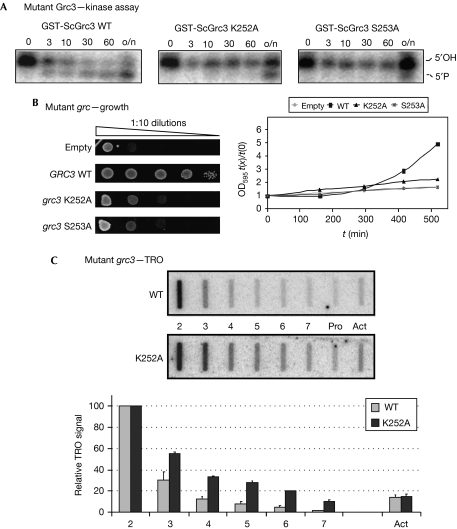
Kinase-inactive Grc3 mutants are defective in cell growth and RNA polymerase I termination. (A) Kinase assays of WT and mutant Grc3. Purified GST-tagged Grc3 (WT, K252A or S253A) was incubated with a 2:1 mixture of single- and double-stranded RNA for the indicated time (in min; o/n, overnight). Substrate phosphorylation was monitored by electrophoresis. Grc3 kinase activity is strongly delayed in the K252A and absent in the S253A mutant. (B) Growth phenotype of cells expressing WT or mutant Grc3 (K252A or S253A) from a centromeric plasmid. Endogenous GRC3 transcription was repressed in glucose. Cell proliferation is severely affected by Grc3 mutation. Cells transformed with an empty plasmid are shown as a control. Left panel: serial dilutions drop plate. Right panel: growth curves in liquid culture. (C) TRO analysis of cells expressing WT or K252A mutant Grc3. The kinase-inactive Grc3 mutant is defective in Pol I termination. Probes and quantification as in Fig 2D. GST, glutathione-S-transferase; Pol I, RNA polymerase I; TRO, transcriptional run on; WT, wild type.
Figure 4
Figure 4
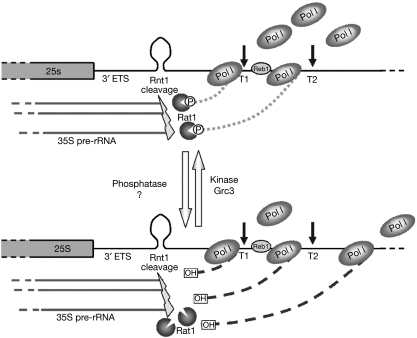
Model of Grc3 kinase activity involvement in the process of transcription termination by Pol I. Rnt1 co-transcriptionally cleaves the transcript RNA at a stem loop structure in the 3′-ETS. The phosphorylation status of the Rnt1 cleavage 3′-product is controlled by the equilibrium between a putative phosphatase activity and the RNA kinase Grc3. The phosphorylated 5′-end (top) is recognized by the 5′–3′ exonuclease Rat1 that ‘torpedoes' Pol I and thus promotes transcription termination. When Grc3 is absent or inactive, the equilibrium is shifted and the 3′-transcripts present a 5′-hydroxyl end (bottom). This is suboptimal substrate for the ‘torpedo' Rat1. As a consequence, the 3′-transcripts are stabilized and Pol I termination is impaired. ETS, external transcribed sequence; Pol I, RNA polymerase I; rRNA, ribosomal RNA.

References

    1. Altschul SF, Madden TL, Schaffer AA, Zhang J, Zhang Z, Miller W, Lipman DJ (1997) Gapped BLAST and PSI-BLAST: a new generation of protein database search programs. Nucleic Acids Res 25: 3389–3402 - PMC - PubMed
    1. de Vries H, Ruegsegger U, Hubner W, Friedlein A, Langen H, Keller W (2000) Human pre-mRNA cleavage factor II(m) contains homologs of yeast proteins and bridges two other cleavage factors. EMBO J 19: 5895–5904 - PMC - PubMed
    1. Edgar RC (2004) MUSCLE: a multiple sequence alignment method with reduced time and space complexity. BMC Bioinformatics 5: 113. - PMC - PubMed
    1. El Hage A, Koper M, Kufel J, Tollervey D (2008) Efficient termination of transcription by RNA polymerase I requires the 5′ exonuclease Rat1 in yeast. Genes Dev 22: 1069–1081 - PMC - PubMed
    1. El-Moghazy AN et al. (2000) Functional analysis of six novel ORFs on the left arm of chromosome XII in Saccharomyces cerevisiae reveals two essential genes, one of which is under cell-cycle control. Yeast 16: 277–288 - PubMed

Publication types

MeSH terms