


The number of grafted fragments affects the outcome of testis tissue xenografting from piglets into recipient mice
- PMID: 20814434
- PMCID: PMC2929510
- DOI: 10.4061/2011/686570
The number of grafted fragments affects the outcome of testis tissue xenografting from piglets into recipient mice
Abstract
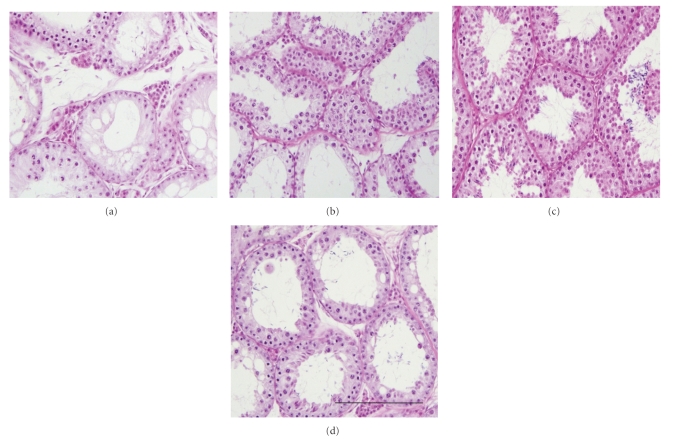
To optimize the procedure for testis tissue xenografting, we grafted 2, 4, 8, or 16 small fragments of immature porcine testis tissue under the back skin of immunodeficient castrated mice (n = 10 mice/group). At 8 months post grafting, the graft recovery rate did not differ between groups; however, not only the total but also the average graft weights were higher (by approximately 12-fold and approximately 2.5-fold, resp.) in mice receiving 16 fragments than those receiving 2 fragments (P < .05). The recipient mice with 16 fragments had the largest vesicular glands (indicators of testosterone release by the grafts) compared with those with 2 fragments (P = .007). The grafts in the group of 16 fragments also had more (P < .05) percentage of tubules with round spermatids than those of the group of mice receiving 2 fragments. Therefore, recipient mice can be grafted with at least 16 testis tissue fragments for optimal results.
Figures
References
-
- Russell LD, Ettlin RA, SinhaHikim AP, Clegg ED. Histological and Histopathological Evaluation of the Testis. Shawnee College Road, Ill, USA: Cache River; 1990.
-
- Gassei K, Schlatt S. Testicular morphogenesis: comparison of in vivo and in vitro models to study male gonadal development. Annals of the New York Academy of Sciences. 2007;1120:152–167. - PubMed
-
- Huleihel M, Abuelhija M, Lunenfeld E. In vitro culture of testicular germ cells: regulatory factors and limitations. Growth Factors. 2007;25(4):236–252. - PubMed
-
- Parks JE, Lee DR, Huang S, Kaproth MT. Prospects for spermatogenesis in vitro. Theriogenology. 2003;59(1):73–86. - PubMed
-
- Honaramooz A, Snedaker A, Boiani M, Schöler H, Dobrinski I, Schlatt S. Sperm from neonatal mammalia testes grafted in mice. Nature. 2002;418(6899):778–781. - PubMed
LinkOut - more resources
Full Text Sources
