. 2010 Aug 30;5(8):e12474.
doi: 10.1371/journal.pone.0012474.

Serological response in RT-PCR confirmed H1N1-2009 influenza a by hemagglutination inhibition and virus neutralization assays: an observational study

Affiliations

Serological response in RT-PCR confirmed H1N1-2009 influenza a by hemagglutination inhibition and virus neutralization assays: an observational study

Mark I Chen et al. PLoS One. .

Abstract

Background: We describe the serological response following H1N1-2009 influenza A infections confirmed by reverse-transcriptase polymerase chain reaction (RT-PCR).

Methodology and principal findings: The study included patients admitted to hospital, subjects of a seroepidemiologic cohort study, and participants identified from outbreak studies in Singapore. Baseline (first available blood sample) and follow-up blood samples were analyzed for antibody titers to H1N1-2009 and recently circulating seasonal influenza A virus strains by hemagglutination inhibition (HI) and virus micro-neutralization (VM) assays. 267 samples from 118 cases of H1N1-2009 were analyzed. Geometric mean titers by HI peaked at 123 (95% confidence interval, CI 43-356) between days 30 to 39. The chance of observing seroconversion (four-fold or greater increase of antibodies) was maximized when restricting analysis to 45 participants with baseline sera collected within 5 days of onset and follow-up sera collected 15 or more days after onset; for these participants, 82% and 89% seroconverted to A/California/7/2009 H1N1 by HI and VM respectively. A four-fold or greater increase in cross-reactive antibody titers to seasonal A/Brisbane/59/2007 H1N1, A/Brisbane/10/2007 H3N2 and A/Wisconsin/15/2009 H3N2 occurred in 20%, 18% and 16% of participants respectively.

Conclusions and significance: Appropriately timed paired serology detects 80-90% RT-PCR confirmed H1N1-2009; Antibodies from infection with H1N1-2009 cross-reacted with seasonal influenza viruses.


Conflict of interest statement

Competing Interests: The authors have declared that no competing interests exist.

Figures

Figure 1
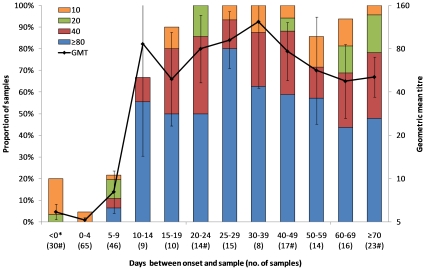
Figure 1. Hemagglutination inhibition titers by time from illness onset to sample collection.
Includes 267 samples from 118 individuals. Samples taken before onset in sero-incidence cohort participants are grouped (as <0* days), as are those taken after 70 days (≥70 days), with other observations summarized in 5 day intervals up to 29 days, 10 day intervals from 30 to 69 days. The number of samples in each interval is in brackets; intervals marked with # include 7 samples from the 3 individuals whose date of positive PCR test was used instead of onset dates: <0 (2 samples), 20 to 24 (1 sample), 40 to 49 (2 samples) and ≥70 (2 samples). Colored stacked bars give the proportion with titers of 10, 20, 40 and ≥80 while the line denotes the geometric mean titer with error bars depicting 95% confidence intervals. The upper limit is off the scale for days 10–14 (518) and days 30–39 (356).
Figure 2
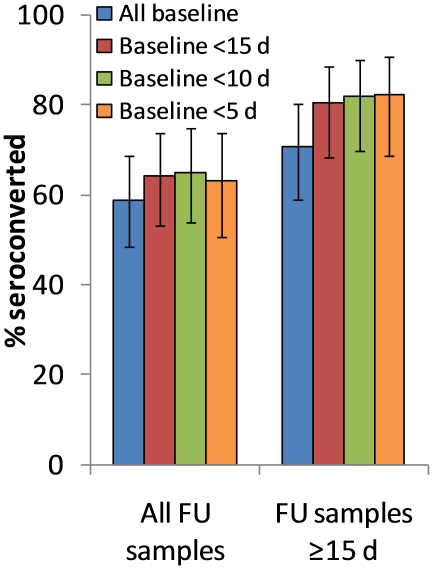
Figure 2. Seroconversion on hemagglutination inhibition assay, by timing of sample collection.
Titers between baseline and follow-up (FU) sample is compared, for all participants regardless of time from onset to follow-up sample (n = 90), and restricting to participants whose follow-up sample was taken 15 or more days after onset (n = 68), with error bars depicting 95% confidence intervals; columns of different colors depict different cut-off points for time from onset to baseline sample. Seroconversion was defined here as a four-fold or greater increase in antibody titer.
Figure 3
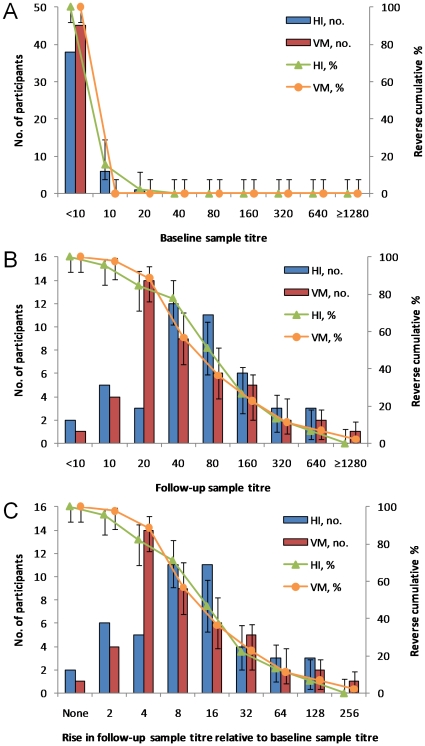
Figure 3. Comparison between hemagglutination inhibition (HI) and virus neutralization (VM).
A) baseline sample titers (n = 45 for HI, n = 45 for VM); B) follow-up sample titers (n = 45 for HI, n = 44 for VM); C) fold rise in titer for follow-up relative to baseline titer (n = 45 for HI, n = 44 for VM). In all three panels, lines denote the reverse cumulative distribution with error bars representing the 95% confidence intervals.

References

    1. World Health Organization. WHO | Pandemic (H1N1) 2009 - update 90 2009.
    1. Dawood FS, Jain S, Finelli L, Shaw MW, Lindstrom S, et al. Emergence of a novel swine-origin influenza A (H1N1) virus in humans. N Engl J Med. 2009;360:2605–2615. - PubMed
    1. Fraser C, Donnelly CA, Cauchemez S, Hanage WP, Van Kerkhove MD, et al. Pandemic potential of a strain of influenza A (H1N1): early findings. Science. 2009;324:1557–1561. - PMC - PubMed
    1. Ong JBS, Chen MIC, Cook AR, Lee HC, Lee VJ, et al. Real-Time Epidemic Monitoring and Forecasting of H1N1-2009 Using Influenza-Like Illness from General Practice and Family Doctor Clinics in Singapore. PLoS ONE. 2010;5:e10036–e10036. - PMC - PubMed
    1. Ross T, Zimmer S, Burke D, Crevar C, Carter D, et al. Seroprevalence Following the Second Wave of Pandemic 2009 H1N1 Influenza. PLoS Curr Influenza. 2010:RRN1148. - PMC - PubMed

Publication types

Substances