


Trends in incidence of subtrochanteric fragility fractures and bisphosphonate use among the US elderly, 1996-2007
- PMID: 20814954
- PMCID: PMC3179297
- DOI: 10.1002/jbmr.233
Trends in incidence of subtrochanteric fragility fractures and bisphosphonate use among the US elderly, 1996-2007
Abstract
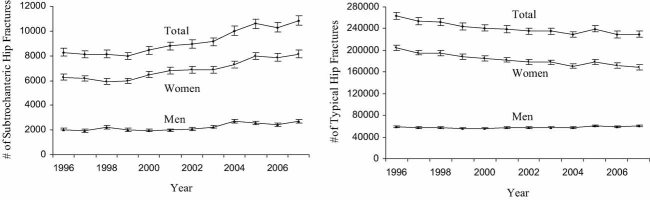
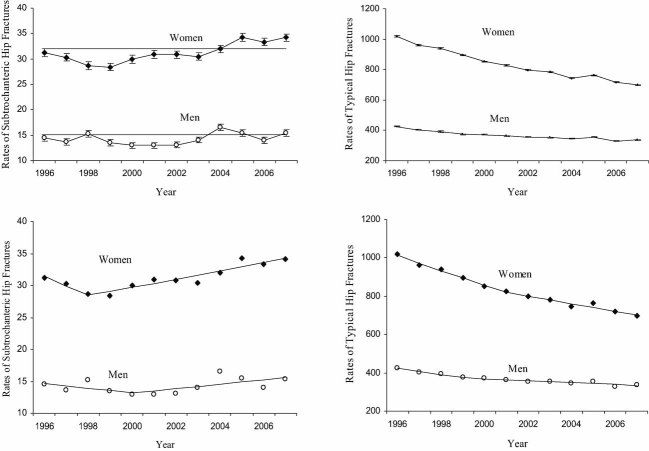
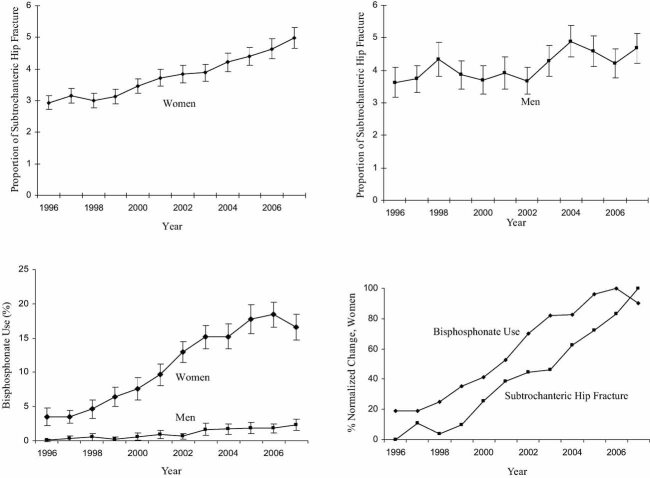
Increasing numbers of atypical hip fractures have been reported among patients with bisphosphonate use. However, the nature and extent of the problem are unknown despite recent investigations. To analyze national trends in hip fractures and medication use in the elderly US population, we respectively used the Nationwide Inpatient Sample (NIS) and the Medical Expenditure Panel Survey (MEPS) from 1996 to 2007. In NIS, subtrochanteric fragility fractures were compared with typical hip fractures in femoral neck and intertrochanteric regions. Between 1996 and 2007, age-adjusted rates for typical hip fractures decreased by 31.6% among women (from 1020.5 to 697.4 per 100,000 population) and 20.5% among men (from 424.9 to 337.6 per 100,000 population). In contrast, overall trends in age-adjusted rates for subtrochanteric fragility fractures remained unchanged among men (p = .34) but increased 20.4% among women from 28.4 (95% confidence interval [CI] 27.7-29.1) in 1999 to 34.2 (95% CI 33.4-34.9) per 100,000 population in 2007. The annual percentage increase was 2.1% (95% CI 1.3-2.8, p < .001) based on joinpoint regression analysis. In MEPS, bisphosphonate use increased predominantly in women (from 3.5% in 1996 to 16.6% in 2007) compared with men (2.3% in 2007). In the context of declining typical hip fractures among the US elderly, we observed small but significant increases in the incidence of subtrochanteric fragility fractures from 1999 among postmenopausal women. Using age-adjusted rates, we estimated that for every 100 or so reduction in typical femoral neck or intertrochanteric fractures, there was an increase of one subtrochanteric fragility fracture.
Copyright © 2011 American Society for Bone and Mineral Research.
Figures
References
-
- Centers for Disease Control and Prevention. http://www.cdc.gov/HomeandRecreationalSafety/Falls/adulthipfx.html; accessed on March 22, 2010.
-
- Leibson CL, Tosteson AN, Gabriel SE, Ransom JE, Melton LJ. Mortality, disability, and nursing home use for persons with and without hip fracture: a population-based study. J Am Geriatr Soc. 2002;50:1644–1650. - PubMed
-
- NIH Consensus Development Panel on Osteoporosis Prevention, Diagnosis, and Therapy. Osteoporosis prevention, diagnosis, and therapy. JAMA. 2001;285:785–795.
-
- Stafford RS, Drieling RL, Hersh AL. National trends in osteoporosis visits and osteoporosis treatment, 1988-2003. Arch Intern Med. 2004;164:1525–1530. - PubMed
-
- Leslie WD, O'Donnell S, Jean S, et al. Trends in hip fracture rates in Canada. JAMA. 2009;302:883–889. - PubMed
Publication types
MeSH terms
Substances
Grants and funding
LinkOut - more resources
Full Text Sources
Medical
