. 2010 Dec;299(6):L749-59.
doi: 10.1152/ajplung.00116.2010. Epub 2010 Sep 3.

Role of LTB₄ in the pathogenesis of elastase-induced murine pulmonary emphysema

Affiliations

Role of LTB₄ in the pathogenesis of elastase-induced murine pulmonary emphysema

Y Michael Shim et al. Am J Physiol Lung Cell Mol Physiol. 2010 Dec.

Abstract

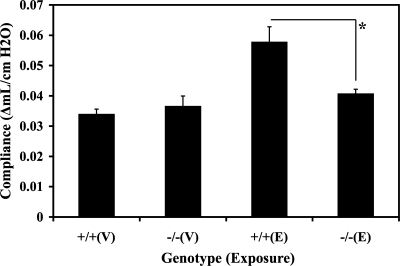
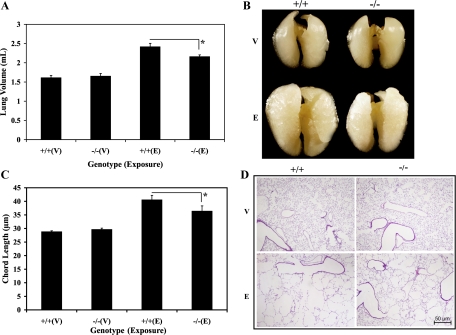
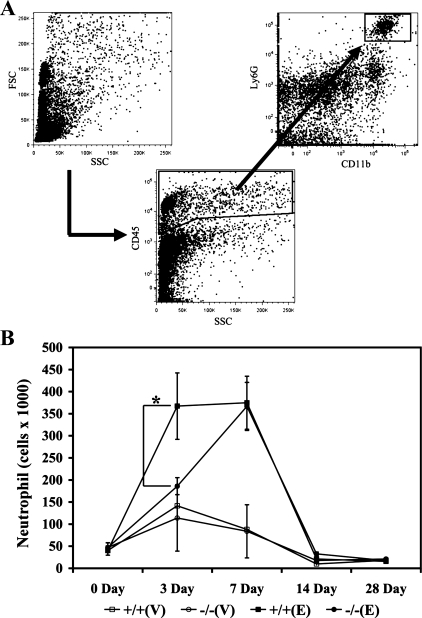
Exaggerated levels of the leukotriene B₄ (LTB₄) frequently coexist at sites of inflammation and tissue remodeling. Therefore, we hypothesize that the LTB₄ pathway plays an important role in the pathogenesis of neutrophilic inflammation that contributes to pulmonary emphysema. In this study, significant levels of LTB₄ were detected in human lung tissues with emphysema compared with lungs without emphysema (9,497 ± 2,839 vs. 4,142 ± 1,173 pg/ml, n = 9 vs. 10, P = 0.04). To further determine the biological role of LTB₄ in the pathogenesis of emphysema, we compared the lungs of wild-type (WT) and LTA₄ hydrolase-/- mice (LTB₄ deficient, LTA₄H-/-) exposed to intranasal elastase or vehicle control. We found that intranasal elastase induced accumulation of LTB₄ in the lungs and caused progressively worsening emphysema between 14 and 28 days after elastase exposure in WT mice but not in LTA₄H-/- mice. Premortem physiology documented increased lung compliance in elastase-exposed WT mice compared with elastase-exposed LTA₄H-/- mice as measured by Flexivent (0.058 ± 0.005 vs. 0.041 ± 0.002 ml/cmH₂O pressure). Postmortem morphometry documented increased total lung volume and alveolar sizes in elastase-exposed WT mice compared with elastase-exposed LTA₄H-/- mice as measured by volume displacement and alveolar chord length assessment. Furthermore, elastase-exposed LTA₄H-/- mice were found to have significantly delayed influx of the CD45(high)CD11b(high)Ly6G(high) leukocytes compatible with neutrophils compared with elastase-exposed WT mice. Mechanistic insights to these phenotypes were provided by demonstrating protection from elastase-induced murine emphysema with neutrophil depletion in the elastase-exposed WT mice and by demonstrating time-dependent modulation of cysteinyl leukotriene biosynthesis in the elastase-exposed LTA₄H-/- mice compared with elastase-exposed WT mice. Together, these findings demonstrated that LTB₄ played an important role in promoting the pathogenesis of pulmonary emphysema associated with neutrophilic pulmonary inflammation.


Figures
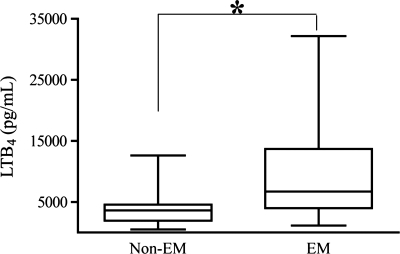
Fig. 1.
Fig. 1.
Assessment of leukotriene B4 (LTB4) in human whole lung tissues by an enzyme immunoassay. Amounts of LTB4 are standardized by protein concentrations of each human lung tissue block. Non-EM, without emphysema (n = 9); EM, with emphysema (n = 10). *P < 0.05.
Fig. 2.
Fig. 2.
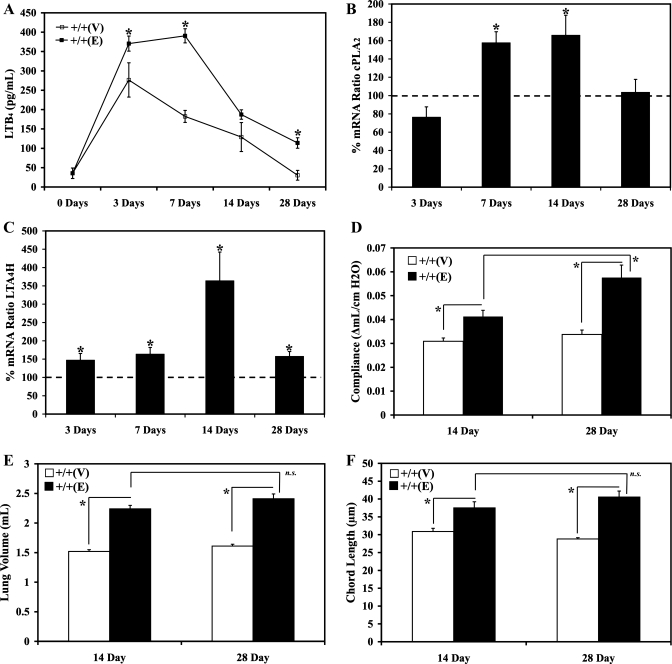
All wild-type 129J mice were exposed to either PBS vehicle or 0.75 μg elastase per kg mouse weight via an intranasal route. A: whole lung bronchoalveolar lavage fluid LTB4 0, 3, 7, 14, and 28 days after elastase exposure was assessed by an enzyme immunoassay. B: gene transcribing for cPLA2 was assessed by Sybergreen real-time RT-PCR 3, 7, 14, and 28 days after elastase exposure, normalized by GAPDH, expressed as % of target gene expression compared with the matched wild-type controls, and assessed for significance from the expected baseline (100%). C: genes transcribing for LTA4H were assessed by Sybergreen real-time RT-PCR 3, 7, 14, and 28 days after elastase exposure, normalized by GAPDH, expressed as % of target gene expression compared with the matched wild-type controls, and assessed for significance from the expected baseline (100%). D: premortem lung compliance was assessed with Flexivent 14 and 28 days after elastase exposure. E: postmortem whole lung volume was assessed by volume displacement technique after inflating the lungs at 25 cmH2O pressure melted 1% low-melting point agarose gel pressure. F: postmortem chord length was assessed in H&E-stained lungs after inflating the lungs with techniques described above. +/+, Wild type; V, vehicle; E, elastase. *P < 0.05; n.s., P value not significant.
Fig. 3.
Fig. 3.
Premortem lung compliance measurement by Flexivent 28 days after intranasal elastase or vehicle exposure. +/+, WT; −/−, LTA4H−/−; V, vehicle; E, elastase. *P < 0.05.
Fig. 4.
Fig. 4.
Lungs were inflated at 25 cmH2O pressure of melted 1% low-melting point agarose gel 28 days after intranasal elastase or vehicle exposure. A: whole lung volumes assessed by PBS volume displacement; n = 7–10/group. B: a representative picture of inflated lungs after being fixed in paraformaldehyde for 18 h. C: serial adjacent images were captured, and then the chord length was assessed by a computerized macro script; n = 6–8/group. D: a representative picture of H&E slides at 5× power after being fixed with paraformaldehyde for 18 h. +/+, WT; −/−, LTA4H−/−; V, vehicle; E, elastase. *P < 0.05.
Fig. 5.
Fig. 5.
WT and LTA4H−/− mice were exposed to intranasal vehicle or elastase, lungs were harvested 0, 3, 7, 14, and 28 days after exposure, cells were triple-stained with CD45, CD11b, and Ly6G, and cells were counted by flow cytometry. A: gating strategy to count CD45highCD11bhighLy6Ghigh (neutrophils). B: neutrophils were counted, and significant reduction was noted in the elastase-exposed LTA4H−/− mice compared with elastase-exposed WT mice 3 days postelastase exposure. No difference was noted between the elastase-exposed WT and LTA4H−/− mice 7 days postelastase exposure. +/+, WT; −/−, LTA4H−/−; V, vehicle; E, elastase. *P < 0.05.
Fig. 6.
Fig. 6.
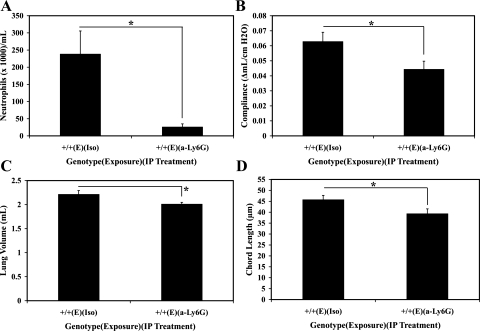
Effects of neutrophil depletion on pulmonary emphysema in elastase-exposed WT mice 28 days after elastase or vehicle exposure. A: flow cytometry of the peripheral blood leukocytes stained with CD45, CD11b, and Ly6G to identify neutrophils. B: premortem lung compliance measurement by Flexivent. C: postmortem whole lung volumes assessed by PBS volume displacement; n = 6/group. D: serial adjacent images were captured, and then the chord length was assessed by a computerized macro script; n = 6/group. +/+, WT; E, elastase; Iso, isotype IgG; a-Ly6G, anti-Ly6G monoclonal antibody. *P < 0.05.
Fig. 7.
Fig. 7.
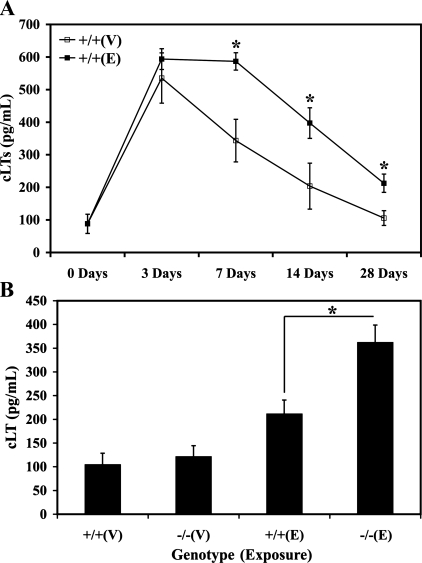
A: WT mice were exposed to intranasal vehicle or elastase, and whole lung BALF were harvested 0, 3, 7, 14, and 28 days after exposure. Levels of cLTs in the BALF were measured by EIA, and two groups of mice at each time point were compared by t-test. *P < 0.05. B: levels of cLTs in the BALF were measured from WT and LTA4−/− mice 28 days postintranasal vehicle or elastase exposure. *P < 0.05. +/+, WT; −/−, LTA4H−/−; V, vehicle; E, elastase.

References

    1. Avis I, Hong SH, Martinez A, Moody T, Choi YH, Trepel J, Das R, Jett M, Mulshine JL. Five-lipoxygenase inhibitors can mediate apoptosis in human breast cancer cell lines through complex eicosanoid interactions. FASEB J 15: 2007–2009, 2001 - PubMed
    1. Avis IM, Jett M, Boyle T, Vos MD, Moody T, Treston AM, Martinez A, Mulshine JL. Growth control of lung cancer by interruption of 5-lipoxygenase-mediated growth factor signaling. J Clin Invest 97: 806–813, 1996 - PMC - PubMed
    1. Bailie MB, Standiford TJ, Laichalk LL, Coffey MJ, Strieter R, Peters-Golden M. Leukotriene-deficient mice manifest enhanced lethality from Klebsiella pneumonia in association with decreased alveolar macrophage phagocytic and bactericidal activities. J Immunol 157: 5221–5224, 1996 - PubMed
    1. Beeh KM, Kornmann O, Buhl R, Culpitt SV, Giembycz MA, Barnes PJ. Neutrophil chemotactic activity of sputum from patients with COPD: role of interleukin 8 and leukotriene B4. Chest 123: 1240–1247, 2003 - PubMed
    1. Busse W. The role and contribution of leukotrienes in asthma. Ann Allergy Asthma Immunol 81: 17–26; quiz 26–19, 1998 - PubMed

Publication types