


Relationships between environmental factors and pathogenic Vibrios in the Northern Gulf of Mexico
- PMID: 20817802
- PMCID: PMC2976234
- DOI: 10.1128/AEM.00697-10
Relationships between environmental factors and pathogenic Vibrios in the Northern Gulf of Mexico
Abstract
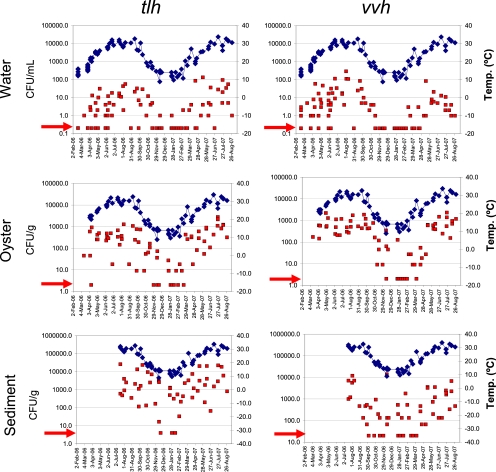
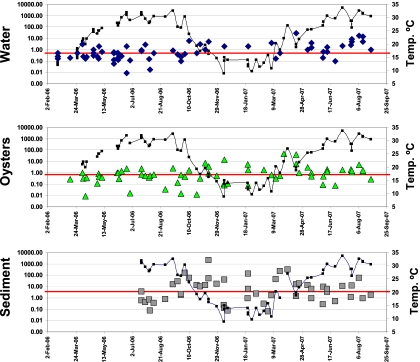
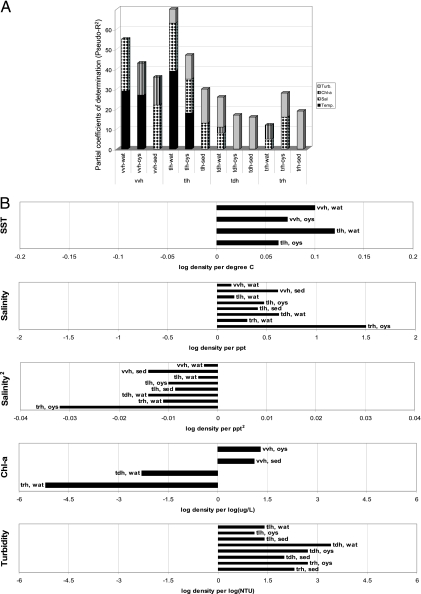
Although autochthonous vibrio densities are known to be influenced by water temperature and salinity, little is understood about other environmental factors associated with their abundance and distribution. Densities of culturable Vibrio vulnificus containing vvh (V. vulnificus hemolysin gene) and V. parahaemolyticus containing tlh (thermolabile hemolysin gene, ubiquitous in V. parahaemolyticus), tdh (thermostable direct hemolysin gene, V. parahaemolyticus pathogenicity factor), and trh (tdh-related hemolysin gene, V. parahaemolyticus pathogenicity factor) were measured in coastal waters of Mississippi and Alabama. Over a 19-month sampling period, vibrio densities in water, oysters, and sediment varied significantly with sea surface temperature (SST). On average, tdh-to-tlh ratios were significantly higher than trh-to-tlh ratios in water and oysters but not in sediment. Although tlh densities were lower than vvh densities in water and in oysters, the opposite was true in sediment. Regression analysis indicated that SST had a significant association with vvh and tlh densities in water and oysters, while salinity was significantly related to vibrio densities in the water column. Chlorophyll a levels in the water were correlated significantly with vvh in sediment and oysters and with pathogenic V. parahaemolyticus (tdh and trh) in the water column. Furthermore, turbidity was a significant predictor of V. parahaemolyticus density in all sample types (water, oyster, and sediment), and its role in predicting the risk of V. parahaemolyticus illness may be more important than previously realized. This study identified (i) culturable vibrios in winter sediment samples, (ii) niche-based differences in the abundance of vibrios, and (iii) predictive signatures resulting from correlations between environmental parameters and vibrio densities.
Figures
References
-
- Andrews, W. H., and T. S. Hammack. April 2003, posting date. Food sampling and preparation of sample homogenate. In G. J. Jackson et al. (ed.), Bacteriological analytical manual online. Center for Food Safety and Applied Nutrition, U.S. Food and Drug Administration, Gaithersburg, MD.
-
- Anonymous. 2005. Quantitative risk assessment on the public health impact of pathogenic Vibrio parahaemolyticus in raw oysters. U.S. Food and Drug Administration, Washington, DC.
-
- Baffone, W., B. Citterio, E. Vittoria, A. Casaroli, R. Campana, L. Falzano, and G. Donelli. 2003. Retention of virulence in viable but non-culturable halophilic Vibrio spp. Int. J. Food Microbiol. 89:31-39. - PubMed
-
- Biber, P. D., C. L. Gallegos, and W. J. Kenworthy. 2008. Calibration of a bio-optical model in the North River, NC: a tool to evaluate water-quality impacts on seagrasses. Estuaries Coasts 31:177-191.
-
- Centers for Disease Control and Prevention. 2006. Surveillance for foodborne-disease outbreaks—United States, 1998-2002. MMWR Morb. Mortal. Wkly. Rep. 55:1-42.
Publication types
MeSH terms
Substances
LinkOut - more resources
Full Text Sources
