


CCL20 is overexpressed in Mycobacterium tuberculosis-infected monocytes and inhibits the production of reactive oxygen species (ROS)
- PMID: 20819093
- PMCID: PMC2996596
- DOI: 10.1111/j.1365-2249.2010.04168.x
CCL20 is overexpressed in Mycobacterium tuberculosis-infected monocytes and inhibits the production of reactive oxygen species (ROS)
Abstract
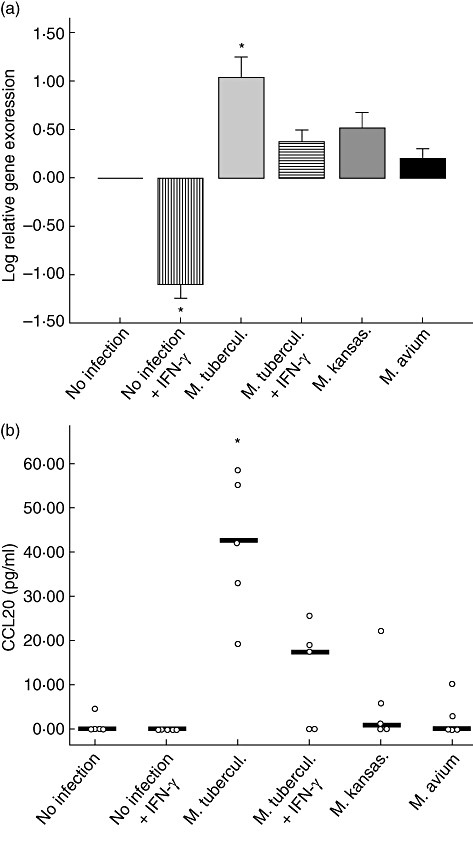
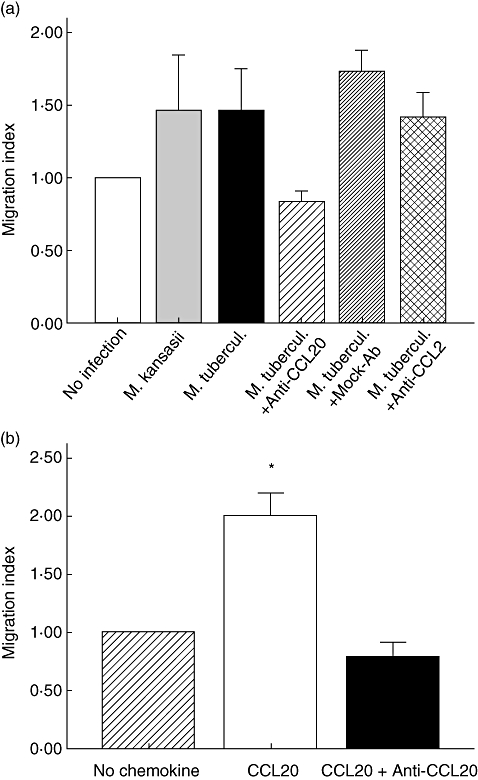
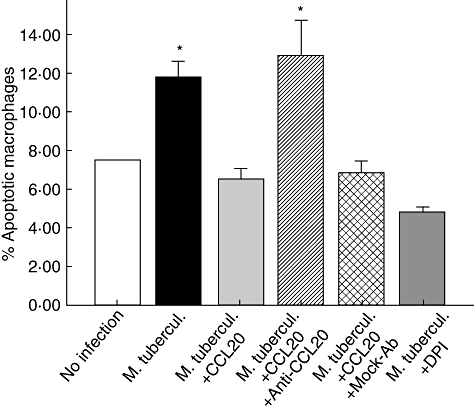
CCL20 is a chemokine that attracts immature dendritic cells. We show that monocytes, cells characteristic of the innate immune response, infected with Mycobacterium tuberculosis express the CCL20 gene at a much higher level than the same cells infected with non-tuberculous mycobacteria. Interferon (IFN)-γ, a fundamental cytokine in the immune response to tuberculosis, strongly inhibits both the transcription and the translation of CCL20. We have also confirmed that dendritic cells are a suitable host for mycobacteria proliferation, although CCL20 does not seem to influence their intracellular multiplication rate. The chemokine, however, down-regulates the characteristic production of reactive oxygen species (ROS) induced by M. tuberculosis in monocytes, which may affect the activity of the cells. Apoptosis mediated by the mycobacteria, possibly ROS-dependent, was also inhibited by CCL20.
© 2010 British Society for Immunology.
Figures
References
-
- World Health Organization. WHO report 2009: Global tuberculosis control: epidemiology, strategy, financing. Geneva: WHO; 2009. WHO/HTM/TB/2009·411.
-
- Milburn HJ. Primary tuberculosis. Curr Opin Pulm Med. 2001;7:133–41. - PubMed
-
- Uehira K, Amakawa R, Ito T, et al. Dendritic cells are decreased in blood and accumulated in granuloma in tuberculosis. Clin Immunol. 2002;105:296–303. - PubMed
-
- Martino A. Mycobacteria and innate cells: critical encounter for immunogenicity. J Biosci. 2008;33:137–44. - PubMed
-
- Algood HM, Chan J, Flynn JL. Chemokines and tuberculosis. Cytokine Growth Factor Rev. 2003;14:467–77. - PubMed
Publication types
MeSH terms
Substances
LinkOut - more resources
Full Text Sources
