Comment
doi: 10.1083/jcb.201008080.
NPHP proteins: gatekeepers of the ciliary compartment
Affiliations
- PMID: 20819931
- PMCID: PMC2935579
- DOI: 10.1083/jcb.201008080
Item in Clipboard
Comment
NPHP proteins: gatekeepers of the ciliary compartment
J Cell Biol.
.
Abstract
The cilia and the cytoplasm are separated by a region called the transition zone, where wedge-shaped structures link the microtubule doublets of the axoneme to the ciliary membrane, thereby forming a ciliary "gate." In this issue, Craige et al. (J. Cell Biol. doi:10.1083/jcb.201006105) demonstrate in Chlamydomonas reinhardtii that Nphp6/cep290, which is mutated in nephronophthisis (NPHP), is an integral component of these connectors and maintains the structural integrity of this gate.
Figures
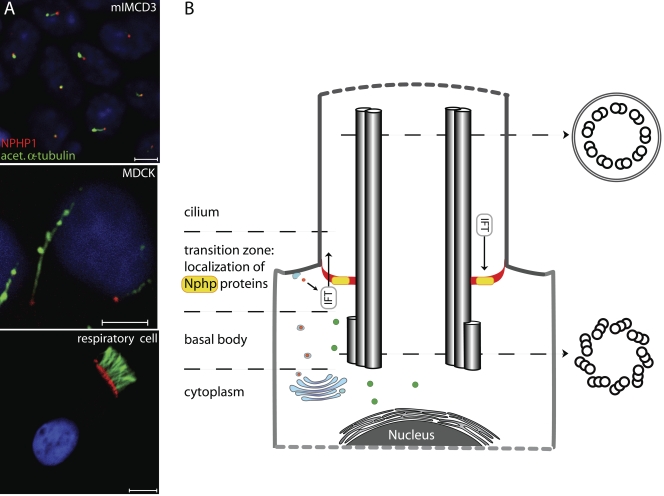
NPHP proteins function at the ciliary gate (transition zone). (A) Localization of nephrocystin (red, NPHP1) at the transition zone is shown in murine (mIMCD3) immotile renal cilia (top), immotile canine renal MDCK cilia (middle), and motile human respiratory cilia (bottom). The ciliary axoneme is stained with antibodies targeting acetylated α-tubulin (green). Bars, 5 µm. (B) The triplet microtubule structure of the basal body is converted into the axonemal doublet structure at the transition zone of primary cilia. Proximal transition y-shaped fibers (red) connect each outer microtubule doublet to the membrane and mark the border at which IFT proteins start to shuffle cargoes to and from the ciliary compartment. The ciliary compartment, including the ciliary membrane, is therefore equipped with a distinct composition of proteins such as polycystin-2 and BBS proteins (i.e., BBS4), which differs from the cytoplasm and the apical plasma membrane. NPHP6/CEP290 as well as other NPHP proteins (e.g., NPHP1) localize at the transition zone and probably function as gatekeepers that control access and exit of proteins to and from the ciliary compartment, respectively.
Comment on
-
CEP290 tethers flagellar transition zone microtubules to the membrane and regulates flagellar protein content.J Cell Biol. 2010 Sep 6;190(5):927-40. doi: 10.1083/jcb.201006105. J Cell Biol. 2010. PMID: 20819941 Free PMC article.
References
-
- Bergmann C., Fliegauf M., Brüchle N.O., Frank V., Olbrich H., Kirschner J., Schermer B., Schmedding I., Kispert A., Kränzlin B., et al. 2008. Loss of nephrocystin-3 function can cause embryonic lethality, Meckel-Gruber-like syndrome, situs inversus, and renal-hepatic-pancreatic dysplasia. Am. J. Hum. Genet. 82:959–970 10.1016/j.ajhg.2008.02.017 - DOI - PMC - PubMed
Publication types
MeSH terms
Substances
LinkOut - more resources
Full Text Sources
Other Literature Sources