Effect of antipsychotic medication alone vs combined with psychosocial intervention on outcomes of early-stage schizophrenia: A randomized, 1-year study
- PMID: 20819983
- PMCID: PMC3632506
- DOI: 10.1001/archgenpsychiatry.2010.105
Effect of antipsychotic medication alone vs combined with psychosocial intervention on outcomes of early-stage schizophrenia: A randomized, 1-year study
Abstract
Context: Antipsychotic drugs are limited in their ability to improve the overall outcome of schizophrenia. Adding psychosocial treatment may produce greater improvement in functional outcome than does medication treatment alone.
Objective: To evaluate the effectiveness of antipsychotic medication alone vs combined with psychosocial intervention on outcomes of early-stage schizophrenia.
Design: Randomized controlled trial.
Setting: Ten clinical sites in China.
Participants: Clinical sample of 1268 patients with early-stage schizophrenia treated from January 1, 2005, through October 31, 2007. Intervention Patients were randomly assigned to receive antipsychotic medication treatment only or antipsychotic medication plus 12 months of psychosocial intervention consisting of psychoeducation, family intervention, skills training, and cognitive behavior therapy administered during 48 group sessions.
Main outcome measures: The rate of treatment discontinuation or change due to any cause, relapse or remission, and assessments of insight, treatment adherence, quality of life, and social functioning.
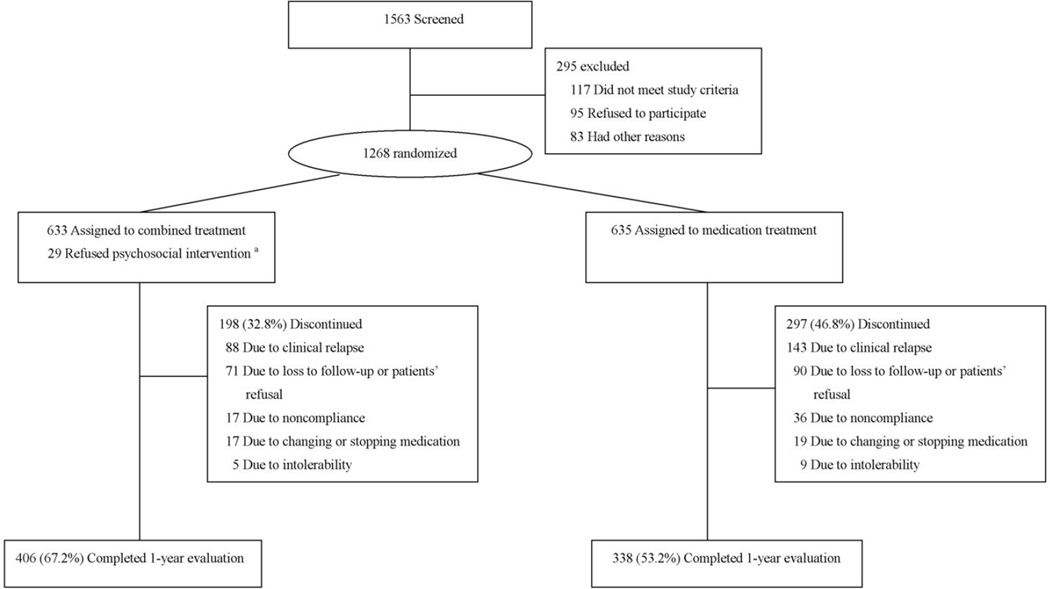
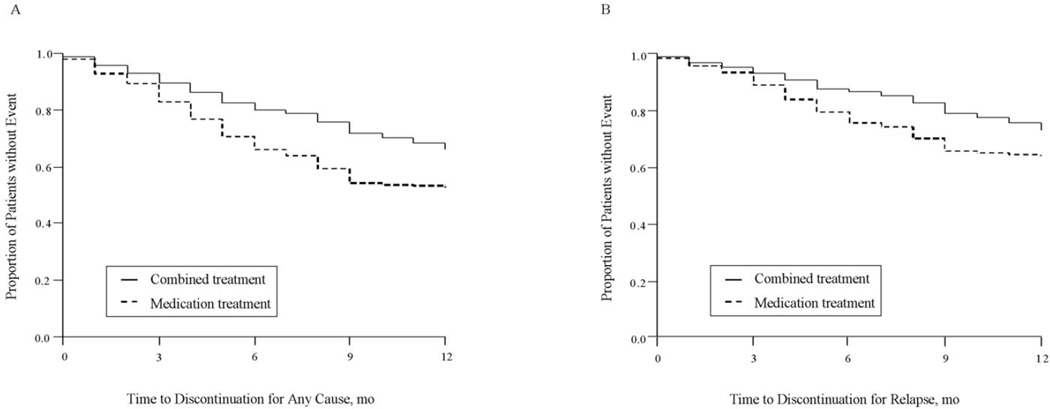
Results: The rates of treatment discontinuation or change due to any cause were 32.8% in the combined treatment group and 46.8% in the medication-alone group. Comparisons with medication treatment alone showed lower risk of any-cause discontinuation with combined treatment (hazard ratio, 0.62; 95% confidence interval, 0.52-0.74; P < .001) and lower risk of relapse with combined treatment (0.57; 0.44-0.74; P < .001). The combined treatment group exhibited greater improvement in insight (P < .001), social functioning (P = .002), activities of daily living (P < .001), and 4 domains of quality of life as measured by the Medical Outcomes Study 36-Item Short Form Health Survey (all P < or = .02). Furthermore, a significantly higher proportion of patients receiving combined treatment obtained employment or accessed education (P = .001).
Conclusion: Compared with those receiving medication only, patients with early-stage schizophrenia receiving medication and psychosocial intervention have a lower rate of treatment discontinuation or change, a lower risk of relapse, and improved insight, quality of life, and social functioning.
Trial registration: clinicaltrials.gov Identifier: NCT00654576.
Figures
Comment in
-
Adding a psychosocial intervention to antipsychotic medication reduces treatment discontinuation and relapse.Evid Based Ment Health. 2011 Feb;14(1):24. doi: 10.1136/ebmh.14.1.24. Evid Based Ment Health. 2011. PMID: 21266621 No abstract available.
-
Interventions for schizophrenia: integrative approaches to group therapy.Int J Group Psychother. 2013 Oct;63(4):603-8. doi: 10.1521/ijgp.2013.63.4.603. Int J Group Psychother. 2013. PMID: 24004017 No abstract available.
References
-
- Freedman R. Schizophrenia. N Engl J Med. 2003;349(18):1738–1749. - PubMed
-
- Lieberman JA, Stroup TS, McEvoy JP, Swartz MS, Rosenheck RA, Perkins DO, Keefe RS, Davis SM, Davis CE, Lebowitz BD, Severe J, Hsiao JK Clinical Antipsychotic Trials of Intervention Effectiveness (CATIE) Investigators. Effectiveness of antipsychotic drugs in patients with chronic schizophrenia. N Engl J Med. 2005;353(12):1209–1223. - PubMed
-
- Mojtabai R, Lavelle J, Gibson PJ, Bromet EJ. Atypical antipsychotics in first admission schizophrenia: medication continuation and outcomes. Schizophr Bull. 2003;29(3):519–530. - PubMed
-
- Weiden PJ, Kozma C, Grogg A, Locklear J. Partial compliance and risk of rehospitalization among California Medicaid patients with schizophrenia. Psyiatr Serv. 2004;55(8):886–891. - PubMed
-
- Penn DL, Waldheter EJ, Perkins DO, Mueser KT, Lieberman JA. Psychosocial treatment for first-episode psychosis: a research update. Am J Psychiatry. 2005;162(12):2220–2232. - PubMed