Review
. 2011 Jan;68(2):185-94.
doi: 10.1007/s00018-010-0516-2. Epub 2010 Sep 6.

The role of endosomal-recycling in long-term potentiation

Affiliations
Review

The role of endosomal-recycling in long-term potentiation

Eoin E Kelly et al. Cell Mol Life Sci. 2011 Jan.

Abstract

Long-term potentiation (LTP) defines persistent increases in neurotransmission strength at synapses that are triggered by specific patterns of neuronal activity. LTP, the most widely accepted molecular model for learning, is best characterised at glutamatergic synapses on dendritic spines. In this context, LTP involves increases in dendritic spine size and the insertion of glutamate receptors into the post-synaptic spine membrane, which together boost post-synaptic responsiveness to neurotransmitters. In dendrites, the material required for LTP is sourced from an organelle termed the endosomal-recycling compartment (ERC), which is localised to the base of dendritic spines. When LTP is induced, material derived from the recycling compartment, which contains α-amino-3-hydroxy-5-methyl-4-isoxazole propionate-type glutamate receptors (AMPARs), is mobilised into dendritic spines feeding the increased need for receptors and membrane at the spine neck and head. In this review, we discuss the importance of endosomal-recycling and the role of key proteins which control these processes in the context of LTP.


Figures
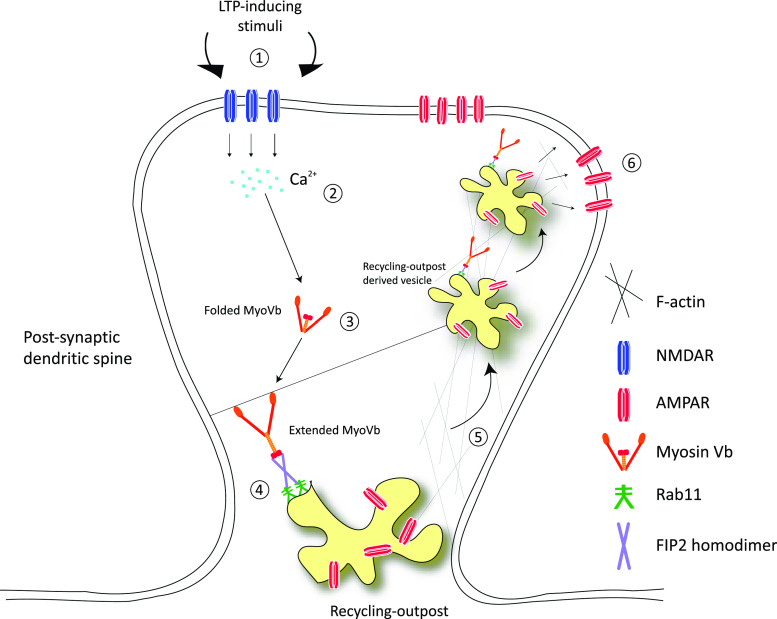
Fig. 1
Fig. 1
Model for MyoVb-dependent trafficking of recycling outpost-derived material in the post-synaptic dendritic spine during LTP-stimulation. 1 LTP-inducing stimuli at the post-synaptic dendritic spine results in the opening of NMDARs. 2 NMDAR opening results in a rapid increase in intracellular Ca2+ levels. 3 Increased intracellular Ca2+ levels stimulate an alteration of MyoVb structure, causing it to adopt its extended conformation. 4 MyoVb is recruited to the recycling-outpost (RO) where its globular-tail domain interacts with the Rab11/FIP2-complex present on the RO membrane. 5 MyoVb, tethered to RO-derived vesicles, progressively moves along actin microfilaments, and as such, these vesicles are transported to the spine neck and head. 6 The RO moves into the head and neck regions of the dendritic spine, eventually fusing with the spine membrane providing the cargo materials (membrane and AMPARs) that are required for LTP

References

    1. Malinow R. AMPA receptor trafficking and long-term potentiation. Philos Trans R Soc Lond B. 2003;358:707–714. doi: 10.1098/rstb.2002.1233. - DOI - PMC - PubMed
    1. Dingledine R, Borges K, Bowie D, Traynelis SF. The glutamate receptor ion channels. Pharmacol Rev. 1999;51:7–61. - PubMed
    1. Bliss TV, Collingridge GL. A synaptic model of memory: long-term potentiation in the hippocampus. Nature. 1993;361:31–39. doi: 10.1038/361031a0. - DOI - PubMed
    1. Lynch G, Larson J, Kelso S, Barrionuevo G, Schottler F. Intracellular injections of EGTA block induction of hippocampal long-term potentiation. Nature. 1983;305:719–721. doi: 10.1038/305719a0. - DOI - PubMed
    1. Malinow R, Malenka RC. AMPA receptor trafficking and synaptic plasticity. Annu Rev Neurosci. 2002;25:103–126. doi: 10.1146/annurev.neuro.25.112701.142758. - DOI - PubMed

Publication types

Substances
