Mutational analysis of flucytosine resistance in Candida glabrata
- PMID: 20823283
- PMCID: PMC2976130
- DOI: 10.1128/AAC.00605-10
Mutational analysis of flucytosine resistance in Candida glabrata
Abstract
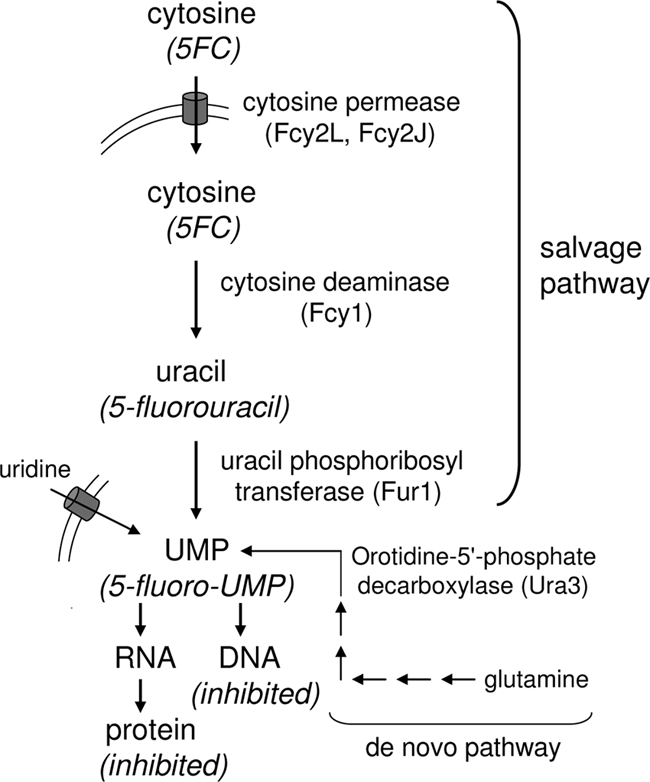
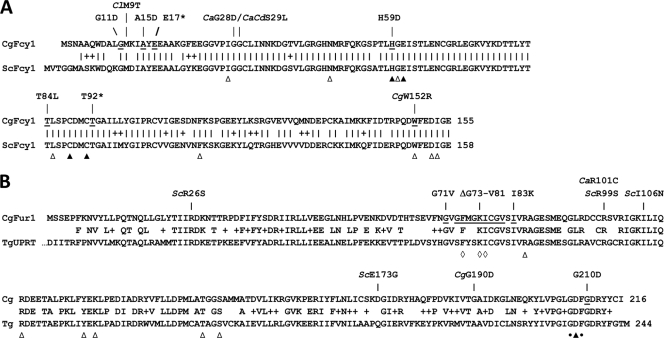
The antifungal flucytosine (5-fluorocytosine [5FC]) is a prodrug metabolized to its toxic form, 5-fluorouracil (5FU), only by organisms expressing cytosine deaminase. One such organism is Candida glabrata, which has emerged as the second most common agent of bloodstream and mucosal candidiasis. This emergence has been attributed to the high rate at which C. glabrata develops resistance to azole antifungals. As an oral agent, 5FC represents an attractive alternative or complement to azoles; however, the frequency of 5FC resistance mutations and the mechanisms by which these mutations confer resistance have been explored only minimally. On RPMI 1640 medium containing 1 μg/ml 5FC (32-fold above the MIC, but less than 1/10 of typical serum levels), resistant mutants occurred at a relatively low frequency (2 × 10⁻⁷). Three of six mutants characterized were 5FU cross-resistant, suggesting a mutation downstream of the Fcy1 gene (cytosine deaminase), which was confirmed by sequence analysis of the Fur1 gene (uracil phosphoribosyl transferase). The remaining three mutants had Fcy1 mutations. To ascertain the effects of 5FC resistance mutations on enzyme function, mutants were isolated in ura3 strains. Three of seven mutants harbored Fcy1 mutations and failed to grow in uridine-free, cytosine-supplemented medium, consistent with inactive Fcy1. The remainder grew in this medium and had wild-type Fcy1; further analysis revealed these to be mutated in the Fcy2L homolog of S. cerevisiae Fcy2 (purine-cytosine transporter). Based on this analysis, we characterized three 5FC-resistant clinical isolates, and mutations were identified in Fur1 and Fcy1. These data provide a framework for understanding 5FC resistance in C. glabrata and potentially in other fungal pathogens.
Figures
References
-
- Chapeland-Leclerc, F., C. Hennequin, N. Papon, T. Noël, A. Girard, G. Socié, P. Ribaud, and C. Lacroix. 2010. Acquisition of flucytosine, azole, and caspofungin resistance in Candida glabrata bloodstream isolates serially obtained from a hematopoietic stem cell transplant recipient. Antimicrob. Agents Chemother. 54:1360-1362. - PMC - PubMed
-
- Erbs, P., F. Exinger, and R. Jund. 1997. Characterization of the Saccharomyces cerevisiae FCY1 gene encoding cytosine deaminase and its homologue FCA1 of Candida albicans. Curr. Genet. 31:1-6. - PubMed
-
- Fasoli, M. O., and D. Kerridge. 1990. Uptake of pyrimidines and their derivatives into Candida glabrata and Candida albicans. J. Gen. Microbiol. 136:1475-1481. - PubMed
-
- Florent, M., T. Noel, G. Ruprich-Robert, B. Da Silva, V. Fitton-Ouhabi, C. Chastin, N. Papon, and F. Chapeland-Leclerc. 2009. Nonsense and missense mutations in FCY2 and FCY1 genes are responsible for flucytosine resistance and flucytosine-fluconazole cross-resistance in clinical isolates of Candida lusitaniae. Antimicrob. Agents Chemother. 53:2982-2990. - PMC - PubMed
Publication types
MeSH terms
Substances
Grants and funding
LinkOut - more resources
Full Text Sources
Molecular Biology Databases