


Osteopontin is a marker for cancer aggressiveness and patient survival
- PMID: 20823889
- PMCID: PMC2966627
- DOI: 10.1038/sj.bjc.6605834
Osteopontin is a marker for cancer aggressiveness and patient survival
Abstract
Background: Only a fraction of molecular cancer markers identified in the scientific literature have found clinical use. Specifically, few predictors of invasiveness are established in diagnostics. Meta-analysis is a valuable tool for biomarker validation. Here, we evaluate Osteopontin as a marker for tumor aggressiveness (grade, stage, early progression) and patient survival.
Methods: Publications through 2008 with the keywords 'osteopontin AND cancer' were retrieved. Titles and abstracts were screened for studies presenting original data on human subjects. This left 228 publications for data extraction. We applied categorical data analysis for testing the relationship between Osteopontin and a clinical variable.
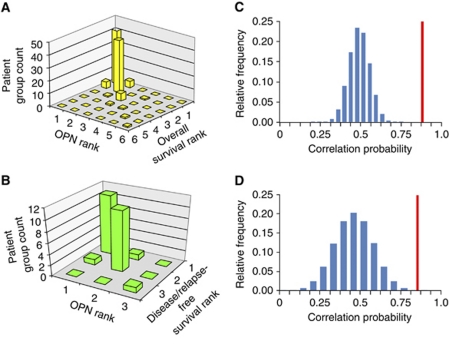
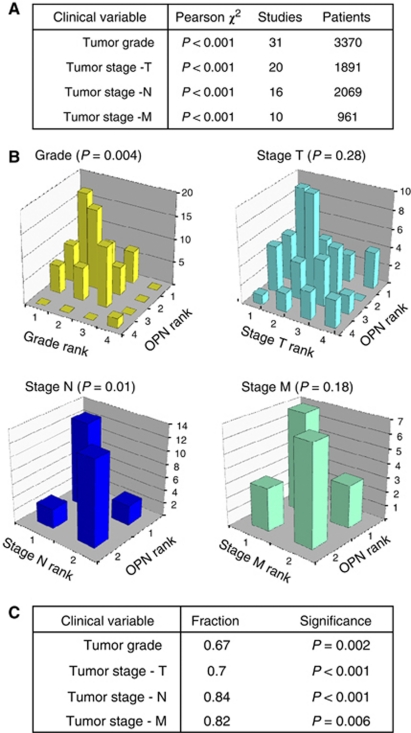
Results: Osteopontin ranks correlated with lower overall and disease-free/relapse-free survival in all tumors combined, as well as in lung cancer, breast cancer, prostate cancer, head and neck cancer, and liver cancer. Further, Osteopontin levels correlated with tumor grade and stage for all tumors combined and for several individual tumor types. Osteopontin levels were significantly associated with the early progression of eight cancers, independent in one, and inversely correlated in two.
Conclusions: Osteopontin is significantly associated with survival in several forms of cancer. Osteopontin levels are also markers for stage, grade, and early tumor progression in multiple cancers, reflecting a common molecular underpinning for distinct clinical measures. Osteopontin has value as a clinical tumor progression marker.
Figures
References
-
- Agresti A (2007) 2nd edn. An Introduction to Categorical Data Analysis. John Wiley and Sons, Inc: Hoboken, NJ
-
- Alonso SR, Tracey L, Ortiz P, Pérez-Gómez B, Palacios J, Pollán M, Linares J, Serrano S, Sáez-Castillo AI, Sánchez L, Pajares R, Sánchez-Aguilera A, Artiga MJ, Piris MA, Rodríguez-Peralto JL (2007) A high-throughput study in melanoma identifies epithelial-mesenchymal transition as a major determinant of metastasis. Cancer Res 67: 3450–3460 - PubMed
-
- Ebert W, Muley T, Drings P (1996) Does the assessment of serum markers in patients with lung cancer aid in the clinical decision making process? Anticancer Res 16: 2161–2168 - PubMed
-
- Hong F, Breitling R (2008) A comparison of meta-analysis methods for detecting differentially expressed genes in microarray experiments. Bioinformatics 24: 374–382 - PubMed
-
- Hong F, Breitling R, McEntee CW, Wittner BS, Nemhauser JL, Chory J (2006) RankProd: a bioconductor package for detecting differentially expressed genes in meta-analysis. Bioinformatics 22: 2825–2827 - PubMed
Publication types
MeSH terms
Substances
Grants and funding
LinkOut - more resources
Full Text Sources
Other Literature Sources
Research Materials
