. 2010 Sep;12(9):708-17.
doi: 10.1593/neo.10356.

Mutations in the c-Kit gene disrupt mitogen-activated protein kinase signaling during tumor development in adenoid cystic carcinoma of the salivary glands

Affiliations

Mutations in the c-Kit gene disrupt mitogen-activated protein kinase signaling during tumor development in adenoid cystic carcinoma of the salivary glands

Osamu Tetsu et al. Neoplasia. 2010 Sep.

Abstract

The Ras/mitogen-activated protein kinase (MAPK) pathway is considered to be a positive regulator of tumor initiation, progression, and maintenance. This study reports an opposite finding: we have found strong evidence that the MAPK pathway is inhibited in a subset of adenoid cystic carcinomas (ACCs) of the salivary glands. ACC tumors consistently overexpress the receptor tyrosine kinase (RTK) c-Kit, which has been considered a therapeutic target. We performed mutational analysis of the c-Kit gene (KIT in 17 cases of ACC and found that 2 cases of ACC had distinct missense mutations in KIT at both the genomic DNA and messenger RNA levels. These mutations caused G664R and R796G amino acid substitutions in the kinase domains. Surprisingly, the mutations were functionally inactive in cultured cells. We observed a significant reduction of MAPK (ERK1/2) activity in tumor cells, as assessed by immunohistochemistry. We performed further mutational analysis of the downstream effectors in the c-Kit pathway in the genes HRAS, KRAS, NRAS, BRAF, PIK3CA, and PTEN. This analysis revealed that two ACC tumors without KIT mutations had missense mutations in either KRAS or BRAF, causing S17N K-Ras and V590I B-Raf mutants, respectively. Our functional analysis showed that proteins with these mutations were also inactive in cultured cells. This is the first time that MAPK activity from the RTK signaling has been shown to be inhibited by gene mutations during tumor development. Because ACC seems to proliferate despite inactivation of the c-Kit signaling pathway, we suggest that selective inhibition of c-Kit is probably not a suitable treatment strategy for ACC.


Figures
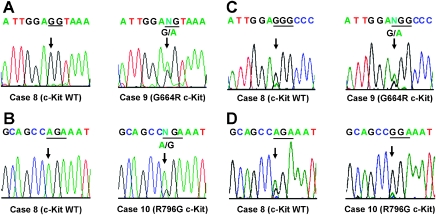
Figure 1
Figure 1
KIT mutations in tumor samples from sporadic ACC. (A) Genomic DNA electropherograms of case 8 (left) and case 9 (right) are shown. They identify the KIT missense mutation in exon 13. Case 8 has a wild-type (WT) sequence. Case 9 has nucleotide (nt) switches, specifically nt1990G → A in exon 13, with a predicted missense substitution of arginine for glycine 664 (G664R). The first and second nucleotides for codon 664 are highlighted with underlines. The third nucleotide is located in a different exon. (B) Genomic DNA electropherograms of case 8 (left) and case 10 (right) are shown, identifying the KIT missense mutation in exon 17. Case 8 has a WT sequence. Case 10 has an nt2386A → G transition in exon 17, with a predicted missense substitution of glycine for arginine 796 (R796G). Triplet nucleotides at codon 796 are marked with underlines. (C) RT-PCR products electropherograms of case 8 (left) and case 9 (right). Case 8 has a wild-type (WT) sequence. Case 9 has the KIT missense mutation in codon 664. Triplet nucleotides for codon 664 are highlighted with underlines. (D) RT-PCR products electropherograms of case 8 (left) and case 10 (right) RT-PCR products are shown. Case 8 has a wild-type (WT) sequence. Case 10 has the KIT missense mutation in codon 796. Triplet nucleotides for codon 796 are highlighted with underlines.
Figure 2
Figure 2
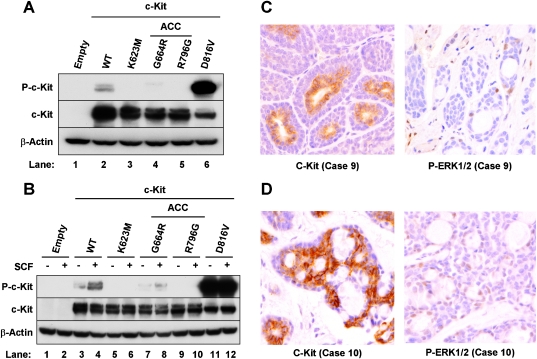
ACC c-Kit mutations are inactive and caused substantial reduction of MAPK activity in tumor cells. (A, B) HEK 293T cells were plated into six-well plates. Twenty-four hours later, subconfluent cells were transfected with 2 µg each of expression vectors containing the various c-Kit mutants. (A) After 24 hours of incubation, the cells were harvested. (B) After 24 hours of incubation, the cells were serum-starved for 16 hours with medium containing 0.5% fetal bovine serum. Cultures were incubated for 15 minutes in the presence (+) or absence (-) of 50 ng/ml SCF before harvesting. Western blot analysis was performed using antibodies against phosphorylation specific c-Kit (P-c-Kit), c-Kit specific for the c-Kit variants, and β-actin as a loading control. The following c-Kit vectors were independently transfected: Empty (pcDNA 3.1) wild-type, K623M (catalytically inactive), D816V (constitutively active), and G664R and R796G (found in ACC). (C, D) IHC was performed on unstained sections using antibodies to Kit (left panels) or phospho-p44/42 MAPK (right panels). Phosphorylated forms of ERK1/2 (right panels) were barely detectable in both cases despite strong expression of c-Kit (left panels).
Figure 3
Figure 3
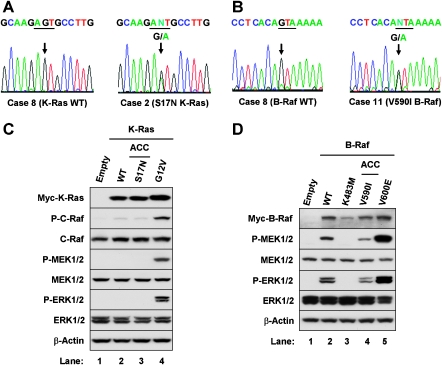
ACC K-Ras and B-Raf mutations were inactive or kinase-impaired. (A and B) KRAS and BRAF mutations were detected in sporadic ACC. (A) Genomic DNA electropherograms of case 8 (left) and case 2 (right) identify the KRAS missense mutation in exon 1. Case 8 has a wild-type (WT) sequence. In contrast, case 2 has a nt50G → A transition with a predicted missense substitution of asparagine for serine 17 (S17N). Triplet nucleotides for codon 17 are highlighted with underlines. (B) Genomic DNA electropherograms of case 8 (left) and case 11 (right) identify the BRAF missense mutation in exon 15. Case 8 shows normal wild-type (WT) sequence. In contrast, case 11 has a nt1768A → G change with a predicted missense substitution of isoleucine for valine 590 (V590I). Triplet nucleotides cording codon 590 are marked with underlines. (C and D) HEK 293T cells were plated into six-well plates. Twenty-four hours later, subconfluent cells were transfected with 2 µg each of expression vectors containing the various K-Ras mutants (C) or 0.25 µg each of expression vectors containing the various B-Raf mutants (D). After 24 hours of incubation, the cells were harvested. Western blot analysis was performed using antibodies against phosphorylation-specific C-Raf (P-C-Raf), MEK1/2 (P-MEK1/2), p44 ERK1 and p42 ERK2 (P-ERK1/2), total C-Raf, total MEK1/2, total ERK1/2, and β-actin. The following vectors were independently transfected: (C) Empty (pcDNA 3.1), wild-type, G12V (constitutively active), and S17N K-Ras (found in ACC). In (D), the vectors were Empty (pcDNA 3.1), wild-type, K483M (catalytically inactive), V600E (constitutively active), and V590I (found in ACC).
Figure 4
Figure 4
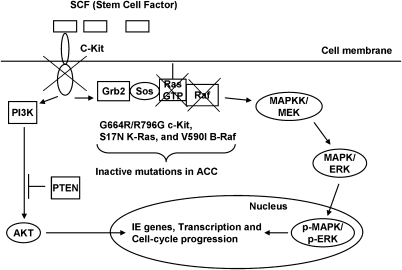
Cell signaling from the RTK c-Kit is disrupted during tumor development in a subset of salivary gland ACCs. C-Kit regulates cell survival and growth control through the PI3K/Akt and MAPK signaling pathways. We found inactivating mutations in KIT, KRAS, and BRAF. Because ACC can proliferate despite inactivation of c-Kit cell signaling, c-Kit must be dispensable for maintaining established ACC tumors. This is the first time that inactivation of MAPK accompanied tumorigenesis. Our results also suggest that selective inhibition of c-Kit is not a promising strategy for ACC therapeutic development.

References

    1. Spiro RH, Huvos AG, Strong EW. Adenoid cystic carcinoma of salivary origin. A clinicopathologic study of 242 cases. Am J Surg. 1974;128:512–520. - PubMed
    1. Carlson ER, Kim J, Mirowski GW, Stewart JCB, Zarbo RJ. Salivary gland diseases. In: Regezi JA, Sciubba JJ, Jordan RCK, editors. Oral Pathology: Clinical Pathology Correlations. St Louis, MO: Saunders; 2008. pp. 179–215.
    1. Phuchareon J, Ohta Y, Woo JM, Eisele DW, Tetsu O. Genetic profiling reveals cross-contamination and misidentification of 6 adenoid cystic carcinoma cell lines: ACC2, ACC3, ACCM, ACCNS, ACCS and CAC2. PLoS One. 2009;4:e6040–e6040. - PMC - PubMed
    1. Chen AM, Garcia J, Lee NY, Bucci MK, Eisele DW. Patterns of nodal relapse after surgery and postoperative radiation therapy for carcinomas of the major and minor salivary glands: what is the role of elective neck irradiation? Int J Radiat Oncol Biol Phys. 2007;67:988–994. - PubMed
    1. Laurie SA, Licitra L. Systemic therapy in the palliative management of advanced salivary gland cancers. J Clin Oncol. 2006;24:2673–2678. - PubMed

Publication types

MeSH terms

Substances