


Human papillomavirus and WHO type I nasopharyngeal carcinoma
- PMID: 20824783
- PMCID: PMC4212520
- DOI: 10.1002/lary.21089
Human papillomavirus and WHO type I nasopharyngeal carcinoma
Abstract
Objectives: Nasopharyngeal carcinoma (NPC) is a rare cancer in the United States. An association between NPC and Epstein-Barr virus (EBV) is well-established for World Health Organization (WHO) types II and III (WHO-II/III) NPC but less well-established for WHO type I (WHO-I) NPC. Given the rise in oropharyngeal tumors positive for high-risk human papillomavirus (HPV) and the unique biology of WHO-I NPC, we examined the relationship between HPV and WHO-I NPC.
Study design: Retrospective case-comparison study.
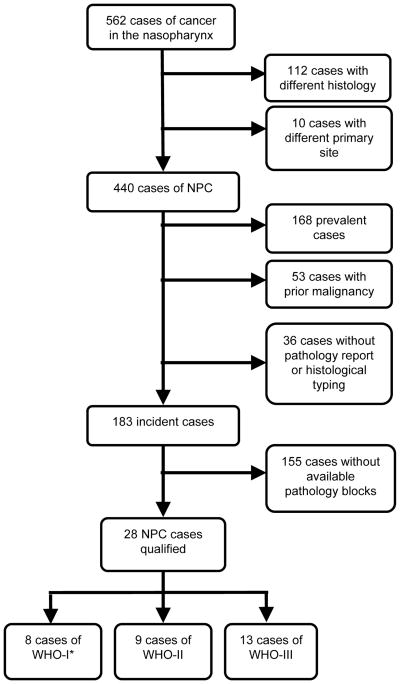
Methods: A search of a large multidisciplinary cancer center tumor registry identified 183 patients seen from January 1999 to December 2008 with incident NPC and no prior cancer. Available paraffin-embedded tumor specimens (N = 30) were analyzed for oncogenic HPV status by in situ hybridization (ISH) and polymerase chain reaction (PCR) for HPV-16 and HPV-18; EBV status by ISH; and p16 expression by immunohistochemistry. Demographic parameters, including race and smoking, were obtained from the medical records.
Results: Among the 18 WHO-I NPC patients, 66% (N = 12) were smokers and 17% (N = 3) Asian; among the 165 WHO-II/III NPC patients, 44% (N = 73) were smokers and 24% (N = 39) Asian. Eight WHO-I NPC patients had available paraffin blocks; five of six were HPV-16-positive by PCR and four of eight were HPV-positive by ISH; only two of eight (25%) were EBV-positive. Twenty-two WHO-II/III NPC patients had available paraffin blocks; only 1 was HPV-positive by ISH, and 13 of 22 (60%) were EBV-positive.
Conclusions: These results suggest that WHO-I NPC is associated with oncogenic HPV, although larger studies are needed to verify these findings. Laryngoscope, 2010.
Figures
References
-
-
Surveillance, Epidemiology, and End Results (SEER) Program, National Cancer Institute, DCCPS, Surveillance Research Program, Cancer Statistics Branch. SEER*Stat Database: Incidence - SEER 9 Regs Limited-Use, Nov 2007 Sub (1973-2005) and SEER 13 Regs Limited-Use, Nov 2007 Sub (1992-2005), released April 2008, based on the November 2007 submission. Available at http://www.seer.cancer.gov. Accessed August 5, 2009.
-
-
- Wei WI, Sham JS. Nasopharyngeal carcinoma. Lancet. 2005;365:2041–2054. - PubMed
-
- Sun LM, Li CI, Huang EY, Vaughan TL. Survival differences by race in nasopharyngeal carcinoma. Am J Epidemiology. 2007;165:271–278. - PubMed
-
- Ou SH, Zell JA, Ziogas A, Anton-Culver H. Epidemiology of nasopharyngeal carcinoma in the United States: improved survival of Chinese patients within the keratinizing squamous cell carcinoma histology. Ann Oncol. 2007;18:29–35. - PubMed
Publication types
MeSH terms
Substances
Grants and funding
LinkOut - more resources
Full Text Sources
