


Cognitive behavioural therapy for tinnitus
- PMID: 20824844
- PMCID: PMC12529915
- DOI: 10.1002/14651858.CD005233.pub3
Cognitive behavioural therapy for tinnitus
Abstract
Background: This is an update of a Cochrane Review originally published in Issue 1, 2007 of The Cochrane Library.Tinnitus is an auditory perception that can be described as the experience of sound, in the ear or in the head, in the absence of external acoustic stimulation. Cognitive behavioural therapy (CBT) uses relaxation, cognitive restructuring of the thoughts and exposure to exacerbating situations in order to promote habituation and may benefit tinnitus patients, as may the treatment of associated psychological conditions.
Objectives: To assess whether CBT is effective in the management of patients suffering from tinnitus.
Search strategy: We searched the Cochrane Ear, Nose and Throat Disorders Group Trials Register; the Cochrane Central Register of Controlled Trials (CENTRAL); PubMed; EMBASE; CINAHL; Web of Science; BIOSIS Previews; Cambridge Scientific Abstracts; PsycINFO; ISRCTN and additional sources for published and unpublished trials. The date of the most recent search was 6 May 2010.
Selection criteria: Randomised controlled trials in which patients with unilateral or bilateral tinnitus as their main symptom received cognitive behavioural treatment.
Data collection and analysis: One review author (PMD) assessed every report identified by the search strategy. Three authors (PMD, AW and MT) assessed the methodological quality and applied inclusion/exclusion criteria. Two authors (PMD and RP) extracted data and conducted the meta-analysis. The four authors contributed to the final text of the review.
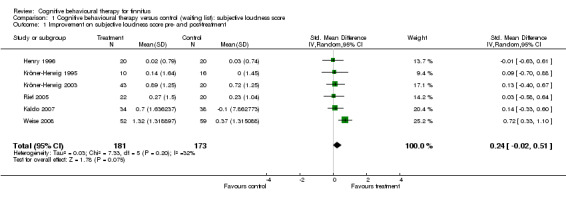
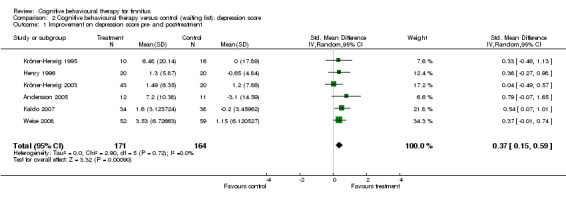
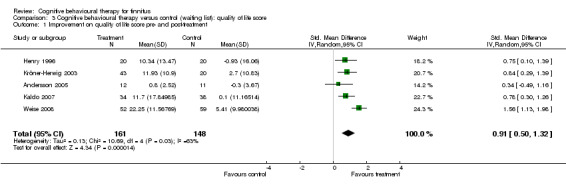
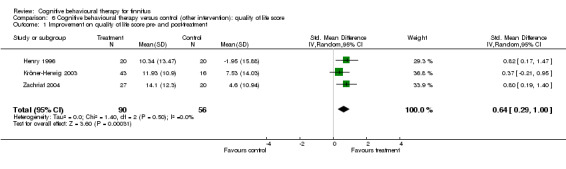
Main results: Eight trials comprising 468 participants were included.For the primary outcome of subjective tinnitus loudness we found no evidence of a difference between CBT and no treatment or another intervention (yoga, education and 'minimal contact - education').In the secondary outcomes we found evidence that quality of life scores were improved in participants who had tinnitus when comparing CBT to no treatment or another intervention (education and 'minimal contact education'). We also found evidence that depression scores improved when comparing CBT to no treatment. We found no evidence of benefit in depression scores when comparing CBT to other treatments (yoga, education and 'minimal contact - education').There were no adverse/side effects reported in any trial.
Authors' conclusions: In six studies we found no evidence of a significant difference in the subjective loudness of tinnitus.However, we found a significant improvement in depression score (in six studies) and quality of life (decrease of global tinnitus severity) in another five studies, suggesting that CBT has a positive effect on the management of tinnitus.
Conflict of interest statement
None known.
Figures


Update of
-
Cognitive behavioural therapy for tinnitus.Cochrane Database Syst Rev. 2007 Jan 24;(1):CD005233. doi: 10.1002/14651858.CD005233.pub2. Cochrane Database Syst Rev. 2007. Update in: Cochrane Database Syst Rev. 2010 Sep 08;(9):CD005233. doi: 10.1002/14651858.CD005233.pub3. PMID: 17253549 Updated.
References
References to studies included in this review
Andersson 2005 {published data only}
-
- Andersson G, Porsaeus D, Wiklund M, Kaldo V, Larsen HC. Treatment of tinnitus in the elderly: a controlled trial of cognitive behavior therapy. International Journal of Audiology 2005;44(11):671‐5. - PubMed
Henry 1996 {published data only}
-
- Henry JL, Wilson PH. The psychological management of tinnitus: comparison of a combined cognitive educational program, education alone and a waiting‐list control. International Tinnitus Journal 1996;2:9‐20. - PubMed
Kaldo 2007 {published data only}
-
- Kaldo V, Cars S, Rahnert M, Larsen HC, Andersson G. Use of a self‐help book with weekly therapist contact to reduce tinnitus distress: a randomized controlled trial. Journal of Psychosomatic Research 2007;63:195–202. - PubMed
Kröner‐Herwig 1995 {published data only}
-
- Kröner‐Herwig B, Hebing G, Rijn‐Kalkman U, Frenzel A, Schilkowsky G, Esser G. The management of chronic tinnitus ‐ comparison of a cognitive‐behavioural group training with yoga. Journal of Psychosomatic Research 1995;39(2):153‐65. - PubMed
Kröner‐Herwig 2003 {published data only}
-
- Kröner‐Herwig B, Frenzel A, Fritsche G, Schilkowsky G, Esser G. The management of chronic tinnitus: comparison of an outpatient cognitive‐behavioral group training to minimal‐contact interventions. Journal of Pyschosomatic Research 2003;54(4):381‐9. - PubMed
Rief 2005 {published data only}
-
- Rief W, Weise C, Kley N, Martin A. Psychophysiologic treatment of chronic tinnitus: a randomized clinical trial. Psychosomatic Medicine 2005;67(5):833‐8. - PubMed
Weise 2008 {published data only}
-
- Weise C, Heinecke K, Rief W. Biofeedback‐based behavioral treatment for chronic tinnitus: results of a randomized controlled trial. Journal of Consulting and Clinical Psychology 2008;76(6):1046‐57. - PubMed
Zachriat 2004 {published and unpublished data}
-
- Zachriat C, Kröner‐Herwig B. Treating chronic tinnitus: comparison of cognitive‐behavioural and habituation‐based treatments. Cognitive Behavioural Therapy 2004;33(4):187‐98. - PubMed
References to studies excluded from this review
Abbott 2009 {published data only}
-
- Abbott JA, Kaldo V, Klein B, Austin D, Hamilton C, Piterman L, et al. A cluster randomised trial of an internet‐based intervention program for tinnitus distress in an industrial setting. Cognitive Behaviour Therapy 2009;38(3):162‐73. - PubMed
Andersson 2002 {published data only}
-
- Andersson G, Stromgren T, Strom L, Lyttkens L. Randomized controlled trial of internet‐based cognitive behavior therapy for distress associated with tinnitus. Psychosomatic Medicine 2002;64:810‐6. - PubMed
Davies 1995 {published data only}
-
- Davies S, McKenna L, Hallam RS. Relaxation and cognitive therapy: a controlled trial in chronic tinnitus. Psychology and Health 1995;10:129‐43.
Delb 2002 {published data only}
-
- Delb W, D'Amelio R, Boisten CJM, Plinkert PK. Evaluation of the tinnitus retraining therapy as combined with a cognitive behavioural group therapy. HNO 2002;50(11):997‐1004. - PubMed
Goebel 2000 {published data only}
-
- Goebel G, Rubler D, Hiller W, Heuser J, Fitcher MM. Evaluation of tinnitus retraining therapy in comparison to cognitive therapy and broad‐band noise generator therapy. Laryngo‐Rhino‐Otologie 2000;79 (Suppl 1):S88.
Henry 1998 {published data only}
-
- Henry JL, Wilson PH. An evaluation of two types of cognitive intervention in the management of chronic tinnitus. Scandinavian Journal of Behaviour Therapy 1998;27(4):156‐66.
Hiller 2004 {published data only}
-
- Hiller W, Haerkotter C. Does sound stimulation have additive effects on cognitive‐behavioural treatment of chronic tinnitus?. Behaviour Research and Therapy 2005;43 (5):595‐612. - PubMed
Jakes 1986 {published data only}
-
- Jakes SC, Hallam RS, Rachman S, Hinchcliffe R. The effects of reassurance, relaxation training and distraction on chronic tinnitus sufferers. Behavior Research and Therapy 1986;24(5):497‐507. - PubMed
Jakes 1992 {published data only}
-
- Jakes SC, Hallam RS, McKenna L, Hinchcliffe R. Group cognitive therapy for medical patients: an application to tinnitus. Cognitive Therapy and Research 1992;16(1):67‐82.
Kaldo 2008 {published data only}
-
- Kaldo V, Levin S, Widarsson J, Buhrman M. Internet versus group cognitive‐behavioral treatment of distress associated with tinnitus: a randomized controlled trial. Behavior Therapy 2008;39:348‐59. - PubMed
Kröner‐Herwig 1999 {published data only}
-
- Kröner‐Herwig B, Esser G, Frenzel A, Fritsche G, Schilkowsky G. Results of an outpatient cognitive‐behavioral group treatment for chronic tinnitus. Sixth International Tinnitus Seminar. 1999:370‐2.
Kröner‐Herwig 2006 {published data only}
Lindberg 1987 {published data only}
-
- Lindberg P, Scott B, Melin L, Lyttkens L. Long‐term effects of psychological treatment of tinnitus. Scandinavian Audiology 1987;16:167‐72. - PubMed
Lindberg 1988 {published data only}
-
- Lindberg P, Scott B, Melin L, Lyttkens L. Behavioural therapy in the clinical management of tinnitus. British Journal of Audiology 1988;22:265‐72. - PubMed
Lindberg 1989 {published data only}
-
- Lindberg P, Scott B, Melin L, Lyttkens L. The psychological treatment of tinnitus: an experimental evaluation. Behaviour Research and Therapy 1989;27(6):593‐603. - PubMed
Robinson 2008 {published data only}
-
- Robinson SK, Viirre ES, Bailey KA, Kindermann S, Minassian AL, Goldin PR, et al. A randomized controlled trial of cognitive‐behavior therapy for tinnitus. International Tinnitus Journal 2008;14(2):119‐26. - PubMed
Sadlier 2008 {published data only}
-
- Sadlier M, Stephens SDG, Kennedy V. Tinnitus rehabilitation: a mindfulness meditation cognitive behavioural therapy approach. Journal of Laryngology & Otology 2008;122:31‐7. - PubMed
Scott 1985 {published data only}
-
- Scott B, Lindberg P, Lyttkens L, Melin L. Psychological treatment of tinnitus. Scandinavian Audiology 1985;14:223‐30. - PubMed
Wise 1998 {published data only}
-
- Wise K, Rief W, Goebel G. Meeting the expectations of chronic tinnitus patients: comparison of a structured group therapy program for tinnitus management with a problem‐solving group. Journal of Psychosomatic Research 1998;44(6):681‐5. - PubMed
References to ongoing studies
Kendall 2009 {published data only}
-
- Kendall CJ, Kerns RD. Cognitive behavioral therapy for tinnitus. Department of Veterans Affairs, Connecticut, United States. http://clinicaltrials.gov/ct2/show/NCT00724152 (accessed 14 July 2010). [NCT00724152]
Zenner 2010 {published data only}
-
- Zenner HP. Randomized controlled clinical trial of efficacy and safety of individual cognitive behavioral therapy (CBT) within the setting of the structured therapy programme sTCP (STructured Tinnitus Care Program) in patients with tinnitus aurium. http://clinicaltrials.gov/ct2/show/NCT00719940 (accessed 14 July 2010). [NCT00719940]
Additional references
Alberti 1987
-
- Alberti PW. Tinnitus in occupational hearing loss: nosological aspects. Journal of Otolaryngology 1987;16(1):34‐5. - PubMed
Argstatter 2008
-
- Argstatter H, Krick C, Bolay HV. Music therapy in chronic tonal tinnitus. Heidelberg model of evidence‐based music therapy. HNO 2008;56(7):678‐85. - PubMed
ATA 2004
-
- American Tinnitus Association. http://www.ata.org 2004 (accessed 30 July 2010).
Axelsson 1985
-
- Axelsson A, Sandh A. Tinnitus in noise‐induced hearing loss. British Journal of Audiology 1985;19(4):271‐6. - PubMed
Baguley 1992
-
- Baguley DM, Moffat DA, Hardy DG. What is the effect of translabyrinthine acoustic schwannoma removal upon tinnitus?. Journal of Laryngology and Otology 1992;106:329‐31. - PubMed
Baguley 2000
-
- Baguley DM, Humphriss RL, Hodgson CA. Convergent validity of the tinnitus handicap inventory and the tinnitus questionnaire. Journal of Laryngology and Otology 2000;114(11):840‐3. - PubMed
Baldo 2006
-
- Baldo P, Doree C, Lazzarini R, Molin P, McFerran DJ. Antidepressants for patients with tinnitus. Cochrane Database of Systematic Reviews 2006, Issue 4. [Art. No.: CD003853. DOI: 10.1002/14651858.CD003853.pub2] - PubMed
Becher 1996
-
- Becher S, Struwe F, Schwenzer C, Weber K. Risk of hearing loss caused by high volume music ‐ presenting an educational concept for preventing hearing loss in adolescents. Gesundheitswesen 1996;58(2):91‐5. - PubMed
Beck 1961
-
- Beck AT, Ward CH, Mendelson M, Mock J, Erbaugh J. An inventory for measuring depression. Archives of General Psychiatry 1961;4:561‐71. - PubMed
Beck 1979
-
- Beck AT, Rush AJ, Shaw BF, Emery G. Cognitive therapy of depression. New York: Guilford Press, 1979.
Beck 1988
-
- Beck AT, Steer RA, Garbin MG. Psychometric properties of the Beck Depression Inventory: Twenty‐five years of evaluation. Clinical Psychology 1988;8:77‐100.
Bennett 2007
-
- Bennett MH, Kertesz T, Yeung P. Hyperbaric oxygen for idiopathic sudden sensorineural hearing loss and tinnitus. Cochrane Database of Systematic Reviews 2007, Issue 1. [Art. No.: CD004739. DOI: 10.1002/14651858.CD004739.pub3] - PubMed
Briner 1995
-
- Briner W. A behavioral nosology for tinnitus. Psychological Reports 1995 Aug;77(1):27‐34. - PubMed
Brummett 1980
-
- Brummett RE. Drug‐induced ototoxicity. Drugs 1980;19(6):412‐28. - PubMed
Chouard 2001
-
- Chouard CH. Urban noise pollution. Comptes rendus de l'Académie des sciences. Série III, Sciences de la vie 2001;324(7):657‐61. - PubMed
Christiansson 1993
-
- Christiansson BA, Wintzell KA. An audiological survey of officers at an infantry regiment. Scandinavian Audiology 1993;22(3):147‐52. - PubMed
Chung 1980
-
- Chung DY, Gannon RP. Hearing loss due to noise trauma. Journal of Laryngology and Otology 1980;9(4):419‐23. - PubMed
Daniell 1998
-
- Daniell WE, Fulton‐Kehoe D, Smith‐Weller T, Franklin GM. Occupational hearing loss in Washington state, 1984‐1991: II. Morbidity and associated costs. American Journal of Industrial Medicine 1998;33(6):529‐36. - PubMed
Dauman 1992
-
- Dauman R, Tyler RS. Some considerations on the classification of tinnitus. Proceedings of the Fourth International Tinnitus Seminar, Bordeaux. 1992:225‐9.
Davis 2000
-
- Davis A, Rafaie A. Epidemiology of tinnitus. In: Richard Tyler editor(s). Tinnitus Handbook. San Diego: Singular Publishing Group, 2000.
Ernst 1999
-
- Ernst E, Stevinson C. Ginkgo biloba for tinnitus: a review. Clinical Otolaryngology 1999;24:164‐7. - PubMed
Fleischer 1999
-
- Fleischer G, Hoffmann E, Lang R, Muller R. Documentation of the effects of child cap pistols. HNO 1999;47(6):535‐40. - PubMed
Gelder 2000
-
- Gelder M, Lopez‐Ibor JJ, Andreasen N. New Oxford Textbook of Psychiatry. Oxford University Press, 2000.
Griest 1998
-
- Griest SE, Bishop PM. Tinnitus as an early indicator of permanent hearing loss. A 15 year longitudinal study of noise exposed workers. AAOHN Journal: Official Journal of the American Association of Occupational Health Nurses 1998;46(7):325‐9. - PubMed
Hallam 1984
-
- Hallam RS, Rachman S, Hinchcliffe R. Psychological aspects of tinnitus. In: Rachman S editor(s). Contributions to Medical Psychology. Oxford: Pergamon, 1984:31‐53.
Hallam 1988
-
- Hallam RS, Jakes SC, Hinchcliffe R. Cognitive variables in tinnitus annoyance. British Journal of Clinical Psychology 1988;27:213‐22. - PubMed
Handbook 2009
-
- Cochrane Handbook for Systematic Reviews of Interventions Version 5.0.2 [updated September 2009]. The Cochrane Collaboration, 2008. Available from www.cochrane‐handbook.org.
Hawton 1989
-
- Hawton K, Salkovskis PM, Kirk J, Clark DM. Cognitive Behavioural Therapy For Psychiatric Problems. A Practical Guide. Oxford Medical Publications, 1989.
Heller 1953
-
- Heller MF, Bergman M. Tinnitus aurium in normally hearing persons. Annals of Otology, Rhinology and Laryngology 1953;62:73‐83. - PubMed
Hilton 2004
-
- Hilton M, Stuart E. Ginkgo biloba for tinnitus. Cochrane Database of Systematic Reviews 2004, Issue 2. [DOI: 10.1002/14651858.CD003852.pub2] - PubMed
Hobson 2007
Hoekstra 2009
Holger 1994
-
- Holger KM, Axelsson A, Pringle I. Ginkgo Biloba extract for the treatment of tinnitus. Audiology 1994;33:85‐92. - PubMed
Jastreboff 1990
-
- Jastreboff PJ. Phantom auditory perception (tinnitus): mechanisms of generation and perception. Neuroscience Research 1990;8(4):221‐54. - PubMed
Jastreboff 2004
-
- Jastreboff PJ, Hazell JWP. Tinnitus Retraining Therapy. Implementing the Neurophysiological Model. Cambridge: Cambridge University Press, 2004.
Koester 2004
-
- Koester M, Storck C, Zorowka P. Tinnitus ‐ classification, causes, diagnosis, treatment and prognosis. MMW Fortschritte der Medizin 2004;146(1‐2):23‐4, 26‐8; quiz 29‐30. - PubMed
Kowalska 2001
-
- Kowalska S, Sulkowski W. Tinnitus in noise‐induced hearing impairment. Medycyna Pracy 2001;52(5):305‐13. - PubMed
Kuk 1990
-
- Kuk K, Tyler RS, Russell D. The psychometric properties of a Tinnitus Handicap Questionnaire. Ear and Hearing 1990;11(6):434‐42. - PubMed
Lee 1999
-
- Lee LT. A study of the noise hazard to employees in local discotheques. Singapore Medical Journal 1999;40(9):571‐4. - PubMed
Li 2009
-
- Li Y, Zeng RF, Zheng D. Acupuncture for tinnitus. Cochrane Database of Systematic Reviews 2009, Issue 4. [Art. No.: CD008149. DOI: 10.1002/14651858.CD008149]
Lockwood 1999
-
- Lockwood AH, Salvi RJ, Burkard RF, Galantowicz PJ, Coad ML, Wack DS. Neuroanatomy of tinnitus. Scandinavian Audiology 1999;51(Suppl):47‐52. - PubMed
Luxon 1993
Marx 1999
-
- Marx SV, Langman AW, Crane RC. Accuracy of fast spin echo magnetic resonance imaging in the diagnosis of vestibular schwannoma. American Journal of Otolaryngology 1999;20(4):211‐6. - PubMed
Mazurek 2007
-
- Mazurek B, Stöver T, Haupt H, Gross J, Szczepek A. The role of cochlear neurotransmitters in tinnitus. HNO 2007;55(12):964‐71. - PubMed
McCombe 2001
-
- McCombe A, Baguley D, Coles R, McKenna L, McKinney C, Windle‐Taylor P. Guidelines for the grading of tinnitus severity: the results of a working group commissioned by the British Association of Otolaryngologists – Head and Neck Surgeons. Clinical Otolaryngology 2001;26:388‐93. - PubMed
McShane 1988
-
- McShane DP, Hyde ML, Alberti PW. Tinnitus prevalence in industrial hearing loss compensation claimants. Clinical Otolaryngology 1988;13(5):323‐30. - PubMed
Melinek 1976
-
- Melinek M, Naggan L, Altman M. Acute acoustic trauma ‐ a clinical investigation and prognosis in 433 symptomatic soldiers. Israel Journal of Medical Sciences 1976;12(6):590‐9. - PubMed
Meng 2009
Metternich 1999
-
- Metternich FU, Brusis T. Acute hearing loss and tinnitus caused by amplified recreational music. Laryngorhinootologie 1999;78(11):614‐9. - PubMed
Mrena 2002
-
- Mrena R, Savolainen S, Kuokkanen JT, Ylikoski J. Characteristics of tinnitus induced by acute acoustic trauma: a long‐term follow‐up. Audiology and Neuro‐otology 2002;7(2):122‐30. - PubMed
Neuberger 1992
-
- Neuberger M, Korpert K, Raber A, Schwetz F, Bauer P. Hearing loss from industrial noise, head injury and ear disease. A multivariate analysis on audiometric examinations of 110,647 workers. Audiology 1992;31(1):45‐57. - PubMed
Olszewski 2008
-
- Olszewski J, Kowalska S, Kuśmierczyk K. Tinnitus diagnosis and treatment on the basis of our experiences. Otolaryngologia Polska 2008;62(1):76‐81. - PubMed
Oregon 1995
-
- Oregon Tinnitus Archive. http://www.tinnitusarchive.org/ 1995.
Phillips 2010
Phoon 1993
-
- Phoon WH, Lee HS, Chia SE. Tinnitus in noise‐exposed workers. Occupational Medicine 1993;43(1):35‐8. - PubMed
Radloff 1977
-
- Radloff LS. The CES‐D Scale: a self‐reported depression scale for research in the general population. Applied Psychology Measurement 1977;1:385‐401.
Rejali 2004
-
- Rejali D, Sivakumar A, Balaji N. Ginkgo biloba does not benefit patients with tinnitus: a randomized placebo‐controlled double‐blind trial and meta‐analysis of randomized trials. Clinical Otolaryngology 2004;29(3):226‐31. - PubMed
Robinson 2007
-
- Robinson S. Antidepressants for treatment of tinnitus. Progress in Brain Research 2007;166:263‐71. - PubMed
Saunders 1998
-
- Saunders JE, Slattery WH 3rd, Luxford WM. Automobile airbag impulse noise: otologic symptoms in six patients. Otolaryngology ‐ Head and Neck Surgery 1998;118(2):228‐34. - PubMed
Seidman 1998
-
- Seidman MD. Glutamate antagonists, steroids and antioxidants as therapeutic options for hearing loss and tinnitus and the use of an inner ear drug delivery system. International Tinnitus Journal 1998;4(2):148‐54. - PubMed
Shea 1981
-
- Shea A. Otosclerosis and tinnitus. Journal of Laryngology and Otology (Supplement) 1981;4:149‐50. - PubMed
Sindhusake 2003
-
- Sindhusake D, Mitchell P, Newall P, Golding M, Rochtchina E, Rubin G. Prevalence and characteristics of tinnitus in older adults: the Blue Mountains Hearing Study. International Journal of Audiology 2003;42(5):289‐94. - PubMed
Stephens 1991
-
- Stephens D, Hetu R. Impairment, disability and handicap in audiology: towards a consensus. Audiology 1991;20:185‐200. - PubMed
Sullivan 1989
-
- Sullivan MD, Dobie RA, Sakai CS, Katon WJ. Treatment of depressed tinnitus patients with nortriptyline. Annals of Otology, Rhinology and Laryngology 1989;98(11):867‐72. - PubMed
Sullivan 1992
-
- Sullivan M, Katon WJ, Russo J, Dobie R, Sakai C. Somatization, co‐morbidity, and the quality of life: measuring the effect of depression upon chronic medical illness. Psychiatric Medicine 1992;10(3):61‐76. - PubMed
Sullivan 1993
-
- Sullivan M, Katon W, Russo J, Dobie R, Sakai C. A randomized trial of nortriptyline for severe chronic tinnitus. Effects on depression, disability, and tinnitus symptoms. Archives of Internal Medicine 1993;153(19):2251‐9. - PubMed
Sullivan 1994
-
- Sullivan M, Katon W, Russo J, Dobie R, Sakai C. Coping and marital support as correlates of tinnitus disability. General Hospital Psychiatry 1994;16(4):259‐66. - PubMed
Temmel 1999
-
- Temmel AF, Kierner AC, Steurer M, Riedl S, Innitzer J. Hearing loss and tinnitus in acute acoustic trauma. Wiener Klinische Wochenschrift 1999;111(21):891‐3. - PubMed
Weissman 2000
-
- Weissman JL, Hirsch BE. Imaging of tinnitus: a review. Radiology 2000;216(2):342‐9. - PubMed
Wilson 1991
-
- Wilson PH, Henry J, Bowen M, Haralambous G. Tinnitus reaction questionnaire: psychometric properties of a measure of distress with tinnitus. Journal of Speech and Hearing Research 1991;34:197‐201. - PubMed
Zerssen 1975
-
- Zerssen D. Die Depressivitäts Skala. Weinheim: Beltz, 1975.
Zigmond 1983
-
- Zigmond AS, Snaith RP. The hospital anxiety and depression scale. Acta Psychiatrica Scandinavica 1983;67:361‐70. - PubMed
Publication types
MeSH terms
LinkOut - more resources
Full Text Sources
Medical
