


Occupational therapy for cognitive impairment in stroke patients
- PMID: 20824849
- PMCID: PMC6464961
- DOI: 10.1002/14651858.CD006430.pub2
Occupational therapy for cognitive impairment in stroke patients
Update in
-
Occupational therapy for cognitive impairment in stroke patients.Cochrane Database Syst Rev. 2022 Mar 29;3(3):CD006430. doi: 10.1002/14651858.CD006430.pub3. Cochrane Database Syst Rev. 2022. PMID: 35349186 Free PMC article.
Abstract
Background: Cognitive impairment is a frequent consequence of stroke and can impact on a person's ability to perform everyday activities. There are a number of different intervention strategies that occupational therapists may use when working with people who have cognitive impairment post-stroke.
Objectives: To determine whether occupational therapy improves functional performance of basic activities of daily living (ADL) and specific cognitive abilities in people who have cognitive impairment following a stroke.
Search strategy: We searched the Cochrane Stroke Group Trials Register (last searched May 2009), the Cochrane Central Register of Controlled Trials (CENTRAL) (The Cochrane Library Issue 1, 2009), MEDLINE (1966 to April 2009), EMBASE (1980 to April 2009), CINAHL (1982 to April 2009), PsycINFO (1840 to April 2009), PsycBITE, OTseeker and Dissertation Abstracts (the latest three were searched up to April 2009). In an effort to identify further published, unpublished, and ongoing trials, we also tracked relevant references through the cited reference search in Science Citation Index (SCI) and Social Science Citation Index (SSCI), reviewed the reference lists of relevant studies and reviews, handsearched relevant occupational therapy journals, and contacted key researchers in the area.
Selection criteria: Randomised and quasi-randomised controlled trials that evaluated an intervention focused on providing cognitive retraining to adults with clinically defined stroke and confirmed cognitive impairment. The intervention needed either to be provided by an occupational therapist or given under the supervision of an occupational therapist.
Data collection and analysis: Two review authors independently examined the abstracts that might meet the inclusion criteria, assessed the quality and extracted data. We have presented results using mean differences.
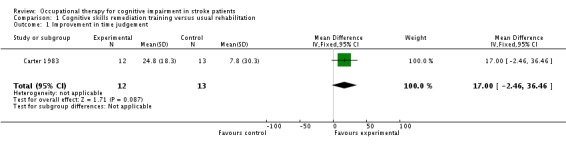
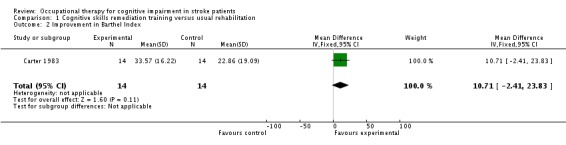
Main results: We included one trial with 33 participants in this review. We found no difference between groups for the two relevant outcomes that were measured: improvement in time judgement skills and improvement in basic ADLs on the Barthel Index.
Authors' conclusions: The effectiveness of occupational therapy for cognitive impairment post-stroke remains unclear. The potential benefits of cognitive retraining delivered as part of occupational therapy on improving basic daily activity function or specific cognitive abilities, or both, of people who have had a stroke cannot be supported or refuted by the evidence included in this review. More research is required.
Conflict of interest statement
None known. Fourth author, Kryss McKenna, deceased: refer to published protocol for previous listed interests.
Figures
Republished in
-
The Cochrane review of occupational therapy for cognitive impairment in stroke patients.Eur J Phys Rehabil Med. 2011 Sep;47(3):513-9. Epub 2011 Apr 14. Eur J Phys Rehabil Med. 2011. PMID: 21494221
References
References to studies included in this review
-
- Carter LT, Howard BE, O'Neill WA. Effectiveness of cognitive skills remediation in acute stroke patients. American Journal of Occupational Therapy 1983;37(5):320‐6. - PubMed
- Carter LT, Oliveira DO, Duponte J, Lynch SV. The relationship of cognitive skills performance to activity of daily living in stroke patients. American Journal of Occupational Therapy 1988;42(7):449‐55. - PubMed
References to studies excluded from this review
-
- Boiko EA, Kulishova TV, Shumakher GI, Iusupkhodzhaev RV. [The role of physical exercises in the improvement of cognitive functions in patients who survived stroke, in the early rehabilitative period]. Voprosy Kurortologii, Fizioterapii i Lechebnoi Fizicheskoi Kultury 2008;6:9‐12. - PubMed
-
- Chen SZ, Jiang Q, Liu P, Huang DF, Ding JX. Effect of the cognitive rehabilitation on the functional independence of hemiplegic patients with stroke. Chinese Journal of Clinical Rehabilitation 2006;10(18):14‐6.
-
- Chen X‐F. Effect of community‐based‐rehabilitation on activities of daily life and cognitive function in stroke patients. Chinese Journal of Clinical Rehabilitation 2006;25(10):4‐6.
-
- Dirette DK, Hinojosa J, Carnevale GJ. Comparison of remedial and compensatory interventions for adults with acquired brain injuries. Journal of Head Trauma Rehabilitation 1999;14(6):595‐601. - PubMed
-
- Donkervoort M, Dekker J, Stehmann‐Saris FC, Deelman BG. Efficacy of strategy training in left hemisphere stroke patients with apraxia: a randomised clinical trial. Neuropsychological Rehabilitation 2001;11(5):549‐66.
References to ongoing studies
-
- Dressing Rehabilitation Evaluation Stroke Study (DRESS). Ongoing study 1 March 2008.
Additional references
-
- Abreu BC, Toglia JP. Cognitive rehabilitation: a model for occupational therapy. American Journal of Occupational Therapy 1987;41(7):439‐48. - PubMed
-
- Blake H, Lincoln NB. Cognitive impairments following a stroke: the strain on caregivers. British Journal of Therapy and Rehabilitation 2002;9:334‐7.
-
- Blundon G, Smits E. Cognitive rehabilitation: a pilot survey of therapeutic modalities used by Canadian occupational therapists with survivors of traumatic brain injury. Canadian Journal of Occupational Therapy 2000;67(3):184‐96. - PubMed
-
- Carter LT, Caruso JL, Languirand MA, Berard MA. Cognitive skills remediation in stroke and non‐stroke elderly. Clinical Neuropsychology 1980;2(3):109‐13.
-
- Centers for Disease Control and Prevention. Public health and aging: hospitalizations for stroke among adults aged > 65 years ‐ United States, 2000. JAMA 2003;290(8):1023‐4.
Publication types
MeSH terms
LinkOut - more resources
Full Text Sources
Medical
Miscellaneous
