. 2010 Nov;84(22):12048-57.
doi: 10.1128/JVI.01063-10. Epub 2010 Sep 8.

Infectivity of hepatitis C virus is influenced by association with apolipoprotein E isoforms

Affiliations

Infectivity of hepatitis C virus is influenced by association with apolipoprotein E isoforms

Takayuki Hishiki et al. J Virol. 2010 Nov.

Abstract

Hepatitis C virus (HCV) is a causative agent of chronic hepatitis, liver cirrhosis, and hepatocellular carcinoma. HCV in circulating blood associates with lipoproteins such as very low density lipoprotein (VLDL) and low-density lipoprotein (LDL). Although these associations suggest that lipoproteins are important for HCV infectivity, the roles of lipoproteins in HCV production and infectivity are not fully understood. To clarify the roles of lipoprotein in the HCV life cycle, we analyzed the effect of apolipoprotein E (ApoE), a component of lipoprotein, on virus production and infectivity. The production of infectious HCV was significantly reduced by the knockdown of ApoE. When an ApoE mutant that fails to be secreted into the culture medium was used, the amount of infectious HCV in the culture medium was dramatically reduced; the infectious HCV accumulated inside these cells, suggesting that infectious HCV must associate with ApoE prior to virus release. We performed rescue experiments in which ApoE isoforms were ectopically expressed in cells depleted of endogenous ApoE. The ectopic expression of the ApoE2 isoform, which has low affinity for the LDL receptor (LDLR), resulted in poor recovery of infectious HCV, whereas the expression of other isoforms, ApoE3 and ApoE4, rescued the production of infectious virus, raising it to an almost normal level. Furthermore, we found that the infectivity of HCV required both the LDLR and scavenger receptor class B, member I (SR-BI), ligands for ApoE. These findings indicate that ApoE is an essential apolipoprotein for HCV infectivity.


Figures
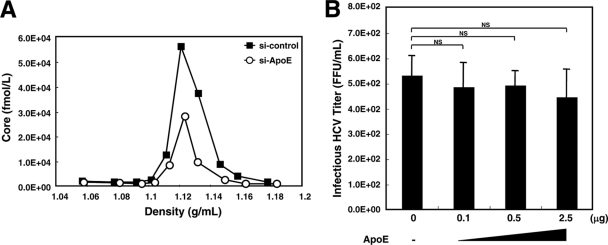
FIG. 1.
FIG. 1.
Nature of HCV produced from ApoE knockdown HuH7.5 cells. (A) Buoyant density analysis. HuH7.5 cells were seeded onto 60-mm-diameter dishes. Cells were transfected with siRNA (si-control or si-ApoE). Four hours after transfection, cells were infected with HCVcc. Forty-eight hours after inoculation, the concentrated culture medium was fractionated using 14 to 54% iodixanol density gradient centrifugation at 36,000 rpm for 16 h at 4°C. The buoyant density profile is represented by the amount of core protein (in femtomoles per liter) in each fraction. Data from a representative of three experiments are shown. (B) Analysis of the infectivity of HCVcc produced from ApoE knockdown HuH7.5 cells after incubation with recombinant ApoE. HCVcc from cells in which ApoE expression was silenced was incubated alone or with different doses of human recombinant ApoE3 at 37°C for 2 h. Then the reaction mixtures were inoculated into naïve HuH7.5 cells. Forty-eight hours after infection, titers of infectious HCV were quantified by a focus-forming unit assay. The average values for three independent experiments are shown; error bars, standard deviations of the means. P values were determined by comparison (by Student's t test) with HCVcc that was not treated with recombinant ApoE3. NS, not significant (P > 0.05).
FIG. 2.
FIG. 2.
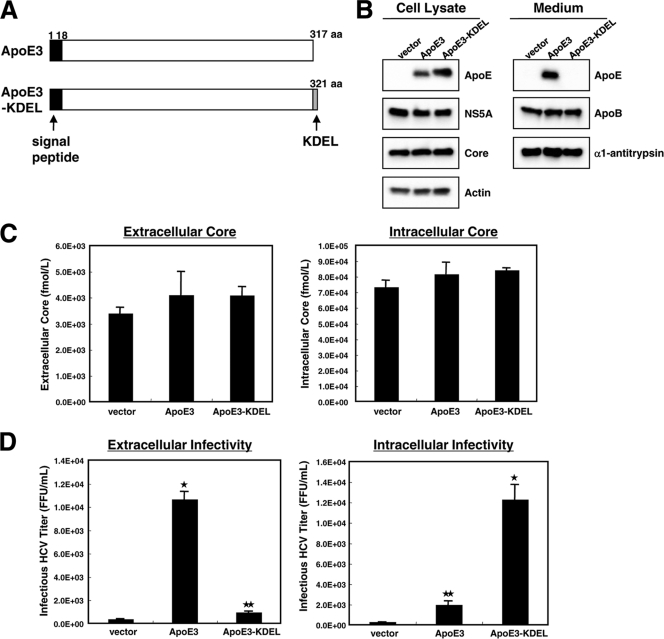
The release of infectious HCV into the culture medium depends on the secretion of ApoE. (A) Schematic representation of ApoE3 and the ApoE3-KDEL mutant. (B) Verification of the expression of ectopic ApoE3 and ApoE3-KDEL. The sh-#3 cells were seeded onto 100-mm-diameter dishes. Cells were transfected with either pCAG (vector), pCAG-ApoE3 (ApoE3), or pCAG-ApoE3-KDEL (ApoE3-KDEL). Four hours after transfection, cells were inoculated with JFH1. Forty-eight hours after inoculation, cell lysates and supernatants were analyzed for the production of ApoE and its mutant by Western blotting with anti-ApoE antibodies. The expression of actin, α1-antitrypsin, ApoB, core, and NS5A was also examined. (C) The amounts of core in the culture supernatant and intracellular fractions were determined by a core-specific ELISA. The cells and transfections were the same as for panel B. (D) Analysis of HCV infectivity. The culture medium or cell lysate was inoculated into naïve HuH7.5 cells. The titers of infectious HCV were quantified by focus-forming unit assays. The average values for three independent experiments are shown; error bars, standard deviations of the means. The cells and transfections were the same as for panel B. P values were determined by comparison (by Student's t test) with cells expressing the control vector. *, P < 0.0005; **, P < 0.005.
FIG. 3.
FIG. 3.
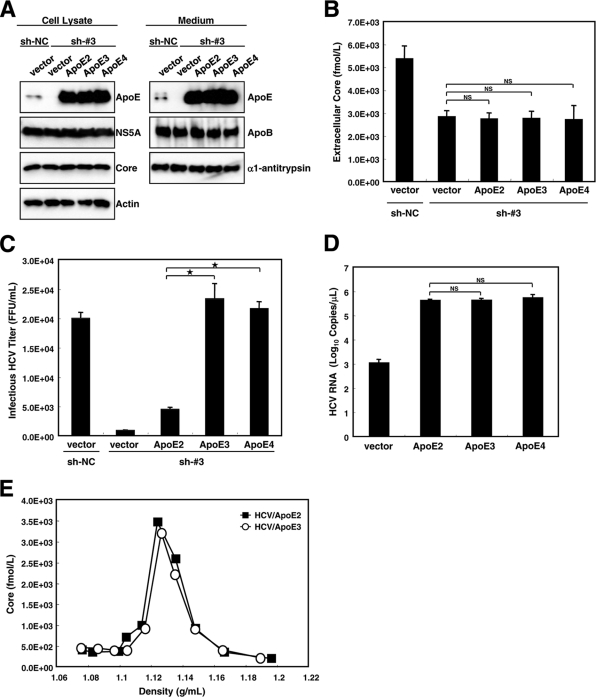
ApoE isoforms affect HCV infectivity. (A) Verification of expression of ectopically introduced ApoE and the effect of ApoE isoforms on HCV genome replication. sh-NC cells and sh-#3 cells were seeded onto 60-mm-diameter dishes. Cells were transfected with either pCAG (vector), pCAG-ApoE2 (ApoE2), pCAG-ApoE3 (ApoE3), or pCAG-ApoE4 (ApoE4). Four hours after transfection, cells were inoculated with JFH1. Forty-eight hours after inoculation, the expression of ApoE, ApoB, NS5A, core, actin, and α1-antitrypsin in cell lysates and/or supernatants was analyzed by Western blotting using relevant antibodies. (B) The release of HCV core into the culture supernatant by cells expressing different ApoE isoforms was measured by a core-specific ELISA. The cells and transfections in panels B to D were the same as those in panel A. P values were determined by comparison (by Student's t test) with HCVcc from sh-#3 cells expressing the control vector. NS, not significant (P > 0.05). (C) Amount of infectious HCV that egressed from HCV-infected cells. Culture media of the indicated cells were inoculated into naïve HuH7.5 cells. Forty-eight hours after infection, naïve HuH7.5 cells were infected with the supernatant. Forty-eight hours after infection, the titers of infectious HCV were quantified by a focus-forming unit assay. P values were determined by comparison (by Student's t test) with HCVcc from sh-#3 cells expressing ApoE2. *, P < 0.0005. (D) Association of HCV with ApoE isoforms. HCV released into the culture medium from cells bearing each ApoE isoform was incubated with an anti-HA antibody. RNA was extracted from the immunoprecipitant and subjected to quantification by quantitative RT-PCR. P values were determined by comparison (by Student's t test) with HCVcc from sh-#3 cells expressing ApoE2. NS, not significant (P > 0.05). (E) Density gradient analysis of HCVcc containing ApoE2 or ApoE3. Concentrated HCVcc from cells expressing ApoE2 or ApoE3 was fractionated using 14 to 54% iodixanol density gradient centrifugation at 36,000 rpm for 16 h at 4°C. The buoyant density profile is represented by measuring the amount of core protein (in femtomoles per liter). HCV/ApoE3, HCV bearing ApoE3; HCV/ApoE2, HCV bearing ApoE2. Data from a representative of three experiments are shown.
FIG. 4.
FIG. 4.
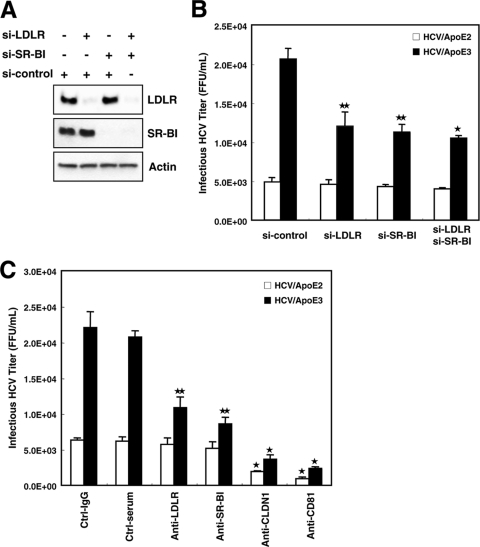
Suppression of LDLR and SR-BI results in reduced HCV infection. (A) Knockdown of the LDLR and SR-BI by siRNA. HuH7.5 cells were seeded onto 24-well plates and transfected with siRNA (si-control, si-LDLR, and/or si-SR-BI). Twenty-four hours after transfection, cell lysates were analyzed for the expression of the LDLR, SR-BI, and actin by Western blotting. (B) Analysis of HCV infectivity for HuH7.5 cells in which either the LDLR, SR-BI, or both were silenced. Cells were transfected with siRNA (si-control, si-LDLR, and/or si-SR-BI). Twenty-four hours after transfection, HCVcc produced from cells bearing ApoE2 (open bars) or ApoE3 (filled bars) was serially diluted and inoculated. Forty-eight hours after infection, infected cells were counted by fluorescence microscopy after staining with an anti-NS5A antibody. HCV/ApoE3, HCV bearing ApoE3; HCV/ApoE2, HCV bearing ApoE2. P values were determined by comparison (by Student's t test) with si-control-treated cells. *, P < 0.0005; **, P < 0.005. (C) HuH7.5 cells were preincubated with control goat IgG (Ctrl-IgG), control rat preimmune serum (Ctrl-serum), or a goat anti-LDLR, rat anti-SR-BI, rat anti-claudin 1 (anti-CLDN1), or mouse anti-CD81 antibody for 1 h at 37°C before infection with serially diluted HCVcc from HuH7.5 cells expressing ApoE2 (open bars) or ApoE3 (filled bars). Forty-eight hours after infection, infected cells were stained with anti-NS5A antibodies and counted by fluorescence microscopy. The average values for three independent experiments are shown; error bars, standard deviations of the means. P values were determined by comparison (by Student's t test) against cells treated with preimmune serum. *, P < 0.0005; **, P < 0.005.

References

    1. André, P., F. Komurian-Pradel, S. Deforges, M. Perret, J. L. Berland, M. Sodoyer, S. Pol, C. Brechot, G. Paranhos-Baccala, and V. Lotteau. 2002. Characterization of low- and very-low-density hepatitis C virus RNA-containing particles. J. Virol. 76:6919-6928. - PMC - PubMed
    1. Appel, N., M. Zayas, S. Miller, J. Krijnse-Locker, T. Schaller, P. Friebe, S. Kallis, U. Engel, and R. Bartenschlager. 2008. Essential role of domain III of nonstructural protein 5A for hepatitis C virus infectious particle assembly. PLoS Pathog. 4:e1000035. - PMC - PubMed
    1. Bartosch, B., A. Vitelli, C. Granier, C. Goujon, J. Dubuisson, S. Pascale, E. Scarselli, R. Cortese, A. Nicosia, and F. L. Cosset. 2003. Cell entry of hepatitis C virus requires a set of co-receptors that include the CD81 tetraspanin and the SR-B1 scavenger receptor. J. Biol. Chem. 278:41624-41630. - PubMed
    1. Benga, W. J., S. E. Krieger, M. Dimitrova, M. B. Zeisel, M. Parnot, J. Lupberger, E. Hildt, G. Luo, J. McLauchlan, T. F. Baumert, and C. Schuster. 2010. Apolipoprotein E interacts with hepatitis C virus nonstructural protein 5A and determines assembly of infectious particles. Hepatology 51:43-53. - PubMed
    1. Blasiole, D. A., R. A. Davis, and A. D. Attie. 2007. The physiological and molecular regulation of lipoprotein assembly and secretion. Mol. Biosyst. 3:608-619. - PubMed

Publication types