


Successful treatment of EBV-associated posttransplantation lymphoma after cord blood transplantation using third-party EBV-specific cytotoxic T lymphocytes
- PMID: 20826724
- PMCID: PMC3012598
- DOI: 10.1182/blood-2010-04-281873
Successful treatment of EBV-associated posttransplantation lymphoma after cord blood transplantation using third-party EBV-specific cytotoxic T lymphocytes
Abstract
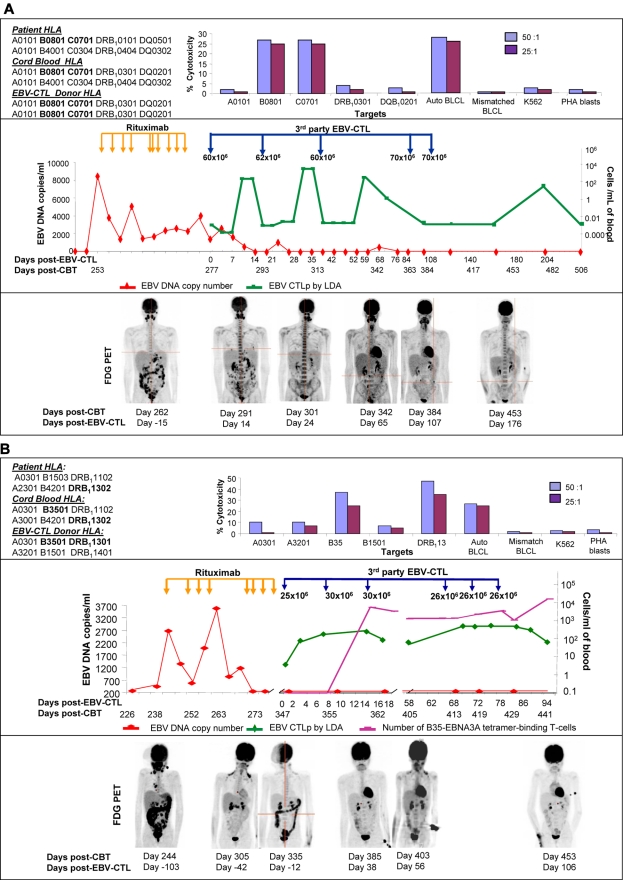
Cellular therapy of Epstein-Barr virus (EBV)(+) posttransplantation lymphoproliferative diseases (PTLD) in cord blood transplant (CBT) recipients is limited by lack of donor access and the donor's naive neonatal immune system. We therefore used partially human leukocyte antigen-matched third-party in vitro expanded EBV-specific cytotoxic T lymphocytes (CTLs) to treat 2 CBT recipients with life-threatening, donor-derived monoclonal EBV(+) diffuse large B-cell lymphomas with extranodal involvement developing in the context of graft-versus-host disease. Both patients had failed immunosuppression taper and Rituximab. After 5 and 9 infusions of 10(6) EBV-CTL/kg, respectively, each patient achieved a sustained complete remission without toxicity or graft-versus-host disease. Each is alive without recurrence at 20 and 15 months, respectively, post-EBV-PTLD diagnosis. This approach demonstrates the efficacy of using "off-the-shelf," virus-specific third-party CTLs restricted by human leukocyte antigens expressed by the tumor to treat otherwise lethal EBV-PTLD. Such therapy may also be applicable to the treatment of other infections and residual or recurrent malignancy after CBT.
Figures
Comment in
-
Off-the-shelf T-cell therapy.Blood. 2010 Dec 2;116(23):4741-3. doi: 10.1182/blood-2010-10-308379. Blood. 2010. PMID: 21127184 No abstract available.
References
-
- Barker JN, Martin PL, Coad JE, et al. Low incidence of Epstein-Barr virus-associated posttransplantation lymphoproliferative disorders in 272 unrelated-donor umbilical cord blood transplant recipients. Biol Blood Marrow Transplant. 2001;7(7):395–399. - PubMed
-
- Weinstock DM, Ambrossi GG, Brennan C, Kiehn TE, Jakubowski A. Preemptive diagnosis and treatment of Epstein-Barr virus-associated post transplant lymphoproliferative disorder after hematopoietic stem cell transplant: an approach in development. Bone Marrow Transplant. 2006;37(6):539–546. - PubMed
-
- Blaes AH, Cao Q, Wagner JE, Young JA, Weisdorf DJ, Brunstein CG. Monitoring and preemptive rituximab therapy for Epstein-Barr virus reactivation after antithymocyte globulin containing nonmyeloablative conditioning for umbilical cord blood transplantation. Biol Blood Marrow Transplant. 2010;16(2):287–291. - PMC - PubMed
-
- Koehne G, Smith KM, Ferguson TL, et al. Quantitation, selection, and functional characterization of Epstein-Barr virus-specific and alloreactive T cells detected by intracellular interferon-gamma production and growth of cytotoxic precursors. Blood. 2002;99(5):1730–1740. - PubMed
Publication types
MeSH terms
Substances
Grants and funding
LinkOut - more resources
Full Text Sources
Other Literature Sources
