. 2010 Nov 12;285(46):35567-77.
doi: 10.1074/jbc.M110.146845. Epub 2010 Sep 8.

An interdomain interaction of the androgen receptor is required for its aggregation and toxicity in spinal and bulbar muscular atrophy

Affiliations

An interdomain interaction of the androgen receptor is required for its aggregation and toxicity in spinal and bulbar muscular atrophy

Christopher R Orr et al. J Biol Chem. .

Abstract

Polyglutamine expansion within the androgen receptor (AR) causes spinal and bulbar muscular atrophy (SBMA) and is associated with misfolded and aggregated species of the mutant AR. We showed previously that nuclear localization of the mutant AR was necessary but not sufficient for SBMA. Here we show that an interdomain interaction of the AR that is central to its function within the nucleus is required for AR aggregation and toxicity. Ligands that prevent the interaction between the amino-terminal FXXLF motif and carboxyl-terminal AF-2 domain (N/C interaction) prevented toxicity and AR aggregation in an SBMA cell model and rescued primary SBMA motor neurons from 5α-dihydrotestosterone-induced toxicity. Moreover, genetic mutation of the FXXLF motif prevented AR aggregation and 5α-dihydrotestosterone toxicity. Finally, selective androgen receptor modulators, which prevent the N/C interaction, ameliorated AR aggregation and toxicity while maintaining AR function, highlighting a novel therapeutic strategy to prevent the SBMA phenotype while retaining AR transcriptional function.


Figures
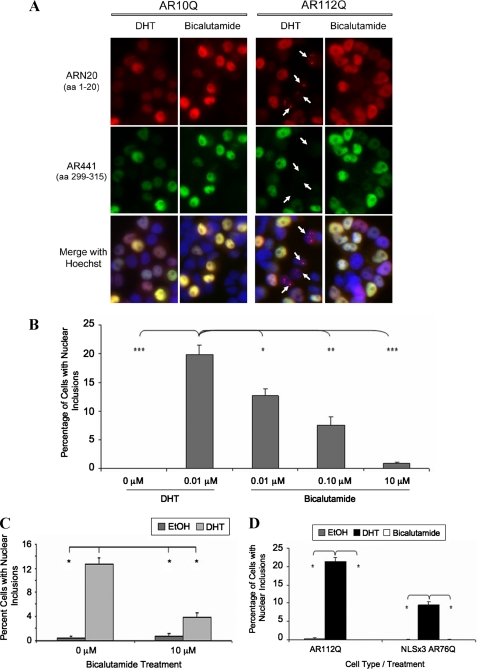
FIGURE 1.
FIGURE 1.
Bicalutamide prevents nuclear inclusions in a cell model of SBMA. Stably transfected PC12 cells were induced with 10 ng/ml doxycycline to express AR10Q or AR112Q for 96 h. Cells were treated with EtOH, 0.01 μm DHT, or 0.01, 0.1, or 10 μm bicalutamide. A, cells were fixed and immunostained with an antibody to the amino terminus of AR (AR-N20), an antibody (AR-441) detecting a more internal epitope of AR (amino acids 299–315), and Hoechst to reveal nuclei. Panels depict cells treated with 0.01 μm DHT or 10 μm bicalutamide. B, 1000 cells were counted for each treatment, in triplicate. The number of cells with ARN20-staining inclusions was averaged, expressed as a percentage of total cells, and graphed. One-way ANOVA was performed (***, p < 0.001; **, p < 0.01; *, p < 0.05). C, AR112Q cells were treated alone or in combination with EtOH, 0.01 μm DHT, and 10 μm bicalutamide for 96 h. Inclusions were counted as in B. One-way ANOVA was performed: *, p < 0.001. These findings are representative of three independent experiments. D, bicalutamide does not induce inclusions of a constitutively nuclear expanded polyQ-AR. AR112Q or NLSx3-AR76Q-expressing cells were treated for 48 h with EtOH, 0.01 mm DHT, or 10 mm bicalutamide. Over 1000 cells were counted/well, and the percentage of cells containing inclusions was averaged and graphed. One-way ANOVA was performed (*, p < 0.001).
FIGURE 2.
FIGURE 2.
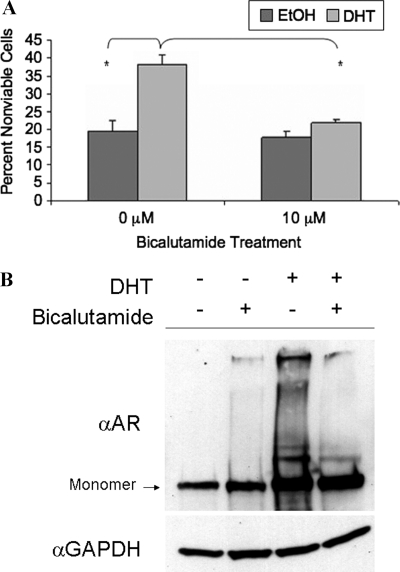
Bicalutamide prevents DHT-induced toxicity in an SBMA cell model. A, stably transfected PC12 cells were induced with 500 ng/ml doxycycline to express AR112Q for 12 days. Cells were treated with EtOH, 0.01 μm DHT, 10 μm bicalutamide, or bicalutamide in the presence of DHT. Cells were harvested and stained with trypan blue, and at least 300 cells were counted in triplicate. Two-way ANOVA was performed (*, p < 0.001). B, Western analysis was performed on protein lysates of AR112Q induced with 500 ng/ml doxycycline and treated with EtOH or 0.01 μm DHT in the presence or absence of 10 μm bicalutamide for 48 h. Comparable results were obtained from cells treated for 12 days (data not shown).
FIGURE 3.
FIGURE 3.
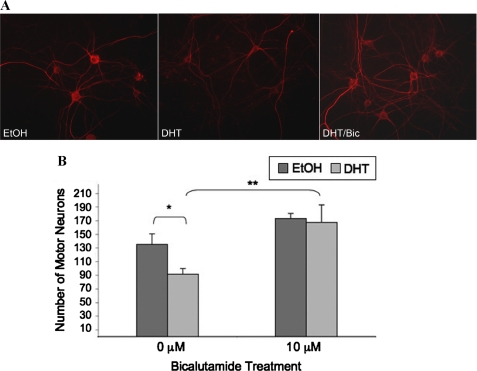
Bicalutamide prevents DHT-induced toxicity in primary motor neuron cultures of SBMA mice. After 3 weeks of differentiation, dissociated spinal cord cultures were treated for 7 days with EtOH or 10 μm DHT in the presence or absence of 10 μm bicalutamide (Bic). A, cells were fixed and immunostained with the antibody SMI-32 (unphosphorylated neurofilament heavy chain) and then stained with Hoechst. B, counts were obtained from 10 random fields at ×20 under a Leica microscope from three separate wells of each treatment of motor neurons and then graphed. Two-way ANOVA was performed with post-hoc Tukey test (*, p < 0.001).
FIGURE 4.
FIGURE 4.
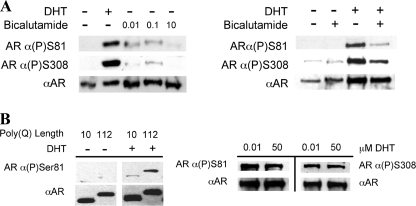
Bicalutamide and polyQ length alter phosphorylation of AR. A, left, Western analysis was performed on protein lysates obtained from AR112Q-expressing cells treated in the presence or absence of 0.01 μm DHT or 0.01, 0.1, or 10 μm bicalutamide. Protein lysates were loaded to achieve equivalent AR levels. Right, bicalutamide reduced phosphorylation of Ser-81 and Ser-308 even in the presence of DHT. B, left, Western analysis was performed on protein lysates obtained from AR10Q- and AR112Q-expressing cells treated with EtOH or 50 μm DHT. The panels of AR10Q and AR112Q came from the same Western blot. Right, the Ser-81 phosphorylation state of the AR was unaffected by DHT concentration. Western analysis was performed on protein lysates obtained from AR112Q-expressing cells treated in the presence of either 0.01 or 50 μm DHT for 96 h. The membranes were probed with antibodies for phosphorylated Ser-81 (AR α(P)Ser81) or phosphorylated Ser-308 (ARα(P)Ser308) and pan-AR (α-AR) (AR-H280 (A) or AR-N20 (B)).
FIGURE 5.
FIGURE 5.
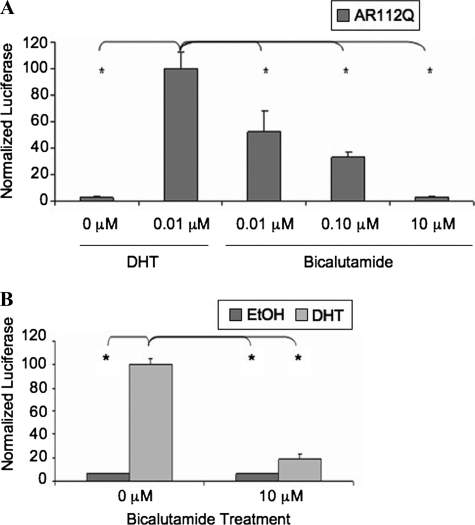
Bicalutamide prevents the N/C interaction of polyQ-expanded AR. Mammalian two-hybrid assay was performed by transfecting HEK293 cells with the N-terminal AR111Q (amino acids 12–660) fused to a VP16 activation domain, the C-terminal AR (amino acids 624–919) fused to the Gal4 DNA-binding domain, the Gal4-luciferase reporter, and the Renilla-luciferase transfection control plasmid. Dual-luciferase activity was determined from cell lysates. A, cells were treated in triplicate with EtOH, 0.01 μm DHT, or increasing amounts of bicalutamide (0.01, 0.1, or 10 μm) for 48 h. The values obtained from the ratios of Gal4-Luc/Renilla-Luc were normalized to the value of DHT-treated AR111Q set to 100. One-way ANOVA was performed (*, p < 0.001). The findings are representative of three independent experiments. B, cells were treated with EtOH or 0.01 μm DHT alone or in combination with 10 μm bicalutamide for 48 h. The values obtained from the ratios of Gal4-Luc/Renilla-Luc were normalized to the value of DHT-treated AR111Q set to 100. One-way ANOVA was performed (*, p < 0.001). The findings are representative of three independent experiments.
FIGURE 6.
FIGURE 6.
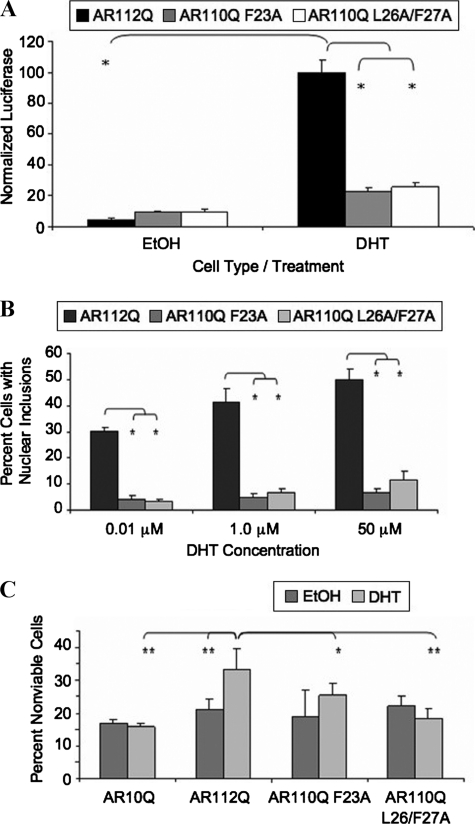
Mutation of the FXXLF motif of AR polyQ-expanded AR prevents the N/C interaction, nuclear inclusions, and toxicity in an SBMA cell model. A, mammalian two-hybrid assay was performed as described in the legend for Fig. 5, including the AR111Q-F23A or ARQ111-L26A/F27A mutant fused to a VP16 activation domain. Student's t test was performed (*, p < 0.01). B, stably transfected PC12 cells were induced to express equivalent levels of AR10Q, AR112Q, AR110Q-F23A, or AR110Q-L26A/F27A. Cells were treated with increasing amounts of DHT (0.01, 1.0, and 50 μm) for 48 h, fixed, and immunostained as in Fig. 1A. Over 1000 cells were counted, and the percentage of cells containing nuclear inclusions graphed. Student's t test was performed (*, p < 0.02). C, toxicity was assessed as in Fig. 2A. Two-way ANOVA was performed (**, p < 0.001;*, p < 0.01). The findings are representative of three independent experiments.
FIGURE 7.
FIGURE 7.
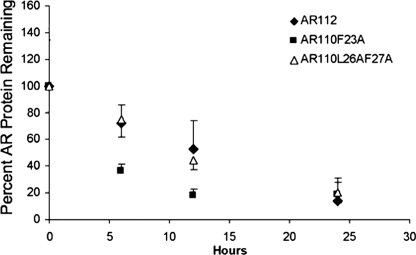
Effect of FXXLF mutation on AR protein half-life. Stably transfected PC12 cells were induced to express equivalent levels of AR112Q, AR110Q-F23A, or AR110Q-L26A/F27A for 48 h. After 48 h of doxycycline induction and EtOH or 0.01 μm DHT treatment, the cells were washed with PBS to remove doxycycline, and 30 μg/ml cycloheximide with EtOH or DHT was added. Cells were harvested at various time points, and Western analysis was performed on protein lysates. Blots were probed with pan-AR (AR-H280) and GAPDH antibodies. Densitometry was performed on the film, and the ratio of AR/GAPDH was graphed for each cell line. The findings are representative of three independent experiments.
FIGURE 8.
FIGURE 8.
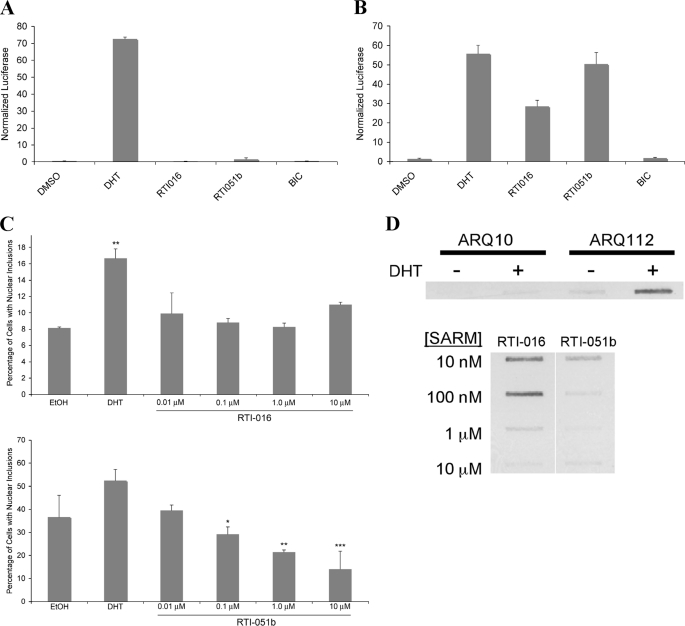
SARMs that do not reduce the AR N/C interaction but promote AR transcriptional activity fail to induce aggregation of expanded polyQ AR in an SBMA cell model. A and B, HepG2 cells were transfected with plasmids for mammalian two-hybrid analysis (A) and transcriptional activity (B). For AR mammalian two-hybrid assays, the DNA transfected into the cells consisted of pcDNA-AR1-660, VP16-AR507-919, MMTV-Luc, and pCMV-βGal. For AR transcriptional assay, the DNA consisted of pSG5-AR, MMTV-Luc, and pCMV-βGal. Cells were treated with hormone for 48 hr, lysed, and firefly luciferase (reporter) and β-galactosidase (transfection normalization) assays performed. C and D, stably- transfected PC12 cells were induced with 1 μg/ml of doxycycline to express AR112Q for 48 hr. Cells were treated with EtOH, DHT (50 μm) or various concentrations of RTI-016 and RTI-051b. C, cells were fixed and immunostained with an antibody to the N terminus of AR (AR-H280), an antibody (AR-441) detecting a more internal epitope of AR (amino acids 299-315), and Hoechst. One thousand cells were counted for each treatment in triplicate. The number of ARN20-staining inclusions was averaged, expressed as a percentage of total cells, and graphed. Student's t test was performed. * = p < 0.05; ** = p < 0.01; *** = p < .005. D, insoluble androgen receptor protein was detected using filter trap analysis. Protein lysates of treated cells were pulled by vaccum through cellulose acetate. The membrane was probed with an antibody for the N terminus of AR (AR-H280).
FIGURE 9.
FIGURE 9.
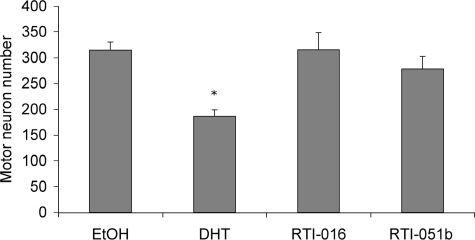
SARMs fail to induce toxicity in primary motor neurons of SBMA mice. After 3 weeks of differentiation, dissociated spinal cord cultures were treated for 7 days with EtOH, DHT, RTI-016, or RTI-051b. Ligands were used at 10 μm concentration. Counts were obtained from analysis using 200× magnification of 10 random fields from three separate wells of each treatment of motor neurons. One-way ANOVA/post-hoc Tukey test was performed (*, p < 0.001, compared with all other conditions).
FIGURE 10.
FIGURE 10.
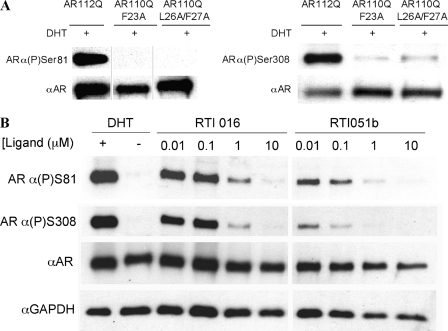
Disruption of the AR N/C interaction prevents phosphorylation of serine 81 and serine 308. A, Western analysis was performed on cell lysates from stably transfected PC12 cells induced to express equivalent levels of AR112Q, AR110Q-F23A, and AR110Q-L26A/F27A and treated with EtOH or 0.01 μm DHT for 48 h. Membranes were probed with antibodies against phosphorylated Ser-81 (ARα(P)Ser81) (left) or phosphorylated Ser-308 (ARα(P)Ser308) (right). Note that the lanes on each Western blot are from the same blot; those shown on the left are noncontiguous. Membranes were reprobed for pan-AR (AR-N20 or AR-H280) and GAPDH (not shown). B, AR112Q cells were treated with EtOH, 0.01 μm DHT, 0.01, 0.1, 1, or 10 μm RTI-016, or RTI-051b for 48 h. Cell lysates were probed with antibodies detecting AR(P)Ser81, AR(P)Ser308, pan-AR (AR-H280), and GAPDH.

References

    1. Kennedy W. R., Alter M., Sung J. H. (1968) Neurology 18, 671–680 - PubMed
    1. La Spada A. R., Wilson E. M., Lubahn D. B., Harding A. E., Fischbeck K. H. (1991) Nature 353, 77–79 - PubMed
    1. Pinsky L., Trifiro M., Kaufman M., Beitel L. K., Mhatre A., Kazemi-Esfarjani P., Sabbaghian N., Lumbroso R., Alvarado C., Vasiliou M., et al. (1992) Clin. Invest. Med. 15, 456–472 - PubMed
    1. Merry D. E., Kobayashi Y., Bailey C. K., Taye A. A., Fischbeck K. H. (1998) Hum. Mol. Genet. 7, 693–701 - PubMed
    1. Li M., Miwa S., Kobayashi Y., Merry D. E., Yamamoto M., Tanaka F., Doyu M., Hashizume Y., Fischbeck K. H., Sobue G. (1998) Ann. Neurol. 44, 249–254 - PubMed

Publication types

MeSH terms