


Prevention of bone resorption by intake of phytoestrogens in postmenopausal women: a meta-analysis
- PMID: 20827510
- PMCID: PMC3168592
- DOI: 10.1007/s11357-010-9180-6
Prevention of bone resorption by intake of phytoestrogens in postmenopausal women: a meta-analysis
Abstract
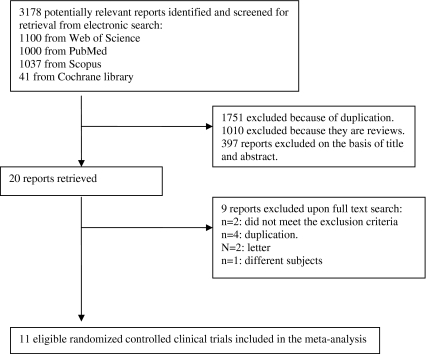
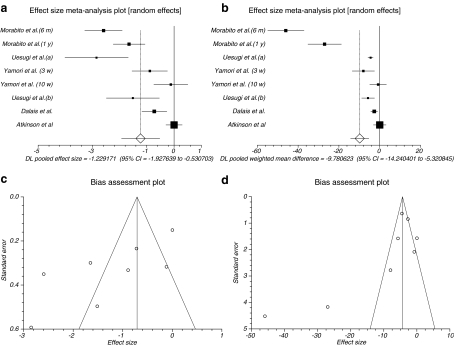
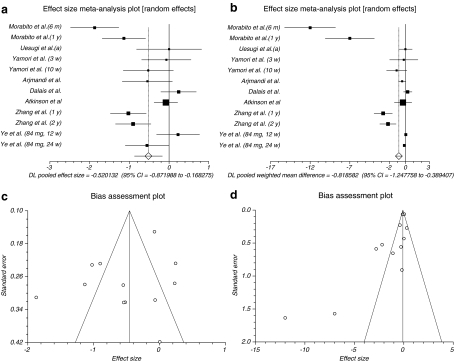
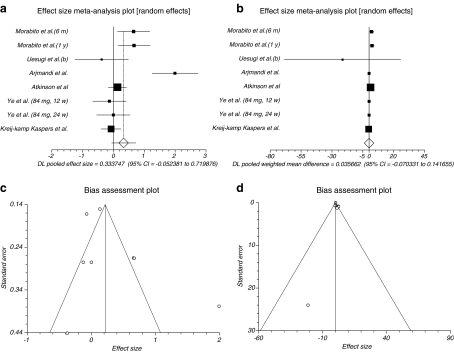
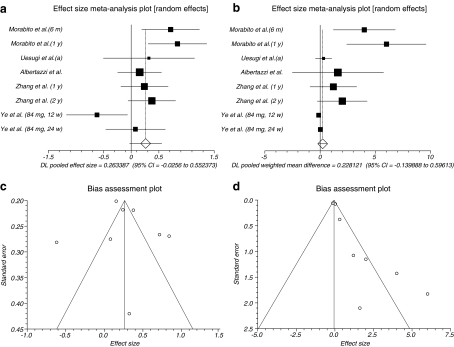
Phytoestrogens as selective estrogen receptor modulators like compounds may consider as a therapeutic option in osteoporosis. In this regard, the effect of phytoestrogens on bone biomarkers was examined in several trials which their results are controversial. We aimed this meta-analysis to evaluate the net effect of phytoestrogens on bone markers. A thorough search was conducted from 2000 to 2010 in English articles. All randomized clinical trials were reviewed, and finally, 11 eligible randomized clinical trials were selected for meta-analysis. Totally 1,252 postmenopausal women were enrolled in the study by considering the changes of pyridinoline (Pyd), desoxypyridinoline (Dpyd), bone alkaline phosphatase, and osteocalcin concentrations in urine and serum after phytoestrogens consumption. The urine Pyd and Dpyd levels decreased significantly in phytoestrogens consumers. Effect size and effect size for weighted mean difference of urine Pyd levels showed -1.229171 (95% confidence interval (CI) = -1.927639 to -0.530703) and -9.780623 (95% CI = -14.240401 to -5.320845), respectively, a significant results in comparison to control group and significant results for Dpyd -0.520132 (95% CI = -0.871988 to -0.168275) and -0.818582 (95% CI = -1.247758 to -0.389407), respectively. Meta-analysis indicates that phytoestrogens intake can prevent bone resorption, but its benefits on bone formation are not significant. This favorable effect was observed in low doses and in at least 3 weeks of phytoestrogens intake.
Figures
Similar articles
-
Management of postmenopausal osteoporosis and the prevention of fractures.Panminerva Med. 2014 Jun;56(2):115-31. Epub 2014 Jun 19. Panminerva Med. 2014. PMID: 24942322
-
Antiresorptive effects of phytoestrogen supplements compared with estradiol or risedronate in postmenopausal women using (41)Ca methodology.J Clin Endocrinol Metab. 2009 Oct;94(10):3798-805. doi: 10.1210/jc.2009-0332. Epub 2009 Jul 7. J Clin Endocrinol Metab. 2009. PMID: 19584189 Free PMC article. Clinical Trial.
-
Soy isoflavone intake inhibits bone resorption and stimulates bone formation in menopausal women: meta-analysis of randomized controlled trials.Eur J Clin Nutr. 2008 Feb;62(2):155-61. doi: 10.1038/sj.ejcn.1602748. Epub 2007 Mar 28. Eur J Clin Nutr. 2008. PMID: 17392695
-
Soy isoflavones prevent bone resorption and loss, a systematic review and meta-analysis of randomized controlled trials.Crit Rev Food Sci Nutr. 2020;60(14):2327-2341. doi: 10.1080/10408398.2019.1635078. Epub 2019 Jul 10. Crit Rev Food Sci Nutr. 2020. PMID: 31290343
-
Genistein aglycone: a dual mode of action anti-osteoporotic soy isoflavone rebalancing bone turnover towards bone formation.Curr Med Chem. 2010;17(27):3007-18. doi: 10.2174/092986710791959738. Curr Med Chem. 2010. PMID: 20629630 Review.
Cited by
-
New horizons in treatment of osteoporosis.Daru. 2017 Feb 7;25(1):2. doi: 10.1186/s40199-017-0167-z. Daru. 2017. PMID: 28173850 Free PMC article. Review.
-
Phytoestrogens in postmenopause: the state of the art from a chemical, pharmacological and regulatory perspective.Curr Med Chem. 2014;21(4):417-36. doi: 10.2174/09298673113206660297. Curr Med Chem. 2014. PMID: 24164197 Free PMC article. Review.
-
Tanshinol attenuates the deleterious effects of oxidative stress on osteoblastic differentiation via Wnt/FoxO3a signaling.Oxid Med Cell Longev. 2013;2013:351895. doi: 10.1155/2013/351895. Epub 2013 Dec 31. Oxid Med Cell Longev. 2013. PMID: 24489983 Free PMC article.
-
Psoralen, a natural phytoestrogen, improves diaphyseal fracture healing in ovariectomized mice: A preliminary study.Exp Ther Med. 2021 Apr;21(4):368. doi: 10.3892/etm.2021.9799. Epub 2021 Feb 19. Exp Ther Med. 2021. PMID: 33732341 Free PMC article.
-
Short-Term Isoflavone Intervention in the Treatment of Severe Vasomotor Symptoms after Surgical Menopause: A Case Report and Literature Review.Case Rep Obstet Gynecol. 2015;2015:962740. doi: 10.1155/2015/962740. Epub 2015 Oct 29. Case Rep Obstet Gynecol. 2015. PMID: 26605099 Free PMC article.
References
-
- Abdollahi M, Larijani B, Rahimi R, Salari P. Role of oxidative stress in osteoporosis. Therapy. 2005;2(5):787–796. doi: 10.2217/14750708.2.5.787. - DOI
-
- Anderson JJ, Ambrose WW, Garner SC. Biphasic effects of genistein on bone tissue in the ovariectomized, lactating rat model. Proc Soc Exp Biol Med. 1998;217:345–350. - PubMed
-
- Anonymous. Prevention and management of osteoporosis. A report of a WHO scientific group 2003. http://whqlibdoc.who.int/trs/WHO_TRS_921.pdf
-
- Arjmandi BH, Khalil DA, Smith BJ, et al. Soy protein has a greater effect on bone in postmenopausal women not on hormone replacement therapy, as evidenced by reducing bone resorption and urinary calcium excretion. J Clin Endocrinol Metab. 2003;88(3):1048–1054. doi: 10.1210/jc.2002-020849. - DOI - PubMed
Publication types
MeSH terms
Substances
LinkOut - more resources
Full Text Sources
Medical