


Zero on the NIHSS does not equal the absence of stroke
- PMID: 20828876
- PMCID: PMC3426834
- DOI: 10.1016/j.annemergmed.2010.06.564
Zero on the NIHSS does not equal the absence of stroke
Abstract
Study objective: The National Institutes of Health Stroke Scale (NIHSS) measures deficits caused by a stroke, but not all stroke signs are captured on the NIHSS. We determine the symptoms and stroke localization of patients with brain infarction and an NIHSS score of 0.
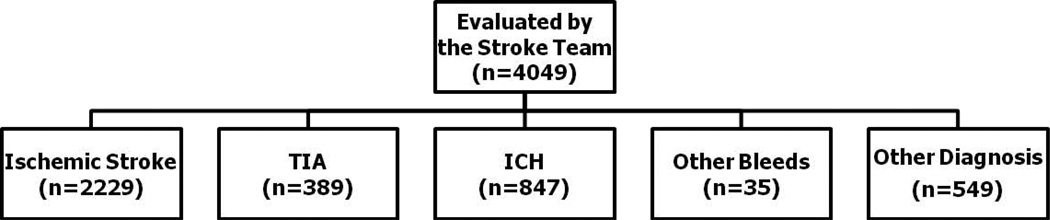
Methods: We studied all patients who presented with acute neurologic symptoms to our stroke center from 2004 to 2008 and had persistent symptoms at the evaluation in the emergency department, an NIHSS score of 0, and an infarct on diffusion-weighted imaging. We characterized the symptoms, signs, lesion location, demographics, and stroke causes.
Results: Twenty patients met inclusion criteria. Symptoms frequently experienced were headache, vertigo, and nausea. The posterior circulation was commonly infarcted in this group. Truncal ataxia was the most common neurologic sign.
Conclusion: Ischemic stroke may cause symptoms that are associated with no deficits on the NIHSS score.
Copyright © 2010 American College of Emergency Physicians. Published by Mosby, Inc. All rights reserved.
Conflict of interest statement
There are no conflicts of interest.
Figures
References
-
- Kasner SE. Clinical interpretation and use of stroke scales. Lancet Neurol. 2006;5:603–612. - PubMed
-
- Lyden P, Brott T, Tilley B, et al. Improved reliability of the NIH stroke scale using video training. NINDS tpa stroke study group. Stroke. 1994;25:2220–2226. - PubMed
-
- Brott T, Adams HP, Jr, Olinger CP, et al. Measurements of acute cerebral infarction: A clinical examination scale. Stroke. 1989;20:864–870. - PubMed
-
- Brott T, Marler JR, Olinger CP, et al. Measurements of acute cerebral infarction: Lesion size by computed tomography. Stroke. 1989;20:871–875. - PubMed
-
- Libman RB, Kwiatkowski TG, Hansen MD, et al. Differences between anterior and posterior circulation stroke in TOAST. Cerebrovasc Dis. 2001;11:311–316. - PubMed
Publication types
MeSH terms
Grants and funding
LinkOut - more resources
Full Text Sources
Medical
Miscellaneous
