


Root-shoot growth responses during interspecific competition quantified using allometric modelling
- PMID: 20829193
- PMCID: PMC2990658
- DOI: 10.1093/aob/mcq186
Root-shoot growth responses during interspecific competition quantified using allometric modelling
Abstract
Background and aims: Plant competition studies are restricted by the difficulty of quantifying root systems of competitors. Analyses are usually limited to above-ground traits. Here, a new approach to address this issue is reported.
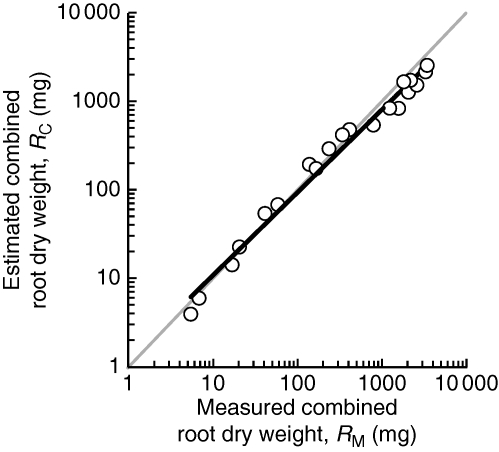
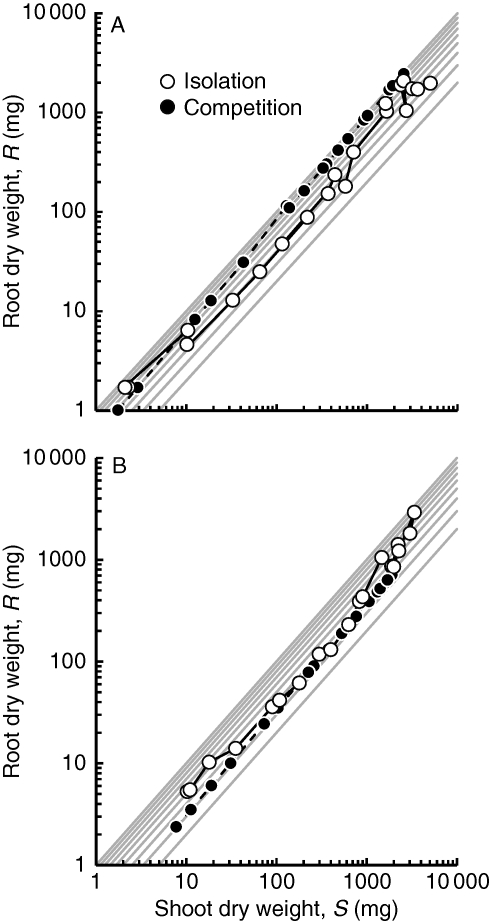
Methods: Root system weights of competing plants can be estimated from: shoot weights of competitors; combined root weights of competitors; and slopes (scaling exponents, α) and intercepts (allometric coefficients, β) of ln-regressions of root weight on shoot weight of isolated plants. If competition induces no change in root : shoot growth, α and β values of competing and isolated plants will be equal. Measured combined root weight of competitors will equal that estimated allometrically from measured shoot weights of each competing plant. Combined root weights can be partitioned directly among competitors. If, as will be more usual, competition changes relative root and shoot growth, the competitors' combined root weight will not equal that estimated allometrically and cannot be partitioned directly. However, if the isolated-plant α and β values are adjusted until the estimated combined root weight of competitors matches the measured combined root weight, the latter can be partitioned among competitors using their new α and β values. The approach is illustrated using two herbaceous species, Dactylis glomerata and Plantago lanceolata.
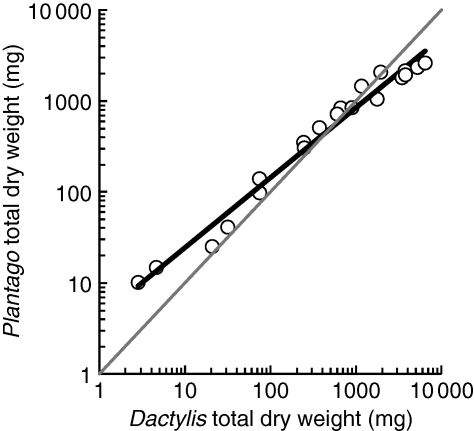
Key results: Allometric modelling revealed a large and continuous increase in the root : shoot ratio by Dactylis, but not Plantago, during competition. This was associated with a superior whole-plant dry weight increase in Dactylis, which was ultimately 2·5-fold greater than that of Plantago. Whole-plant growth dominance of Dactylis over Plantago, as deduced from allometric modelling, occurred 14-24 d earlier than suggested by shoot data alone.
Conclusion: Given reasonable assumptions, allometric modelling can analyse competitive interactions in any species mixture, and overcomes a long-standing problem in studies of competition.
Figures
References
-
- Berendse F, Möller F. Effects of competition on root-shoot allocation in Plantago lanceolata L.: adaptive plasticity or ontogenetic drift? Plant Ecology. 2009;201:567–573.
-
- Brouwer R. Distribution of dry matter in the plant. Netherlands Journal of Agricultural Sciences. 1962;10:399–408.
-
- Cahill JF. What evidence is necessary in studies which separate root and shoot competition along productivity gradient? Journal of Ecology. 2002;90:201–205.
-
- Cheeseman JM. Plant growth modelling without integrating mechanisms. Plant, Cell & Environment. 1993;16:137–147.
-
- Davidson RL. The effect of root/leaf temperature differentials on root/shoot ratios in some pasture grasses and clover. Annals of Botany. 1969;33:561–569.
