. 2010 Nov 19;285(47):36804-17.
doi: 10.1074/jbc.M110.139113. Epub 2010 Sep 9.

Cactin targets the MHC class III protein IkappaB-like (IkappaBL) and inhibits NF-kappaB and interferon-regulatory factor signaling pathways

Affiliations

Cactin targets the MHC class III protein IkappaB-like (IkappaBL) and inhibits NF-kappaB and interferon-regulatory factor signaling pathways

Paola Atzei et al. J Biol Chem. .

Abstract

Toll-like receptors (TLRs) act as primary sensors of the immune system by recognizing specific microbial motifs and inducing proinflammatory genes that facilitate innate and adaptive immunity. TLRs regulate gene expression by activating transcription factors, such as NF-κB and interferon-regulatory factors. Dysregulation of these pathways can lead to inflammatory diseases, and thus they are subject to stringent control by negative regulators of innate immune signaling. Cactin (Cactus interactor) was initially discovered as a novel interactor of Drosophila Cactus, a regulator of Drosophila Toll signaling. We now describe the first functional characterization of the human ortholog of Cactin (hCactin) and show that it acts as a negative regulator of TLRs. Overexpression of hCactin suppresses TLR-induced activation of NF-κB and interferon-regulatory factor transcription factors and induction of TLR-responsive genes, whereas knockdown of endogenous hCactin augments TLR induction of these responses. hCactin also interacts with IκB-like protein and targets other proteins that are encoded by genes in the MHC Class III region of chromosome 6. We demonstrate that hCactin localizes to the nucleus, and this nuclear localization is critical for manifesting its inhibitory effects on TLR signaling. This study thus defines hCactin as a novel negative regulator of TLR signaling and reveals its capacity to target MHC Class III genes at the molecular and functional level.


Figures
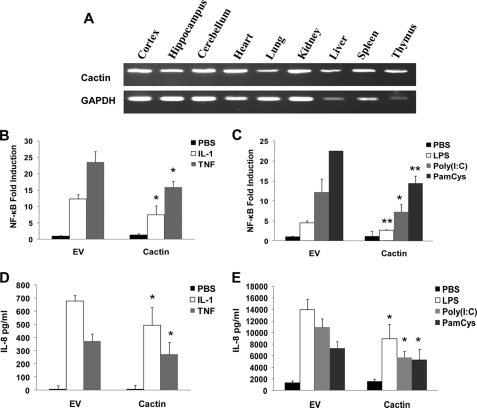
FIGURE 1.
FIGURE 1.
hCactin is ubiquitously expressed and inhibits IL-1β, TNF-α, PamCys, poly(I-C), and LPS-induced activation of NF-κB. A, tissue distribution of Cactin. Total RNA was extracted from various tissues and subjected to RT-PCR using Cactin- and GAPDH-specific primers. B–E, HEK293 cells stably transfected with TLR2, TLR3, and TLR4 were cotransfected with plasmids encoding NF-κB-regulated firefly luciferase (80 ng) and constitutively expressed TK Renilla luciferase (40 ng) in the absence or presence of Cactin (90 ng). Empty vector (EV) pcDNA3.1 was used to normalize the amount of total DNA transfected. Transfected cells were left overnight and then treated with or without various ligands: IL-1β (10 ng/ml) and TNF-α (50 ng/ml) (B and D) or PamCys (100 ng/ml), Poly(I-C) (25 μg/ml), and LPS (100 ng/ml) (C and E) for 6 h. Cell lysates were assayed for firefly luciferase activity and normalized for transfection efficiency using Renilla luciferase activity (B and C). Data are represented relative to untreated cells that had been transfected in the absence of hCactin. Conditioned media from cells were also assayed for IL-8 levels by sandwich ELISA with data being expressed in absolute concentrations of IL-8 (D and E). Data are presented as the mean ± S.E. (error bars) of triplicate determinations from three independent experiments and analyzed by paired Student's t test. *, p < 0.05; **, p < 0.01; ligand-stimulated cells transfected with empty vector versus ligand stimulated cells transfected with hCactin.
FIGURE 2.
FIGURE 2.
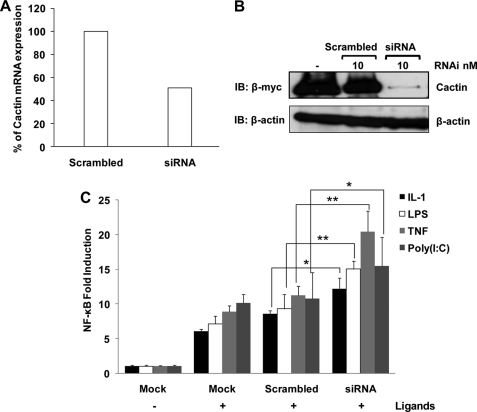
Knockdown of hCactin by siRNA augments IL-1β, TNF-α, LPS, and poly(I-C)-induced activation of NF-κB. A, HEK293 cells, stably expressing TLR4, were transfected with hCactin-specific siRNA or a sequence-scrambled version of this siRNA (25 nm). Total RNA was extracted 48 h post-transfection. The expression level of hCactin was normalized relative to expression of the housekeeping gene HPRT. Data represent the mean from three independent experiments. B, HEK293 TLR4 cells were transfected with Myc-tagged Cactin (2 μg) with or without Cactin siRNA or scrambled siRNA (10 nm). Cell lysates were generated 48 h post-transfection and analyzed by Western immunoblotting (IB) using anti-Myc and anti-β-actin antibodies. Results are representative of two independent experiments. C, HEK293-TLR4 or -TLR3 (in the case of poly(I-C)) cells were cotransfected with plasmids encoding NF-κB-regulated firefly luciferase (80 ng) and constitutively expressed TK Renilla luciferase (40 ng) in the absence (Mock) or presence of Cactin-specific siRNA or scrambled siRNA (25 nm). 48 h post-transfection cells were treated with or without various ligands: IL-1β (10 ng/ml), TNF-α (50 ng/ml), LPS (100 ng/ml), or poly(I-C) (25 μg/ml) for 6 h. Cell lysates were assayed for firefly luciferase activity and normalized for transfection efficiency using Renilla luciferase activity. Data are presented relative to unstimulated mock transfected cells and represent the mean ± S.E. (error bars) of triplicate determinations from three independent experiments and analyzed by paired Student's t test *, p < 0.05; **, p < 0.01; ligand-stimulated cells transfected with scrambled siRNA versus ligand-stimulated cells transfected with hCactin-specific siRNA.
FIGURE 3.
FIGURE 3.
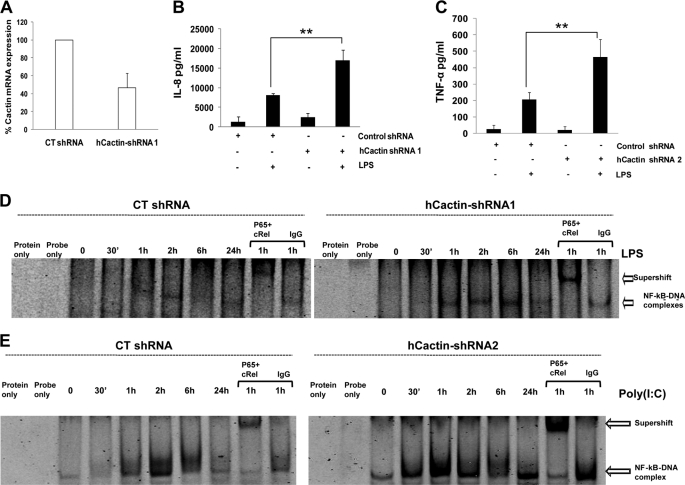
Cactin-specific shRNA augments TLR activation of NF-κB and induction of IL-8 in THP-1 and U373 cells. A, total RNA was extracted from THP-1 cells, grown under puromycin selection, after transduction with hCactin shRNA1 or control shRNA. Samples were assayed by quantitative real-time PCR for levels of hCactin mRNA and normalized relative to the housekeeping gene HPRT. Data represent the mean from three independent experiments. Puromycin-selected THP-1 (B) and U373 (C) cells, previously transduced with control or hCactin shRNA, were seeded into 96-well plates and stimulated with LPS (100 ng/ml) for 24 h. Supernatants were analyzed for IL-8 (B) and TNF production (C) using sandwich ELISA. Data are presented as the mean ± S.E. (error bars) of triplicate determinations from three independent experiments and analyzed by paired Student's t test. **, p < 0.01; LPS-treated cells transduced with control shRNA versus LPS-treated cells transduced with Cactin-specific shRNA. THP-1 (D) and U373 (E) cells stably transduced with Control or Cactin-specific shRNA were grown in 6-well plates for 24 h. (Quantitative real-time PCR confirmed ∼50% suppression of hCactin expression in U373 cells by Cactin-specific shRNA2.) Cells were then stimulated with LPS (100 ng/ml) (D) or poly(I-C) (25 μg/ml) (E) for the indicated time periods. Nuclear extracts (10 μg of protein) were generated and assayed for binding to an oligonucleotide containing a consensus NF-κB-binding motif by EMSA. Nuclear extracts from cells stimulated for 1 h with LPS or poly(I-C) were preincubated with anti-p65 and c-Rel or nonimmune (IgG) antibody before assaying NF-κB-DNA binding activity. These results are each representative of two independent experiments.
FIGURE 4.
FIGURE 4.
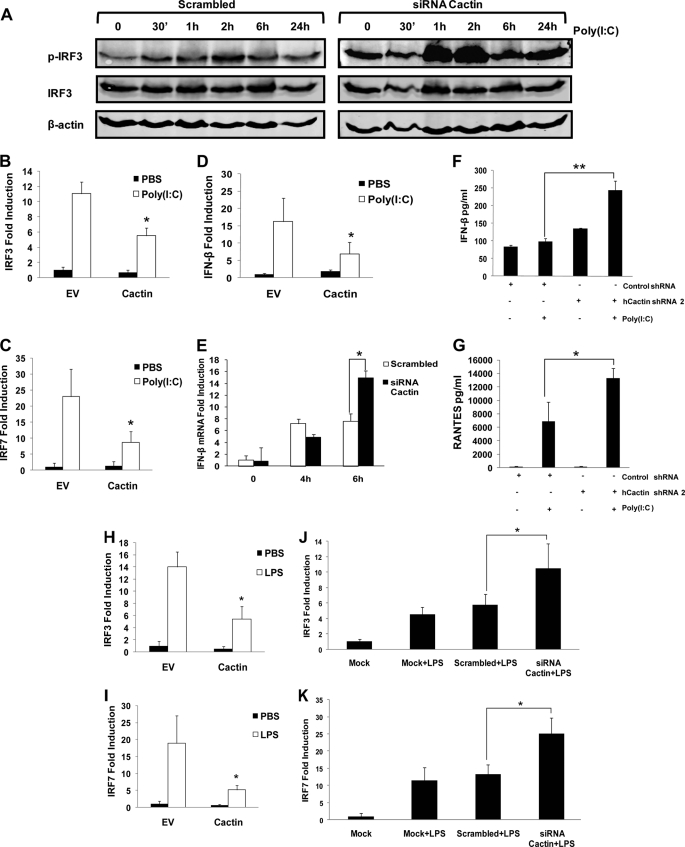
hCactin negatively regulates TLR-mediated activation of IRF3 and IRF7 and induction of IRF-responsive genes. A, HEK293-TLR3 cells were cotransfected with Cactin-specific siRNA or a sequence-scrambled siRNA (25 nm) and IRF3 (2 μg) and grown for 48 h. Cells were stimulated with poly(I-C) (25 μg/ml) for the indicated time periods, and cell lysates were generated and subjected to Western blotting using anti-phospho-IRF3, anti-IRF3, and anti-β-actin antibodies. Immunoreactivity was visualized using the Odyssey infrared imaging system. Results are indicative of three independent experiments. B–D, HEK293-TLR3 cells were cotransfected with pFA-IRF3 (30 ng) and pFR-regulated firefly luciferase (60 ng) (B), pFA-IRF7 (25 ng) and pFR-regulated firefly luciferase (60 ng) (C), and IFN-β promoter-regulated firefly luciferase (80 ng) and constitutively expressed TK Renilla luciferase (20 ng) (D) in the absence or presence of Cactin (90 ng). Empty vector pcDNA3.1 (EV) was used to normalize the amount of total DNA transfected. Transfected cells were left overnight and then treated with or without poly(I-C) (25 μg/ml) for 6 h. Cell lysates were assayed for firefly luciferase activity and normalized for transfection efficiency using Renilla luciferase activity. Data are represented relative to untreated cells that had been transfected in the absence of hCactin. E, HEK293 cells, stably expressing TLR3, were transfected with hCactin-specific siRNA or a sequence-scrambled version of this siRNA (25 nm) and grown for 48 h. Cells were stimulated with poly(I-C) (25 μg/ml) for 0–6 h. Total cDNA was generated and assayed by quantitative real-time PCR for levels of IFN-β mRNA. The expression level of hCactin was normalized relative to expression of the housekeeping gene HPRT. Data are presented relative to untreated cells transfected with scrambled siRNA. F and G, U373 cells, stably transduced with control or Cactin-specific shRNA were stimulated with poly(I-C) (25 μg/ml) for 24 h. Supernatants were analyzed for levels of IFN-β (F) and RANTES protein (G) by Mesoscale Singleplex and sandwich ELISA, respectively. H and I, HEK293-TLR3 cells were transfected with IRF3 (H) and IRF7 (I) reporter constructs as described for B and C. Cells were then treated with LPS (100 ng/ml) for 6 h and processed as above. J and K, HEK293-TLR4 cells were cotransfected with pFA-IRF3 (30 ng) (J) or pFA-IRF7 (25 ng) (K), pFR-regulated firefly luciferase (60 ng), and constitutively expressed TK Renilla luciferase (40 ng) in the absence (Mock) or presence of Cactin-specific siRNA or scrambled siRNA (25 nm). 48 h post-transfection, cells were treated with or without LPS (100 ng/ml) for 6 h. Cell lysates were assayed for firefly luciferase activity and normalized for transfection efficiency using Renilla luciferase activity. Data are presented relative to unstimulated mock-transfected cells. All data are presented as the mean ± S.E. (error bars) of triplicate determinations from three independent experiments and analyzed by paired Student's t test. *, p < 0.05; **, p < 0.01. B–D, H, and I, ligand-stimulated cells transfected with empty vector versus ligand-stimulated cells transfected with hCactin.
FIGURE 5.
FIGURE 5.
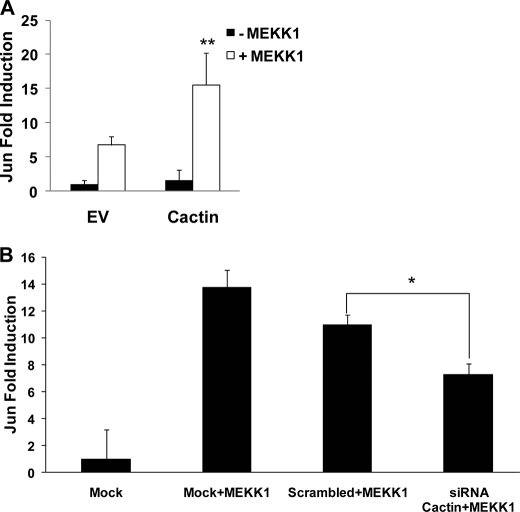
hCactin positively regulates activation of c-Jun. A, HEK293-TLR4 cells were cotransfected with pFA-Jun (30 ng), pFR-regulated firefly luciferase (60 ng), and constitutively expressed TK Renilla luciferase (20 ng) with or without a construct encoding MEKK1 (30 ng) in the absence or presence of hCactin (90 ng). Empty vector pcDNA3.1 (EV) was used to normalize the amount of total DNA transfected. B, cells were similarly transfected with the reporter constructs and MEKK1 in the absence or presence of Cactin-specific siRNA or scrambled siRNA (25 nm). Transfected cells were left for 48 h, and cell lysates were assayed for firefly luciferase activity and normalized for transfection efficiency using Renilla luciferase activity. Data are represented relative to cells that had been transfected in the absence of MEKK1 and hCactin. Data are presented as the mean ± S.E. (error bars) of triplicate determinations from three independent experiments and analyzed by paired Student's t test. *, p < 0.05; **, p < 0.01. A, cells transfected with MEKK1 and EV versus cells transfected with MEKK1 and hCactin.
FIGURE 6.
FIGURE 6.
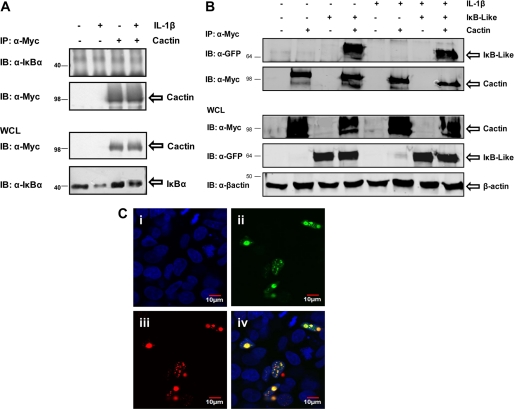
hCactin fails to interact with IκBα but interacts with nuclear IκBL. A, HEK293 cells were transfected with Myc-tagged hCactin (1 μg) or pcDNA3.1 (1 μg) (−) and grown for 24 h. Cells were treated with or without IL-1 (10 ng/ml) for 15 min. Cell lysates (WCL) were immunoprecipitated (IP) using anti-Myc antibodies. Immunoprecipitates and cell lysates were subsequently subjected to Western immunoblotting (IB) using anti-Myc and anti-IκBα antibodies. B, HEK293 cells were cotransfected in the absence and presence of Myc-tagged hCactin (1 μg) and GFP-tagged IκBL (1 μg) and grown for 24 h. Cells were treated with or without IL-1 (10 ng/ml) for 15 min. Cell lysates were immunoprecipitated using anti-Myc antibodies. Immunoprecipitates and cell lysates were subsequently subjected to Western immunoblotting using anti-Myc and anti-GFP and anti-β-actin antibodies. C, HEK293 cells were grown in chamber slides and transfected with and without hCactin-RFP (400 ng) (ii and iv) and GFP-tagged IκBL (400 ng) (iii and iv) and grown for 24 h. Cells were harvested 24 h post-transfection and mounted in anti-fade medium with DAPI. Slides were visualized using confocal microscopy. Confocal images were captured using a ×63 objective lens (oil immersion) on the UV Zeiss 510 Meta System laser-scanning microscope equipped with the appropriate filter sets. Data analysis was performed using the LSM 5 browser imaging software. All data are representative of three independent experiments.
FIGURE 7.
FIGURE 7.
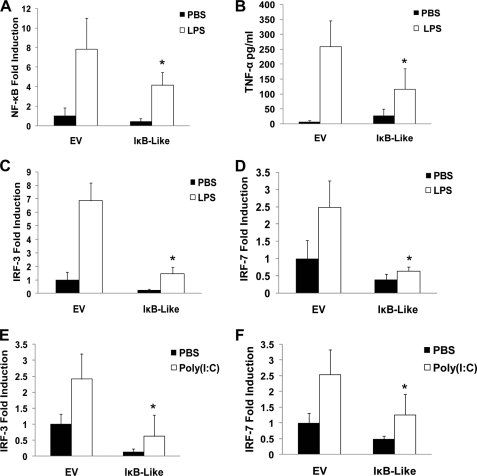
IκBL inhibits TLR-induced activation of NF-κB and IRFs. A and B, HEK293 cells stably transfected with TLR4 were cotransfected with plasmids encoding NF-κB-regulated firefly luciferase (80 ng) and constitutively expressed TK Renilla luciferase (40 ng) in the absence or presence of an expression construct encoding IκBL (90 ng). B, supernatants were analyzed for TNF production using sandwich ELISA. HEK293-TLR4 (C and D) or HEK293-TLR3 cells (E and F) were cotransfected with pFA-IRF3 (30 ng) (C and E), pFA-IRF7 (25 ng) (D and F), and pFR-regulated firefly luciferase (60 ng) and TK Renilla luciferase (20 ng) in the absence or presence of IκBL (90 ng). Empty vector pcDNA3.1 (EV) was used to normalize the amount of total DNA transfected. Transfected cells were left overnight and then treated with or without LPS (100 ng/ml) (A–D) or poly(I-C) (25 μg/ml) (E and F) for 6 h. Cell lysates were assayed for firefly luciferase activity and normalized for transfection efficiency using Renilla luciferase activity. Data are presented relative to untreated cells that had been transfected in the absence of IκBL and represent the mean ± S.E. (error bars) of triplicate determinations from three independent experiments analyzed by paired Student's t test. *, p < 0.05; **, p < 0.01; ligand-stimulated cells transfected with empty vector versus ligand stimulated cells transfected with IκBL.
FIGURE 8.
FIGURE 8.
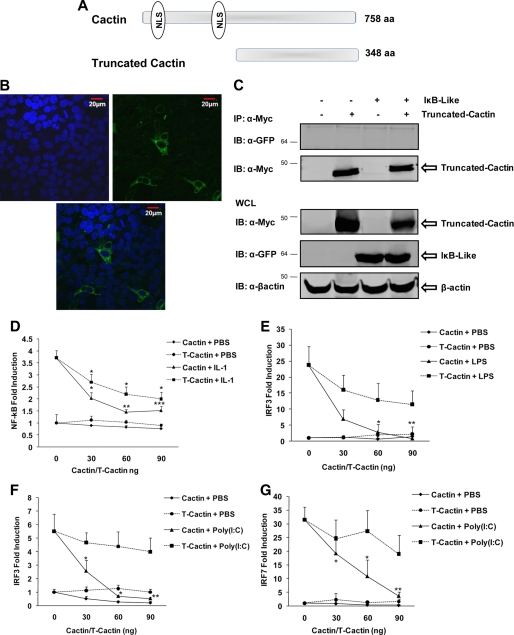
The nuclear localization of hCactin is important for manifesting its inhibitory effects on TLR signaling. A, schematic representation of full-length and truncated hCactin with location of nuclear localization sequences (NLS) depicted. B, HEK293 cells were grown in chamber slides, transfected with GFP-truncated hCactin (800 ng), and grown for 24 h. Cells were harvested 24 h post-transfection and mounted in anti-fade medium with DAPI. Slides were visualized using confocal microscopy. Confocal images were captured using a ×40 objective lens (oil immersion) on the UV Zeiss 510 Meta System laser-scanning microscope equipped with the appropriate filter sets. Data analysis was performed using the LSM 5 browser imaging software. i, DAPI staining channel; ii, GFP channel; iii, overlay. C, HEK293-TLR4 cells were cotransfected with or without expression constructs encoding Myc-tagged truncated hCactin (1 μg) in the presence or absence of GFP-tagged IκBL (1 μg) and grown for 24 h. Cell lysates were immunoprecipitated (IP) with anti-Myc antibodies. Immunoprecipitates and cell lysates were subsequently subjected to Western immunoblotting (IB) using anti-Myc, anti-GFP, and anti-β-actin antibodies. Immunoreactivity was visualized using the Odyssey infrared imaging system. D, HEK293 cells stably transfected with TLR4 were cotransfected with plasmids encoding NF-κB-regulated firefly luciferase (80 ng) and constitutively expressed TK Renilla luciferase (40 ng) in the absence or presence of an expression construct encoding full-length Cactin or truncated Cactin (T-Cactin) (0–90 ng). HEK293-TLR4 (E) or HEK293-TLR3 cells (F and G) were cotransfected with pFA-IRF3 (30 ng) (E and F), pFA-IRF7 (25 ng) (G), and pFR-regulated firefly luciferase (60 ng) and TK Renilla luciferase (20 ng) in the absence or presence of full-length Cactin or truncated Cactin (0–90 ng). Empty vector pcDNA3.1 was used to normalize the amount of total DNA transfected. Transfected cells were left overnight and then treated with or without IL-1 (10 ng/ml) (D), LPS (100 ng/ml) (E), or poly(I-C) (25 μg/ml) (F and G) for 6 h. Cell lysates were assayed for firefly luciferase activity and normalized for transfection efficiency using Renilla luciferase activity. Data are presented relative to untreated cells that had been transfected in the absence of either Cactin construct and represent the mean ± S.E. (error bars) of triplicate determinations from three independent experiments analyzed by paired Student's t test. *, p < 0.05; **, p < 0.01; ***, p < 0.001; ligand-stimulated cells transfected with empty vector versus ligand stimulated cells transfected with hCactin/truncated Cactin.

References

    1. Medzhitov R., Preston-Hurlburt P., Janeway C. A., Jr. (1997) Nature 388, 394–397 - PubMed
    1. Poltorak A., He X., Smirnova I., Liu M. Y., Van Huffel C., Du X., Birdwell D., Alejos E., Silva M., Galanos C., Freudenberg M., Ricciardi-Castagnoli P., Layton B., Beutler B. (1998) Science 282, 2085–2088 - PubMed
    1. Takeuchi O., Hoshino K., Kawai T., Sanjo H., Takada H., Ogawa T., Takeda K., Akira S. (1999) Immunity 11, 443–451 - PubMed
    1. O'Neill L. A., Greene C. (1998) J. Leukoc. Biol. 63, 650–657 - PubMed
    1. Roach J. C., Glusman G., Rowen L., Kaur A., Purcell M. K., Smith K. D., Hood L. E., Aderem A. (2005) Proc. Natl. Acad. Sci. U.S.A. 102, 9577–9582 - PMC - PubMed

Publication types

MeSH terms