


MicroRNAs as biomarkers in colorectal cancer
- PMID: 20829435
- PMCID: PMC2947254
- DOI: 10.2353/ajpath.2010.100024
MicroRNAs as biomarkers in colorectal cancer
Abstract
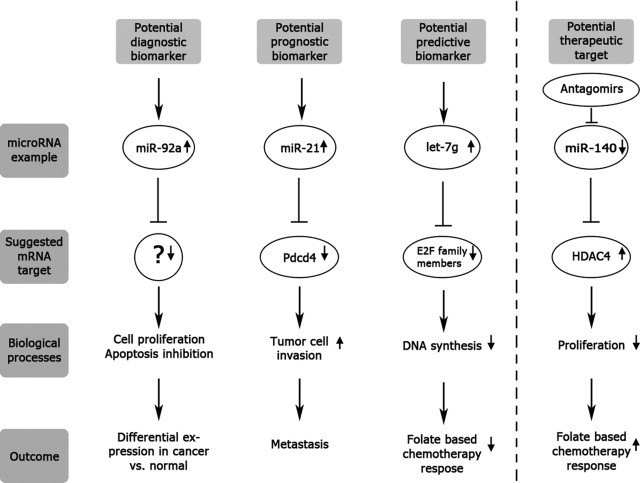
Colorectal cancer is a leading cause of cancer-related morbidity and mortality in the Western world. While improved diagnostic surveillance and treatment strategies involving surgery, chemo-, and radiotherapy have all contributed to earlier detection and improved survival, treatment decisions are still made almost exclusively based on the cancer's clinicopathological stage at diagnosis. Therefore, the search for new biomarkers to facilitate early diagnosis and individualized treatment is particularly warranted. MicroRNAs (miRNAs) are short, noncoding RNAs that regulate gene expression through posttranscriptional interactions with mRNA, thereby potentially leading to a vast range of downstream effects that depend on the target proteins affected. The discovery that miRNAs may act as either oncogenes or tumor suppressors has initiated extensive research in the cancer field, leading to the identification of numerous miRNAs implicated in carcinogenesis and tumor progression. MiRNAs are chemically stable and can thus be detected in a broad range of clinical samples, making these molecules particularly attractive as potential biomarkers in cancer. While the knowledge of miRNA involvement in colorectal cancer biology is less extensive than for other cancer types and several targets with potential biological and clinical relevance have been identified, a significant amount of research is still needed. In this review, we explore the literature regarding the relevance of miRNAs in colorectal cancer, focusing in particular on miRNAs as potential diagnostic, prognostic, and predictive biomarkers.
Figures
References
-
- Lee RC, Feinbaum RL, Ambros V. The C. elegans heterochronic gene lin-4 encodes small RNAs with antisense complementarity to lin-14. Cell. 1993;75:843–854. - PubMed
-
- Lu J, Getz G, Miska EA, Alvarez-Saavedra E, Lamb J, Peck D, Sweet-Cordero A, Ebert BL, Mak RH, Ferrando AA, Downing JR, Jacks T, Horvitz HR, Golub TR. MicroRNA expression profiles classify human cancers. Nature. 2005;435:834–838. - PubMed
-
- Esquela-Kerscher A, Slack FJ. Oncomirs - microRNAs with a role in cancer. Nat Rev Cancer. 2006;6:259–269. - PubMed
-
- Bartel DP. MicroRNAs: genomics, biogenesis, mechanism, and function. Cell. 2004;116:281–297. - PubMed
Uncited reference
-
- Valadi H, Ekstrom K, Bossios A, Sjostrand M, Lee JJ, Lotvall JO. Exosome-mediated transfer of mRNAs and microRNAs is a novel mechanism of genetic exchange between cells. Nat Cell Biol. 2007;9:654–659. - PubMed
Publication types
MeSH terms
Substances
LinkOut - more resources
Full Text Sources
Medical
