Patients with ice hockey injuries presenting to US emergency departments, 1990-2006
- PMID: 20831391
- PMCID: PMC2938317
- DOI: 10.4085/1062-6050-45.5.467
Patients with ice hockey injuries presenting to US emergency departments, 1990-2006
Abstract
Context: Although the number of US ice hockey participants doubled from 1990 to 2006, no nationally representative studies have examined US ice hockey injuries among participants of all ages during this period.
Objective: To describe patients with ice hockey injuries presenting to a representative sample of US emergency departments (EDs) from 1990 through 2006.
Design: Prospective injury surveillance study.
Setting: The US Consumer Product Safety Commission collects data from 100 nationally representative EDs via the National Electronic Injury Surveillance System (NEISS).
Patients or other participants: Individuals injured while playing ice hockey and presenting to a NEISS-affiliated ED from 1990 through 2006.
Main outcome measure(s): Incidence and patterns of ice hockey-related injuries.
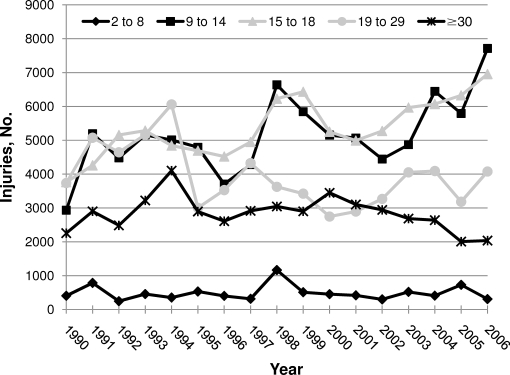
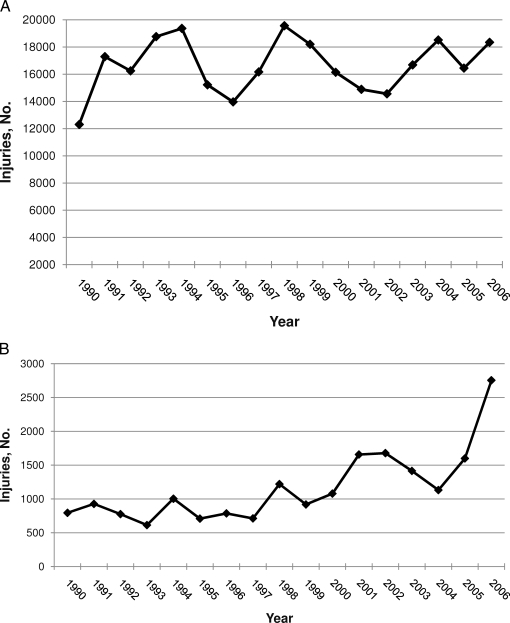
Results: From 1990 through 2006, 8228 patients with ice hockey-related injuries presented to NEISS-affiliated EDs, representing an estimated 302 368 ice hockey-related injuries sustained nationally during this time. Injuries occurred predominantly among males (93.5%). More than half of the injured were aged 9 to 14 years (28.9%) or 15 to 18 years (30.1%), and injury incidence in these age groups increased over the study period (P = .009 and P < .001, respectively). The most commonly injured body sites were the face (19.1%), wrist/hand/finger (14.1%), shoulder/upper arm (13.8%), and lower leg/ankle/foot (11.1%). Lacerations (27.0%), contusions/abrasions (23.6%), fractures (17.3%), and sprains/strains (16.9%) were the most common injuries. Falls (16.5%), contact with boards (13.6%), and contact with stick (13.0%) were the most common injury mechanisms. Compared with those aged 9 to 18 years, those aged 2 to 8 years and those older than 18 years sustained larger proportions of face (injury proportion ratio [IPR] = 2.66; 95% confidence interval [CI] = 2.29, 3.08) and mouth (IPR = 4.34; 95% CI = 2.87, 6.56) injuries. Concussions were more common among those aged 2 to 18 years (9.0%) than in those who were older than 18 years (3.7%) (IPR = 2.47; 95% CI = 1.75, 3.49).
Conclusions: Ice hockey injury patterns vary by age and sex. Our findings indicate that many trips to the ED might be prevented by using protective equipment appropriately.
Figures
Comment in
-
Commentary: the injury proportion ratio: what's it all about?J Athl Train. 2010 Sep-Oct;45(5):475-7; discussion 478-9. doi: 10.4085/1062-6050-45.5.475. J Athl Train. 2010. PMID: 20831392 Free PMC article. No abstract available.
References
-
- USA Hockey. Membership statistics. USA Hockey Web site. http://www.usahockey.com//Template_Usahockey.aspx?NAV=ME_03&ID=29074. Accessed January 20, 2009.
-
- Le Menestrel S., Perkins D. F. An overview of how sports, out-of-school time, and youth well-being can and do intersect. New Dir Youth Dev. 2007;(115):13–25. - PubMed
-
- Molsa J., Kujala U., Nasman O., Lehtipuu T. P., Airaksinen O. Injury profile in ice hockey from the 1970s through the 1990s in Finland. Am J Sports Med. 2000;28(3):322–327. - PubMed
-
- USA Hockey. 2007–2009 Official rules of ice hockey. USA Hockey Web site. http://www.usahockey.com/uploadedFiles/USAHockey/Menu_Officials/Menu_Rul.... Accessed April 10, 2008.
MeSH terms
LinkOut - more resources
Full Text Sources
Medical