


Caregiver-assisted coping skills training for lung cancer: results of a randomized clinical trial
- PMID: 20832982
- PMCID: PMC3010525
- DOI: 10.1016/j.jpainsymman.2010.04.014
Caregiver-assisted coping skills training for lung cancer: results of a randomized clinical trial
Abstract
Context: Lung cancer is one of the most common cancers in the United States and is associated with high levels of symptoms, including pain, fatigue, shortness of breath, and psychological distress. Caregivers and patients are adversely affected. However, previous studies of coping skills training (CST) interventions have not been tested in patients with lung cancer nor have systematically included caregivers.
Objectives: This study tested the efficacy of a caregiver-assisted CST protocol in a sample of patients with lung cancer.
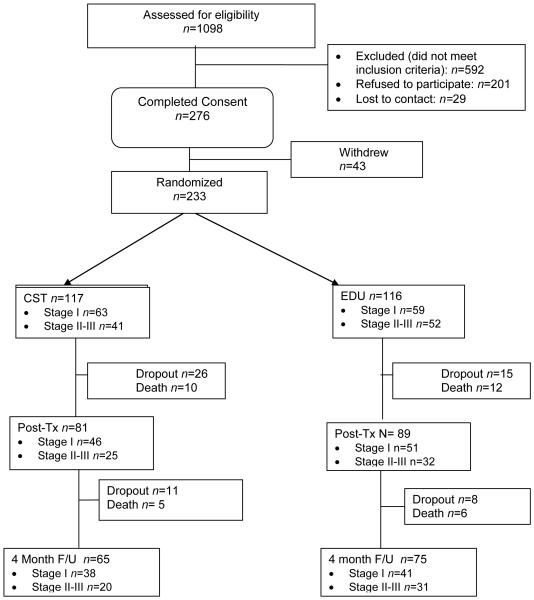
Methods: Two hundred thirty-three lung cancer patients and their caregivers were randomly assigned to receive 14 telephone-based sessions of either caregiver-assisted CST or education/support involving the caregiver. Patients completed measures assessing pain, psychological distress, quality of life (QOL), and self-efficacy for symptom management; caregivers completed measures assessing psychological distress, caregiver strain, and self-efficacy for helping the patient manage symptoms.
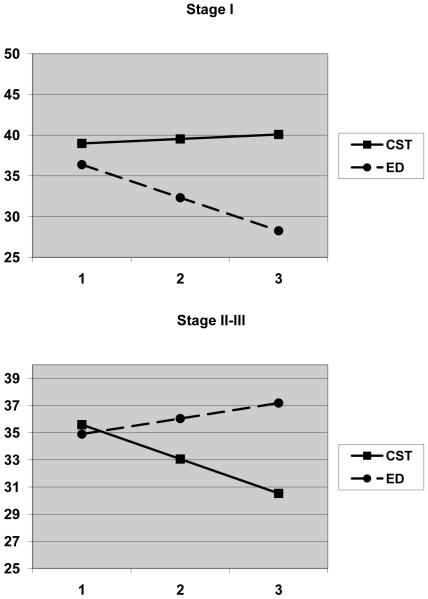
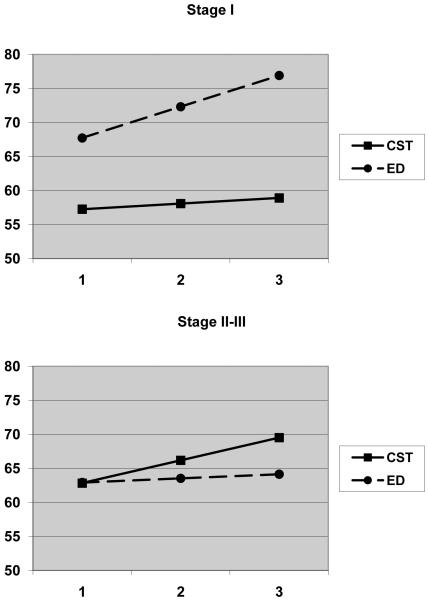
Results: Patients in both treatment conditions showed improvements in pain, depression, QOL, and self-efficacy, and caregivers in both conditions showed improvements in anxiety and self-efficacy from baseline to four-month follow-up. Results of exploratory analyses suggested that the CST intervention was more beneficial to patients/caregivers with Stage II and III cancers, whereas the education/support intervention was more beneficial to patients/caregivers with Stage I cancer.
Conclusion: Taken together with the broader literature in this area, results from this study suggest that psychosocial interventions can lead to improvements in a range of outcomes for cancer patients. Suggestions for future studies include the use of three-group designs (e.g., comparing two active interventions with a standard-care control) and examining mechanisms of change.
Copyright © 2011 U.S. Cancer Pain Relief Committee. Published by Elsevier Inc. All rights reserved.
Figures
References
-
- American Cancer Society . Cancer facts and figures 2008. American Cancer Society; Atlanta: 2008.
-
- Cooley ME. Symptoms in adults with lung cancer. A systematic research review. J Pain Symptom Manage. 2000;19(2):137–153. - PubMed
-
- Steinberg T, Roseman M, Kasymjanova G, et al. Prevalence of emotional distress in newly diagnosed lung cancer patients. Support Care Cancer. 2009;17(12):1493–1497. - PubMed
-
- Sarna L. Lung cancer. In: Holland JC, editor. Psycho-oncology. Oxford University Press; New York: 1998. pp. 340–348.
-
- Sarna L, Padilla G, Holmes C, et al. Quality of life of long-term survivors of non-small-cell lung cancer. J Clin Oncol. 2002;20(13):2920–2929. - PubMed
Publication types
MeSH terms
Grants and funding
LinkOut - more resources
Full Text Sources
Medical
