


Organ-specific carboxylesterase profiling identifies the small intestine and kidney as major contributors of activation of the anticancer prodrug CPT-11
- PMID: 20833148
- PMCID: PMC2991631
- DOI: 10.1016/j.bcp.2010.09.001
Organ-specific carboxylesterase profiling identifies the small intestine and kidney as major contributors of activation of the anticancer prodrug CPT-11
Abstract
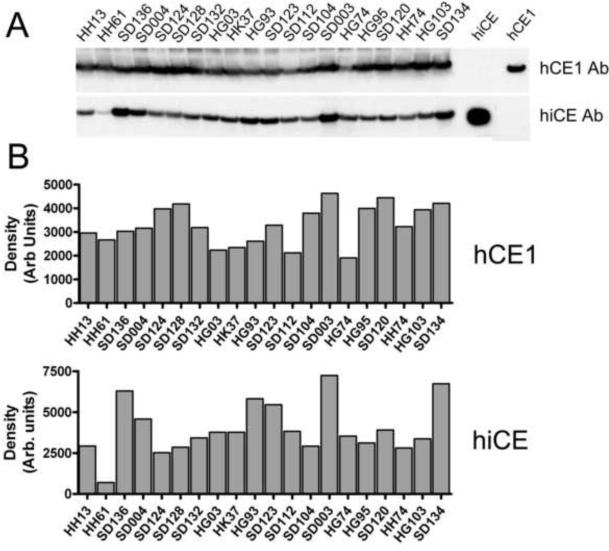
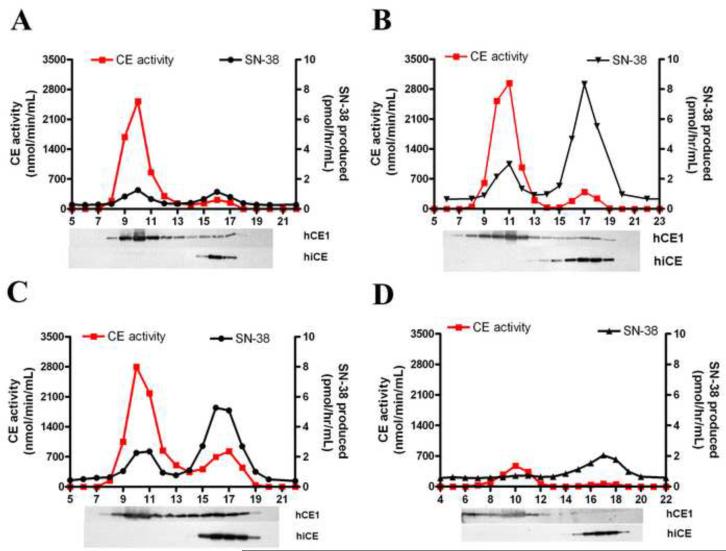
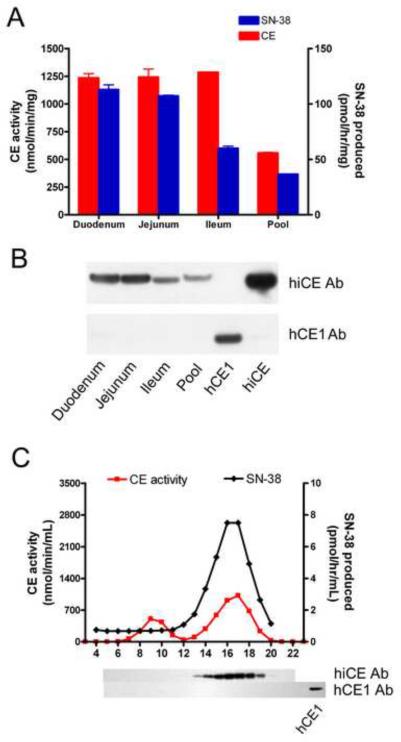
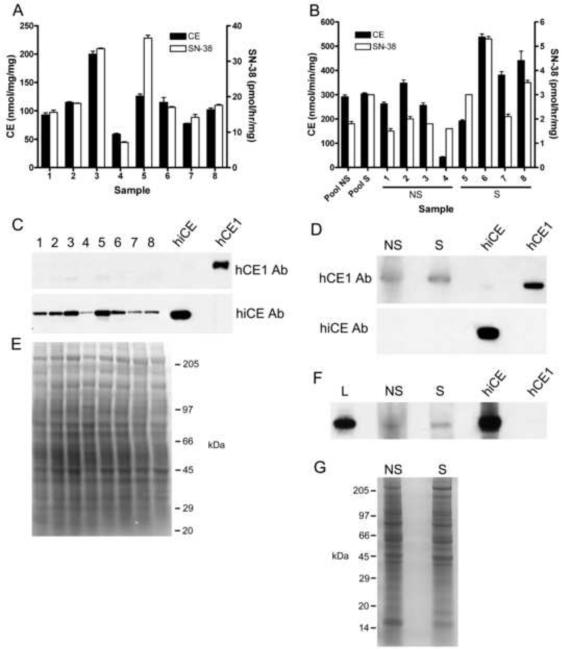
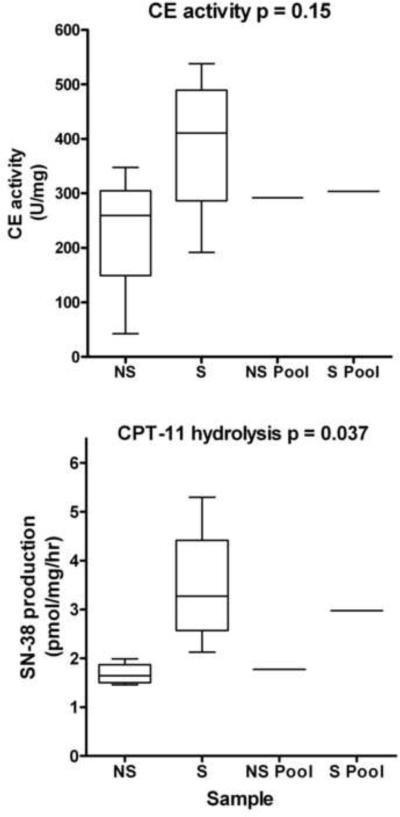
The activation of the anticancer prodrug CPT-11, to its active metabolite SN-38, is primarily mediated by carboxylesterases (CE). In humans, three CEs have been identified, of which human liver CE (hCE1; CES1) and human intestinal CE (hiCE; CES2) demonstrate significant ability to hydrolyze the drug. However, while the kinetic parameters of CPT-11 hydrolysis have been measured, the actual contribution of each enzyme to activate the drug in biological samples has not been addressed. Hence, we have used a combination of specific CE inhibition and conventional chromatographic techniques to determine the amounts, and hydrolytic activity, of CEs present within human liver, kidney, intestinal and lung specimens. These studies confirm that hiCE demonstrates the most efficient kinetic parameters for CPT-11 activation, however, due to the high levels of hCE1 that are expressed in liver, the latter enzyme can contribute up to 50% of the total of drug hydrolysis in this tissue. Conversely, in human duodenum, jejunum, ileum and kidney, where hCE1 expression is very low, greater than 99% of the conversion of CPT-11 to SN-38 was mediated by hiCE. Furthermore, analysis of lung microsomal extracts indicated that CPT-11 activation was more proficient in samples obtained from smokers. Overall, our studies demonstrate that hCE1 plays a significant role in CPT-11 hydrolysis even though it is up to 100-fold less efficient at drug activation than hiCE, and that drug activation in the intestine and kidney are likely major contributors to SN-38 production in vivo.
Copyright © 2010 Elsevier Inc. All rights reserved.
Figures
References
-
- Tanizawa A, Fujimori A, Fujimori Y, Pommier Y. Comparison of topoisomerase I inhibition, DNA damage, and cytotoxicity of camptothecin derivatives presently in clinical trials. J Natl Cancer Inst. 1994;86:836–42. - PubMed
-
- Danks MK, Morton CL, Krull EJ, Cheshire PJ, Richmond LB, Naeve CW, et al. Comparison of activation of CPT-11 by rabbit and human carboxylesterases for use in enzyme/prodrug therapy. Clin Cancer Res. 1999;5:917–24. - PubMed
-
- Danks MK, Morton CL, Pawlik CA, Potter PM. Overexpression of a rabbit liver carboxylesterase sensitizes human tumor cells to CPT-11. Cancer Res. 1998;58:20–2. - PubMed
-
- Humerickhouse R, Lohrbach K, Li L, Bosron W, Dolan M. Characterization of CPT-11 hydrolysis by human liver carboxylesterase isoforms hCE-1 and hCE-2. Cancer Res. 2000;60:1189–92. - PubMed
-
- Khanna R, Morton CL, Danks MK, Potter PM. Proficient metabolism of CPT-11 by a human intestinal carboxylesterase. Cancer Res. 2000;60:4725–8. - PubMed
Publication types
MeSH terms
Substances
Grants and funding
LinkOut - more resources
Full Text Sources
Miscellaneous
