


Keratinocyte growth factor enhances barrier function without altering claudin expression in primary alveolar epithelial cells
- PMID: 20833776
- PMCID: PMC3006268
- DOI: 10.1152/ajplung.00233.2010
Keratinocyte growth factor enhances barrier function without altering claudin expression in primary alveolar epithelial cells
Abstract
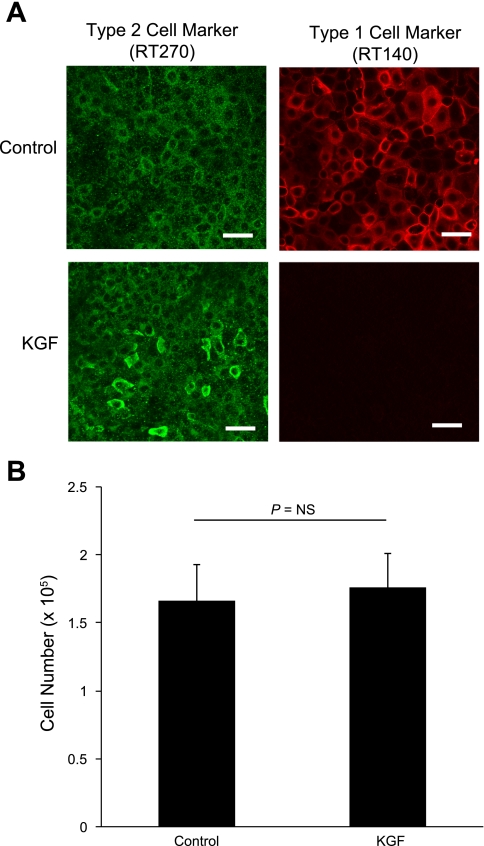
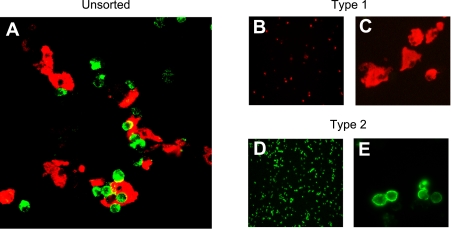
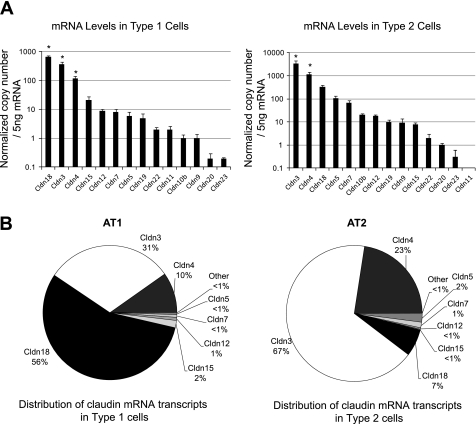
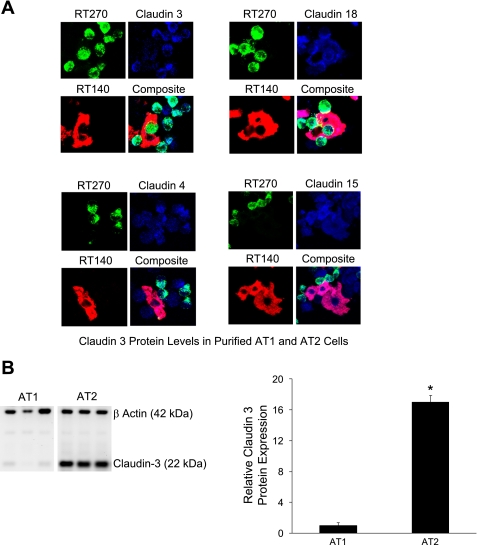
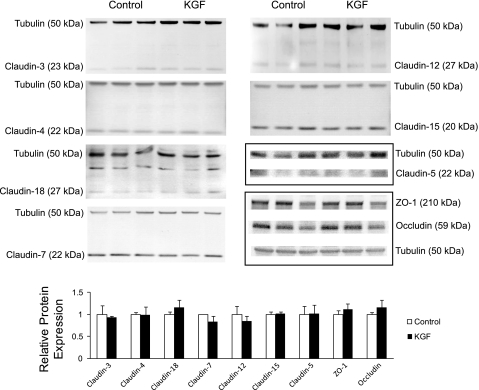
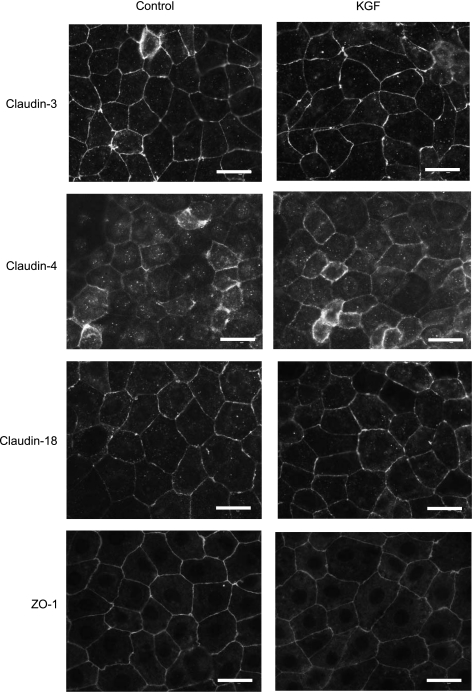
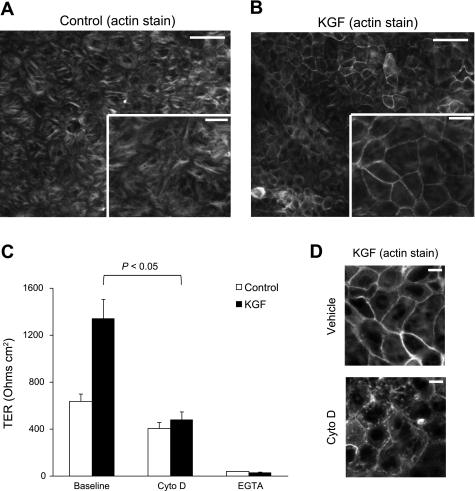
Keratinocyte growth factor (KGF) has efficacy in several experimental models of lung injury; however, the mechanisms underlying KGF's protective effect remain incompletely understood. This study was undertaken to determine whether KGF augments barrier function in primary rat alveolar epithelial cells grown in culture, specifically whether KGF alters tight junction function via claudin expression. KGF significantly increased alveolar epithelial barrier function in culture as assessed by transepithelial electrical resistance (TER) and paracellular permeability. Fluorescence-activated cell sorting of freshly isolated type 1 (AT1) and type 2 (AT2) cells followed by quantitative real-time RT-PCR revealed that more than 97% of claudin mRNA transcripts in these cells were for claudins-3, -4, and -18. Using cultured AT2 cells, we then examined the effect of KGF on the protein levels of the claudins with the highest mRNA levels: -3, -4, -5, -7, -12, -15, and -18. KGF did not alter the levels of any of the claudins tested, nor of zona occludens-1 (ZO-1) or occludin. Moreover, localization of claudins-3, -4, -18, and ZO-1 was unchanged. KGF did induce a marked increase in the apical perijunctional F-actin ring. Actin depolymerization with cytochalasin D blocked the KGF-mediated increase in TER without significantly changing TER in control cells. Together, these data support a novel mechanism by which KGF enhances alveolar barrier function, modulation of the actin cytoskeleton. In addition, these data demonstrate the complete claudin expression profile for AT1 and AT2 cells and indicate that claudins-3, -4, and -18 are the primary claudins expressed in these cell types.
Figures

Comment in
-
Keratinocyte growth factor improves alveolar barrier function: keeping claudins in line.Am J Physiol Lung Cell Mol Physiol. 2010 Dec;299(6):L721-3. doi: 10.1152/ajplung.00365.2010. Epub 2010 Oct 15. Am J Physiol Lung Cell Mol Physiol. 2010. PMID: 20952495 Free PMC article. No abstract available.
References
-
- Abraham V, Chou ML, DeBolt KM, Koval M. Phenotypic control of gap junctional communication by cultured alveolar epithelial cells. Am J Physiol Lung Cell Mol Physiol 276: L825–L834, 1999 - PubMed
-
- Adamson IY, Bowden DH. The type 2 cell as progenitor of alveolar epithelial regeneration. A cytodynamic study in mice after exposure to oxygen. Lab Invest 30: 35–42, 1974 - PubMed
-
- Atabai K, Ishigaki M, Geiser T, Ueki I, Matthay MA, Ware LB. Keratinocyte growth factor can enhance alveolar epithelial repair by nonmitogenic mechanisms. Am J Physiol Lung Cell Mol Physiol 283: L163–L169, 2002 - PubMed
-
- Baba Y, Yazawa T, Kanegae Y, Sakamoto S, Saito I, Morimura N, Goto T, Yamada Y, Kurahashi K. Keratinocyte growth factor gene transduction ameliorates acute lung injury and mortality in mice. Hum Gene Ther 18: 130–141, 2007 - PubMed
Publication types
MeSH terms
Substances
Grants and funding
LinkOut - more resources
Full Text Sources
Other Literature Sources
Research Materials
