Changes in the incidence of lower extremity amputations in individuals with and without diabetes in England between 2004 and 2008
- PMID: 20833865
- PMCID: PMC2992196
- DOI: 10.2337/dc10-0989
Changes in the incidence of lower extremity amputations in individuals with and without diabetes in England between 2004 and 2008
Abstract
Objective: To describe recent trends in the incidence of nontraumatic amputations among individuals with and without diabetes and estimate the relative risk of amputations among individuals with diabetes in England.
Research design and methods: We identified all patients aged >16 years who underwent any nontraumatic amputation in England between 2004 and 2008 using national hospital activity data from all National Health Service hospitals. Age- and sex-specific incidence rates were calculated using the total diabetes population in England every year. To test for time trend, we fitted Poisson regression models.
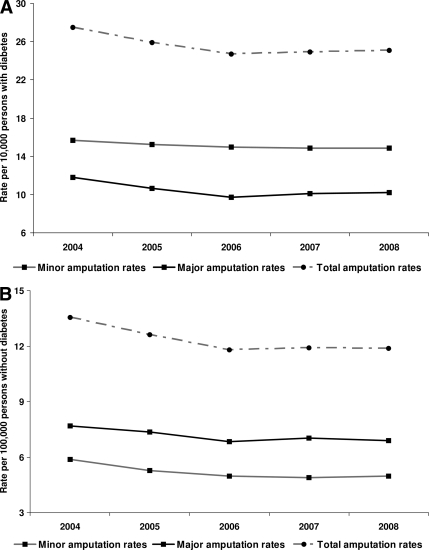
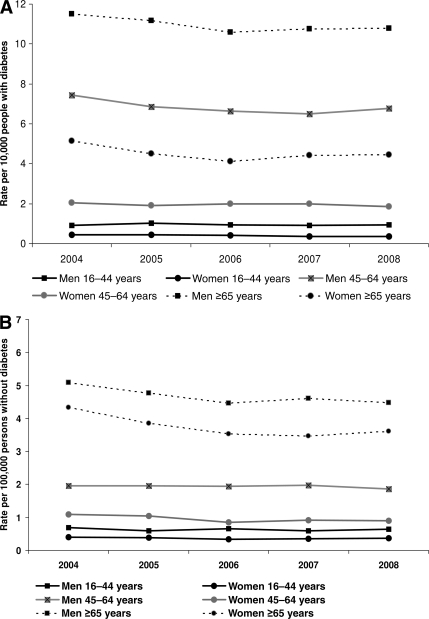
Results: The absolute number of diabetes-related amputations increased by 14.7%, and the incidence decreased by 9.1%, from 27.5 to 25.0 per 10,000 people with diabetes, during the study period (P > 0.2 for both). The incidence of minor and major amputations did not significantly change (15.7-14.9 and 11.8-10.2 per 10,000 people with diabetes; P = 0.66 and P = 0.29, respectively). Poisson regression analysis showed no statistically significant change in diabetes-related amputation incidence over time (0.98 decrease per year [95% CI 0.93-1.02]; P = 0.12). Nondiabetes-related amputation incidence decreased from 13.6 to 11.9 per 100,000 people without diabetes (0.97 decrease by year [0.93-1.00]; P = 0.059). The relative risk of an individual with diabetes undergoing a lower extremity amputation was 20.3 in 2004 and 21.2 in 2008, compared with that of individuals without diabetes.
Conclusions: This national study suggests that the overall population burden of amputations increased in people with diabetes at a time when the number and incidence of amputations decreased in the aging nondiabetic population.
Figures
References
-
- Boulton AJ, Vileikyte L, Ragnarson-Tennvall G, Apelqvist J: The global burden of diabetic foot disease. Lancet 2005;366:1719–1724 - PubMed
-
- Reiber GE, Lipsky BA, Gibbons GW: The burden of diabetic foot ulcers. Am J Surg 1998;176:5S–10S - PubMed
-
- Department of Health Health survey for England [article online], 2007. Available from http://www.dh.gov.uk/en/Publicationsand statistics/PublishedSurvey/Healt... Accessed 16 April 2010
-
- Vamos EP, Bottle A, Majeed A, Millett C: Trends in lower extremity amputations in people with and without diabetes in England, 1996–2005. Diabetes Res Clin Pract 2010;87:275–282 - PubMed
-
- The NHS Information Centre The quality and outcomes framework: audits and performance [article online], 2009. Available from http://www.ic.nhs.uk/statistics-and- data-collections/audits-and-perform... Accessed 16 April 2010