. 2010 Nov;19(11):2196-209.
doi: 10.1002/pro.498.

Non-native interactions play an effective role in protein folding dynamics

Affiliations

Non-native interactions play an effective role in protein folding dynamics

Patrícia F N Faísca et al. Protein Sci. 2010 Nov.

Abstract

Systematic Monte Carlo simulations of simple lattice models show that the final stage of protein folding is an ordered process where native contacts get locked (i.e., the residues come into contact and remain in contact for the duration of the folding process) in a well-defined order. The detailed study of the folding dynamics of protein-like sequences designed as to exhibit different contact energy distributions, as well as different degrees of sequence optimization (i.e., participation of non-native interactions in the folding process), reveals significant differences in the corresponding locking scenarios--the collection of native contacts and their average locking times, which are largely ascribable to the dynamics of non-native contacts. Furthermore, strong evidence for a positive role played by non-native contacts at an early folding stage was also found. Interestingly, for topologically simple target structures, a positive interplay between native and non-native contacts is observed also toward the end of the folding process, suggesting that non-native contacts may indeed affect the overall folding process. For target models exhibiting clear two-state kinetics, the relation between the nucleation mechanism of folding and the locking scenario is investigated. Our results suggest that the stabilization of the folding transition state can be achieved through the establishment of a very small network of native contacts that are the first to lock during the folding process.


Figures
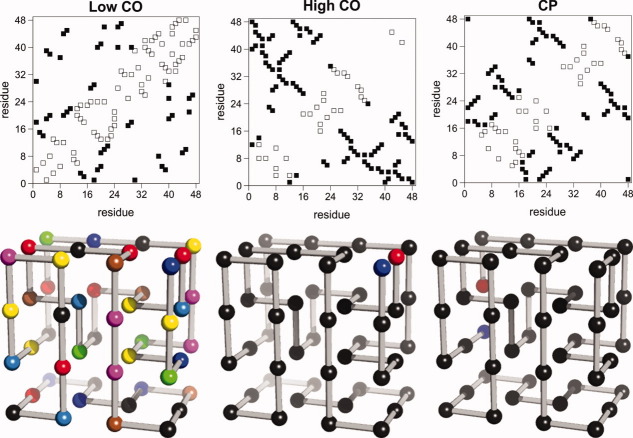
Figure 1
Figure 1
Contact map (top) and three-dimensional representation (bottom) of three target structures investigated in this study that are representative of the two structural classes (high- and low-CO geometries) considered. Each square in the contact map represents a native contact. For maximally compact cuboids with N = 48 beads, there are 57 native contacts. A nonlocal contact between two beads i and j is defined as long range (LR) if their sequence separation is at least 10 units (i.e., |ij| ≥ 10). Accordingly, the number of LR contacts (black squares) in the low-CO structure is 23 and in the high-CO structure is 33. These numbers of LR contacts correspond to long-range order parameters of 0.48 and 0.69, respectively. The (relative) contact orders of the selected targets are 0.23 and 0.45. Also show is the circular permutant of the high-CO structure that has the lowest contact order CO = 0.29 and a long-range order of 0.77. In the three-dimensional representation, beads of different colors are used to distinguish between different amino acid species. [Color figure can be viewed in the online issue, which is available at wileyonlinelibrary.com.]
Figure 2
Figure 2
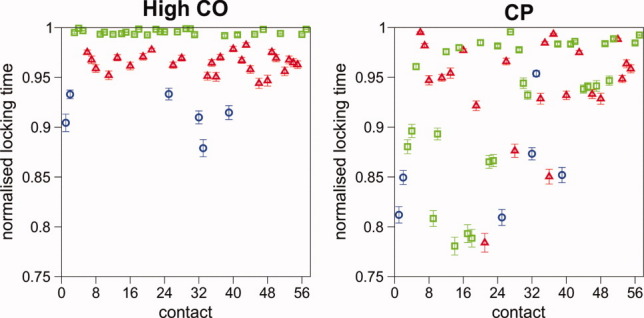
Locking scenarios for the high-CO target (left) and for its circular permutant with lowest CO (right). Amino acid interactions are modeled by the Gō potential. The locking time, tlock, of a native contact is computed as the mean locking time (normalised to the run's FPT) averaged over 500 folding runs. The error bars indicate dispersion in the values of tlock. The native contacts are numbered according to increasing contact length (whenever two contacts correspond to the same sequence separation |ij| they are ranked in order of increasing sequence location of bead i). Different colors and symbols are used to distinguish contacts within the three locking groups identified for the wild-type high-CO target (blue circles, first group; red triangles, second group; green squares, third group). To highlight the differences between both locking scenarios, the color and symbol code used for the contacts in the wild-type locking scenario is the same as in the permutant's scenario. It is clear that by changing the connectivity of the chain, as keeping the native structure fixed, one can induce a complete change in the locking scenario (i.e., locking order and timing at which locking starts). [Color figure can be viewed in the online issue, which is available at wileyonlinelibrary.com.]
Figure 3
Figure 3
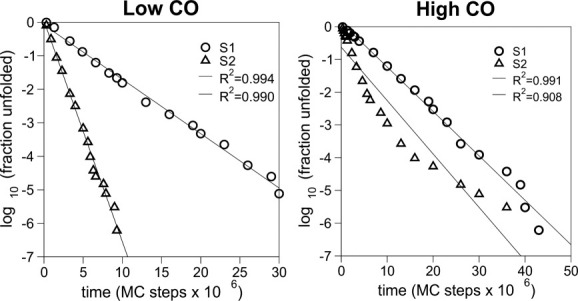
Except for sequence S2 folding to the high-CO target, the other studied sequences fold with single-exponential (i.e., two-state) kinetics.
Figure 4
Figure 4
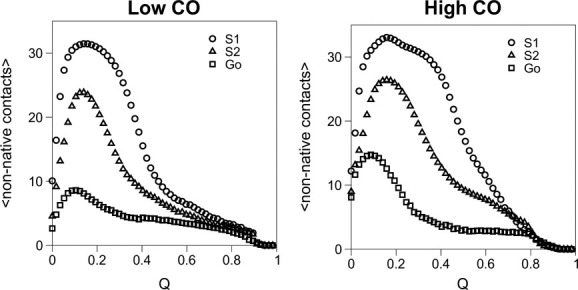
Mean number of non-native contacts (computed over 500 MC runs) formed as a function of the fraction of native contacts, Q, for the low- and high-CO targets. The average number of non-native contacts formed for fraction of native contacts Q is always smaller for sequence S2 than for sequence S1. Clearly, sequence S2 represents a compromise between the Gō sequence and the less optimized sequence S1.
Figure 5
Figure 5
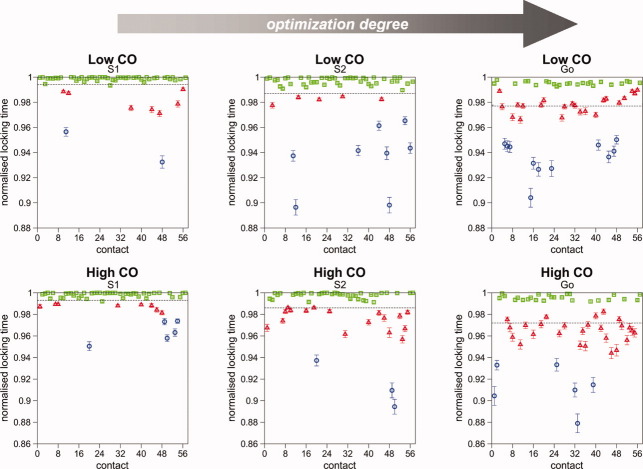
The locking scenarios of the three sequences studied for the low-CO and high-CO targets. The dotted line represents the mean locking time. As sequence optimization increases from sequence S1 to Gō, the locking of native contacts starts at a considerably earlier stage of the folding process. [Color figure can be viewed in the online issue, which is available at wileyonlinelibrary.com.]
Figure 6
Figure 6
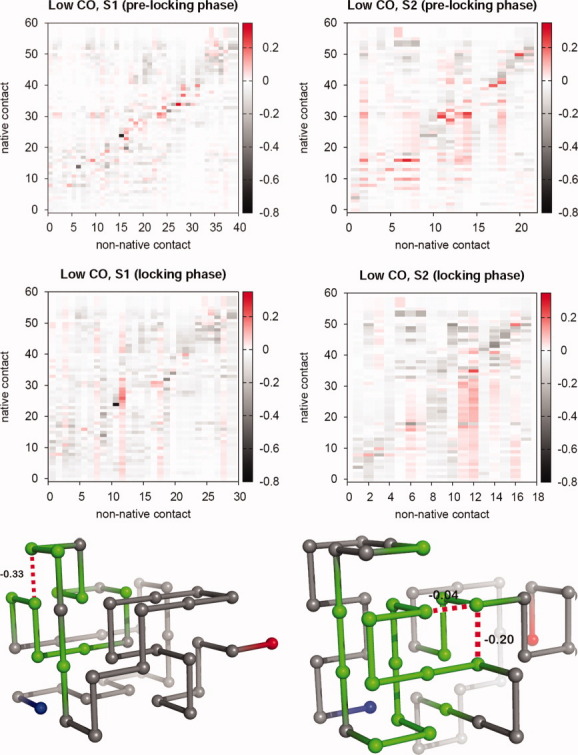
Correlation matrices between the non-native contacts, which are the most frequent during the prelocking phase (corresponding to 20–80% of the folding time) and locking phase (last 20% of the folding time), and the 57 native contacts of the low-CO target. Representative conformations sampled from the locking phase where we have highlighted the non-native contacts (and their interaction energies) and part of the backbone entailing the native contacts for which strong positive correlations were observed with the non-native ones (bottom). [Color figure can be viewed in the online issue, which is available at wileyonlinelibrary.com.]
Figure 7
Figure 7
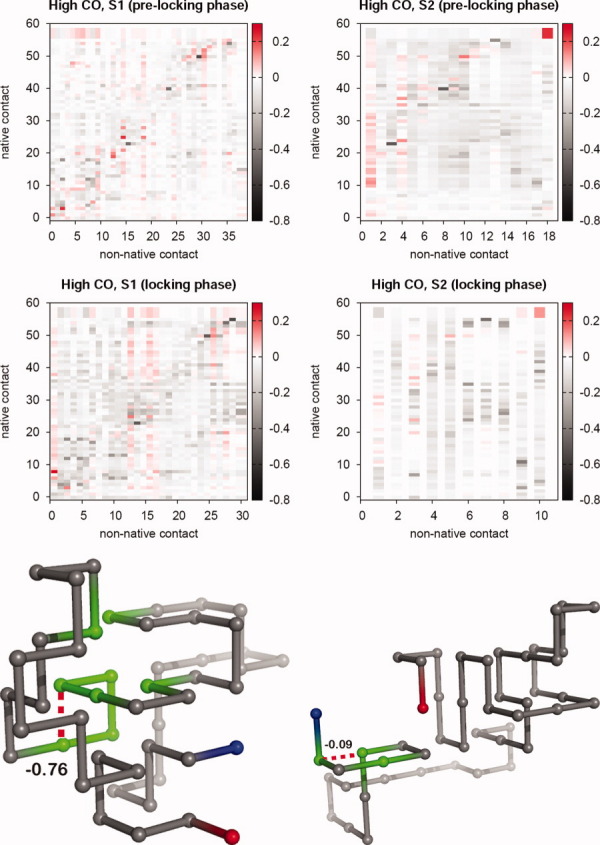
Correlation matrices between the non-native contacts, which are the most frequent during the prelocking phase (corresponding to 20–80% of the folding time) and locking phase (last 20% of the folding time), and the 57 native contacts of the high-CO target. Representative conformations sampled from the locking phase where we have highlighted the non-native contacts (and their interaction energies) and part of the backbone entailing the native contacts for which strong positive correlations were observed with the non-native ones (bottom). [Color figure can be viewed in the online issue, which is available at wileyonlinelibrary.com.]
Figure 8
Figure 8
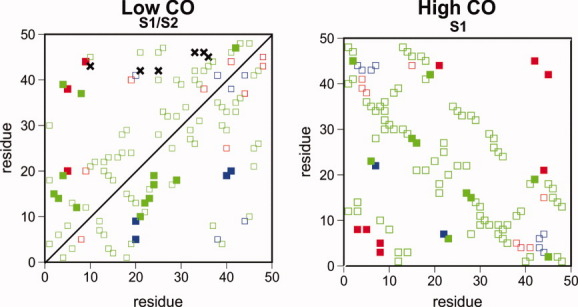
Locking maps showing the set of contacts identified as FN (filled squares) for the low- and high-CO targets. The contacts in the locking maps are colored according to their order of locking (red first, blue second, green last). In the case of the low-CO target, the FN of sequence S1 (S2) is shown above (respectively below) the diagonal. In the FN of sequence S1 of the low-CO target, there are six non-native contacts (marked with crosses) that show a remarkable probability increase (0.3 < Δp < 0.4) between pre- and TS-conformations. [Color figure can be viewed in the online issue, which is available at wileyonlinelibrary.com.]

References

    1. Dill KA, Ozkan B, Weikl TR, Chodera JD, Voelz VA. The protein folding problem: when will it be solved? Curr Opin Struc Biol. 2007;17:342–346. - PubMed
    1. Service RF. Problem solved (*sort of) Science. 2008;321:784–786. - PubMed
    1. Brockwell DJ, Radford SE. Intermediates: ubiquitous species on folding energy landscapes? Curr Opin Struct Biol. 2007;17:30–37. - PMC - PubMed
    1. Jackson SE. How do small single-domain proteins fold? Fold Des. 1998;3:R81–R91. - PubMed
    1. Bai Y. Hidden intermediates and Levinthal paradox in the folding of small proteins. Biochem Biophys Res Commun. 2003;305:785–788. - PubMed

Publication types

LinkOut - more resources