


A comparison of PAM50 intrinsic subtyping with immunohistochemistry and clinical prognostic factors in tamoxifen-treated estrogen receptor-positive breast cancer
- PMID: 20837693
- PMCID: PMC2970720
- DOI: 10.1158/1078-0432.CCR-10-1282
A comparison of PAM50 intrinsic subtyping with immunohistochemistry and clinical prognostic factors in tamoxifen-treated estrogen receptor-positive breast cancer
Abstract
Purpose: To compare clinical, immunohistochemical (IHC), and gene expression models of prognosis applicable to formalin-fixed, paraffin-embedded blocks in a large series of estrogen receptor (ER)-positive breast cancers from patients uniformly treated with adjuvant tamoxifen.
Experimental design: Quantitative real-time reverse transcription-PCR (qRT-PCR) assays for 50 genes identifying intrinsic breast cancer subtypes were completed on 786 specimens linked to clinical (median follow-up, 11.7 years) and IHC [ER, progesterone receptor (PR), HER2, and Ki67] data. Performance of predefined intrinsic subtype and risk-of-relapse scores was assessed using multivariable Cox models and Kaplan-Meier analysis. Harrell's C-index was used to compare fixed models trained in independent data sets, including proliferation signatures.
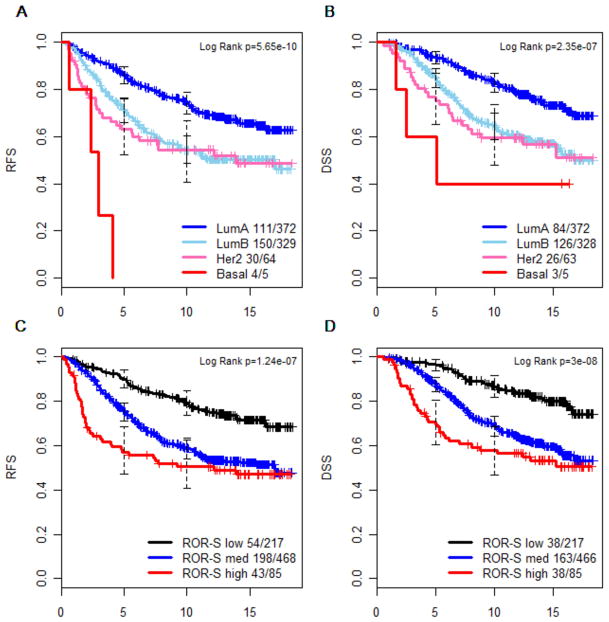
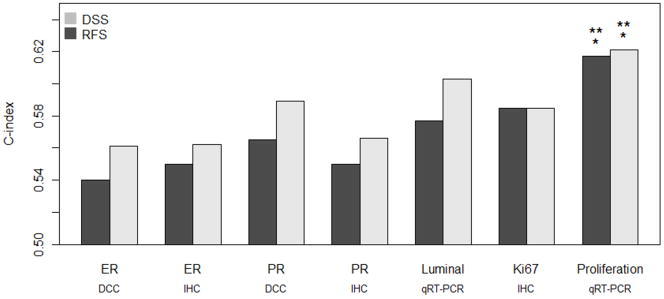
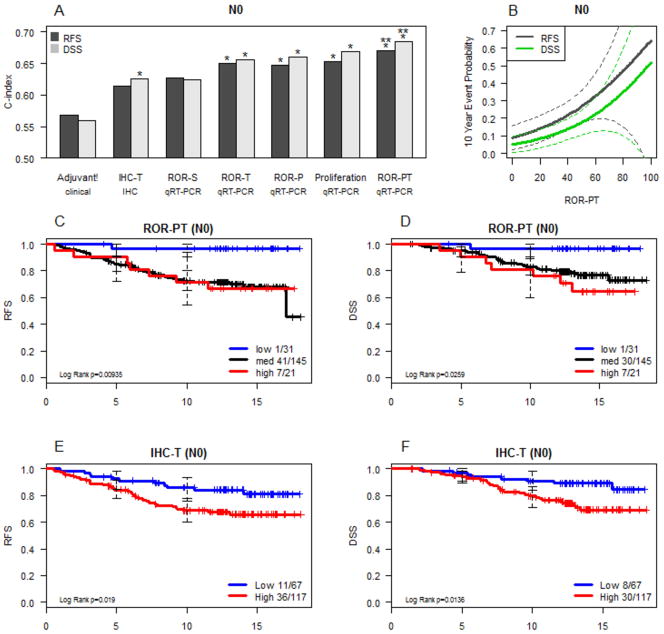
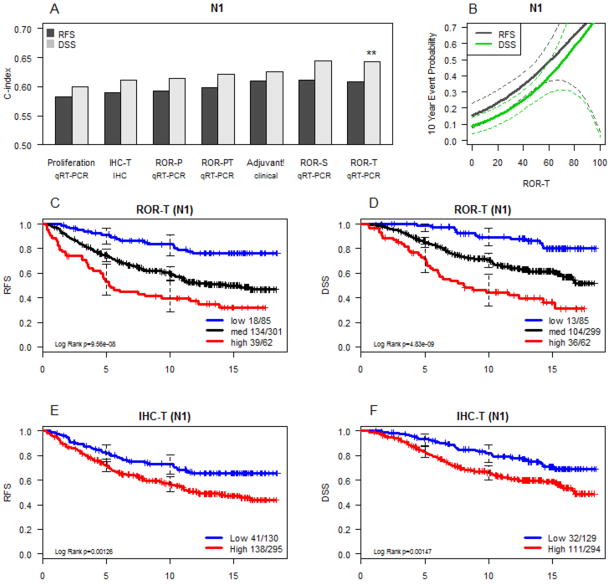
Results: Despite clinical ER positivity, 10% of cases were assigned to nonluminal subtypes. qRT-PCR signatures for proliferation genes gave more prognostic information than clinical assays for hormone receptors or Ki67. In Cox models incorporating standard prognostic variables, hazard ratios for breast cancer disease-specific survival over the first 5 years of follow-up, relative to the most common luminal A subtype, are 1.99 [95% confidence interval (CI), 1.09-3.64] for luminal B, 3.65 (95% CI, 1.64-8.16) for HER2-enriched subtype, and 17.71 (95% CI, 1.71-183.33) for the basal-like subtype. For node-negative disease, PAM50 qRT-PCR-based risk assignment weighted for tumor size and proliferation identifies a group with >95% 10-year survival without chemotherapy. In node-positive disease, PAM50-based prognostic models were also superior.
Conclusion: The PAM50 gene expression test for intrinsic biological subtype can be applied to large series of formalin-fixed, paraffin-embedded breast cancers, and gives more prognostic information than clinical factors and IHC using standard cut points.
©2010 AACR.
Figures
References
-
- Paik S, Shak S, Tang G, et al. A multigene assay to predict recurrence of tamoxifen-treated, node-negative breast cancer. N Engl J Med. 2004;351:2817–26. - PubMed
-
- Desmedt C, Piette F, Loi S, et al. Strong time dependence of the 76-gene prognostic signature for node-negative breast cancer patients in the TRANSBIG multicenter independent validation series. Clin Cancer Res. 2007;13:3207–14. - PubMed
-
- Goetz MP, Suman VJ, Ingle JN, et al. A two-gene expression ratio of homeobox 13 and interleukin-17B receptor for prediction of recurrence and survival in women receiving adjuvant tamoxifen. Clin Cancer Res. 2006;12:2080–7. - PubMed
-
- Ross JS. Multigene classifiers, prognostic factors, and predictors of breast cancer clinical outcome. Adv Anat Pathol. 2009;16:204–15. - PubMed
Publication types
MeSH terms
Substances
Grants and funding
LinkOut - more resources
Full Text Sources
Other Literature Sources
Medical
Research Materials
Miscellaneous
