


FKS mutations and elevated echinocandin MIC values among Candida glabrata isolates from U.S. population-based surveillance
- PMID: 20837754
- PMCID: PMC2981257
- DOI: 10.1128/AAC.00836-10
FKS mutations and elevated echinocandin MIC values among Candida glabrata isolates from U.S. population-based surveillance
Abstract
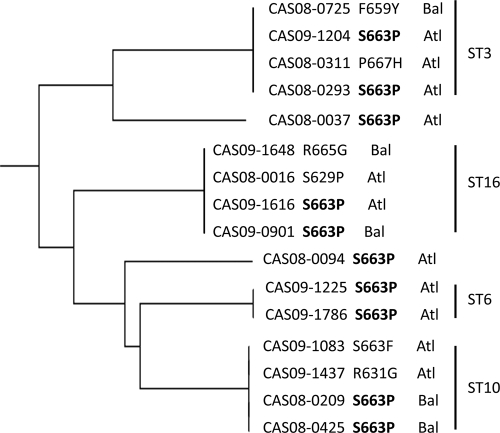
Candida glabrata is the second leading cause of candidemia in the United States. Its high-level resistance to triazole antifungal drugs has led to the increased use of the echinocandin class of antifungal agents for primary therapy of these infections. We monitored C. glabrata bloodstream isolates from a population-based surveillance study for elevated echinocandin MIC values (MICs of ≥0.25 μg/ml). From the 490 C. glabrata isolates that were screened, we identified 16 isolates with an elevated MIC value (2.9% of isolates from Atlanta and 2.0% of isolates from Baltimore) for one or more of the echinocandin drugs caspofungin, anidulafungin, and micafungin. All of the isolates with elevated MIC values had a mutation in the previously identified hot spot 1 of either the glucan synthase FKS1 (n = 2) or FKS2 (n = 14) gene. No mutations were detected in hot spot 2 of either FKS1 or FKS2. The predominant mutation was mutation of FKS2-encoded serine 663 to proline (S663P), found in 10 of the isolates with elevated echinocandin MICs. Two of the mutations, R631G for FKS1 and R665G for FKS2, have not been reported previously for C. glabrata. Multilocus sequence typing indicated that the predominance of the S663P mutation was not due to the clonal spread of a single sequence type. With a rising number of echinocandin therapy failures reported, it is important to continue to monitor rates of elevated echinocandin MIC values and the associated mutations.
Figures
References
-
- Ahlquist, A., M. M. Farley, L. H. Harrison, W. Baughman, B. Siegel, R. Hollick, S. R. Lockhart, S. S. Magill, and T. Chiller. 2009. Epidemiology of candidemia in metropolitan Atlanta and Baltimore city and county: preliminary results of population-based, active laboratory surveillance—2008-2010, abstr. M-1241. Abstr. 49th Int. Conf. Antimicrob. Agents Chemother., San Francisco, CA. American Society for Microbiology, Washington, DC.
-
- Bennett, J. E. 2006. Echinocandins for candidemia in adults without neutropenia. N. Engl. J. Med. 355:1154-1159. - PubMed
-
- Cappelletty, D., and K. Eiselstein-McKitrick. 2007. The echinocandins. Pharmacotherapy 27:369-388. - PubMed
Publication types
MeSH terms
Substances
LinkOut - more resources
Full Text Sources
Other Literature Sources
Medical
