. 2010 Dec;54(12):5344-51.
doi: 10.1128/AAC.00790-10. Epub 2010 Sep 13.

Tafenoquine, an antiplasmodial 8-aminoquinoline, targets leishmania respiratory complex III and induces apoptosis

Affiliations

Tafenoquine, an antiplasmodial 8-aminoquinoline, targets leishmania respiratory complex III and induces apoptosis

Luis Carvalho et al. Antimicrob Agents Chemother. 2010 Dec.

Abstract

Tafenoquine (TFQ), an 8-aminoquinoline analogue of primaquine, which is currently under clinical trial (phase IIb/III) for the treatment and prevention of malaria, may represent an alternative treatment for leishmaniasis. In this work, we have studied the mechanism of action of TFQ against Leishmania parasites. TFQ impaired the overall bioenergetic metabolism of Leishmania promastigotes, causing a rapid drop in intracellular ATP levels without affecting plasma membrane permeability. TFQ induced mitochondrial dysfunction through the inhibition of cytochrome c reductase (respiratory complex III) with a decrease in the oxygen consumption rate and depolarization of mitochondrial membrane potential. This was accompanied by ROS production, elevation of intracellular Ca(2+) levels and concomitant nuclear DNA fragmentation. We conclude that TFQ targets Leishmania mitochondria, leading to an apoptosis-like death process.


Figures
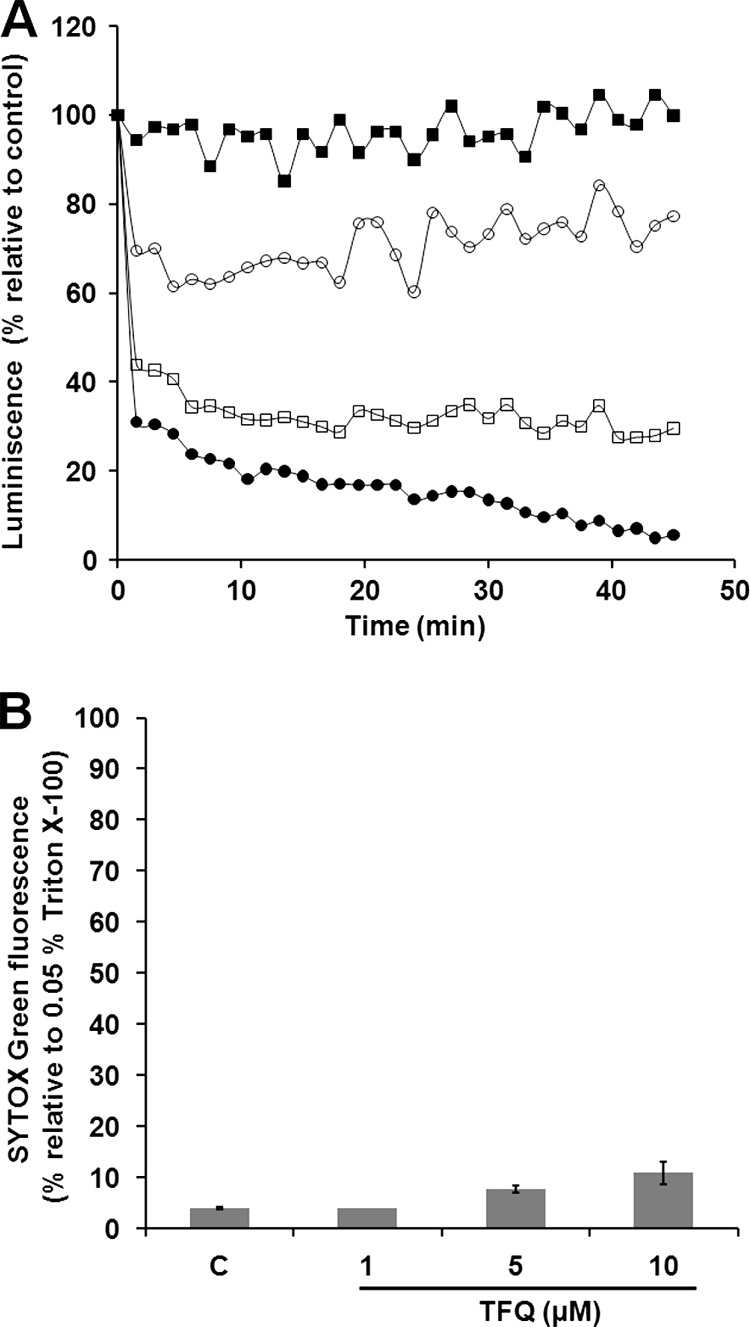
FIG. 1.
FIG. 1.
TFQ reduces intracellular ATP level without plasma membrane permeabilization. (A) Changes in the intracellular ATP levels were determined by variation of luminescence in L. donovani 3-Luc promastigotes treated with different TFQ concentrations: 2 (▪), 5 (○), 8 (□), and 10 μM (•). Promastigotes were preloaded with 25 μM DMNPE-luciferin, and when luminescence reached a plateau, TFQ was added (t = 0) and luminescence was monitored as described in Materials and Methods. Variation of luminiscence was normalized relative to the level in the control untreated parasites. Similar results were obtained in three independent experiments. At the concentrations tested, TFQ did not inhibit the activity of recombinant firefly luciferase. (B) The effect of TFQ on the plasma membrane permeability was determined by incubating promastigotes without (control [c]) and with 1, 5, and 10 μM TFQ for 45 min in HBS at 28°C and then treating them with 2 μM SYTOX Green for 15 min at 28°C. SYTOX Green fluorescence is represented relative to parasites treated with 0.05% Triton X-100 used as 100% permeabilization. Results are means ± standard deviations (SD) from three independent experiments.
FIG. 2.
FIG. 2.
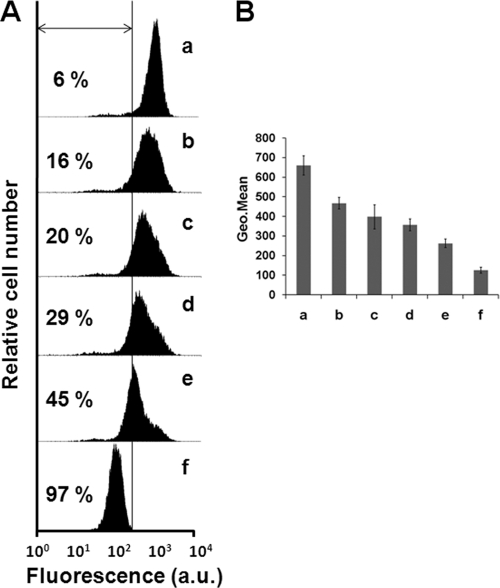
ΔΨm depolarization induced by TFQ. L. donovani promastigotes were treated with 5 μM TFQ for 1, 5, 10, and 30 min (b to e, respectively) and analyzed for fluorescence by flow cytometry, after being stained with 0.8 μM Rh123. TFQ-untreated parasites were used as a control (a), and treatment with 10 μM FCCP for 10 min was used as a depolarization control (f). (A) Histogram of a representative experiment. Percentages of depolarized cells are shown. (B) Geometrical (Geo.) mean channel fluorescence values ± SD from three experiments versus the control were significantly different by Student's t test (P < 0.05).
FIG. 3.
FIG. 3.
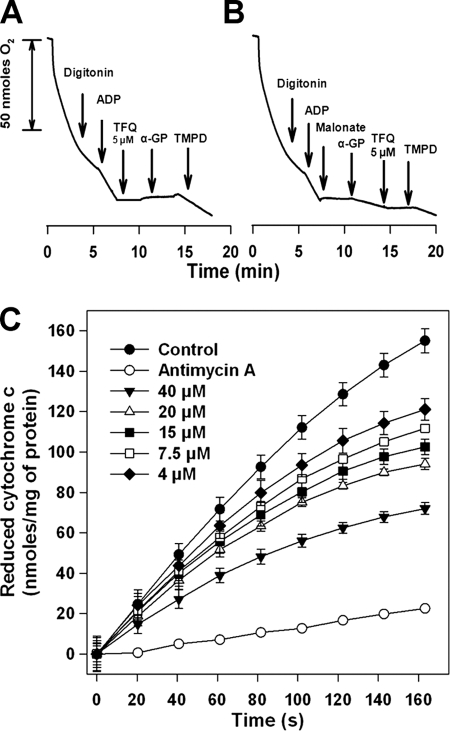
Identification of the inhibition site of the respiratory chain of Leishmania by TFQ. (A and B) Inhibition of the oxygen consumption rates of permeabilized L. donovani promastigotes in the presence of 5 mM succinate as the substrate. The arrows indicate the addition of the indicated substrates and inhibitors at their respective final concentrations as stated: 60 μM digitonin, 100 μM ADP, 0.1 mM TMPD plus 1.7 mM ascorbate, 2 mM malonate, 6.7 mM α-glycerophosphate (α-GP), and 5 μM TFQ. (C) Inhibition of CcR activity by TFQ. CcR activity ± SD was monitored by the increase of absorbance at 550 nm due to the reduction of initially oxidized cytochrome c solution (32 μM) after addition of different TFQ concentrations to mitochondrial fraction as described in Materials and Methods. Samples without succinate or in the presence of antimycin A, as the inhibitor of CcR, were considered as controls. Activity was measured at 37°C.
FIG. 4.
FIG. 4.
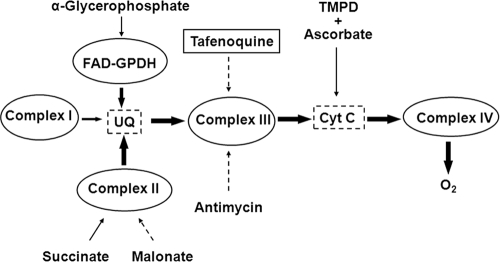
Scheme of the respiratory chain in Leishmania with the specific substrates and inhibitors used in this study. Sites of electron feeding or inhibition are indicated by solid or dotted lines, respectively. UQ, ubiquinone; Cyt C, cytochrome c. Feeding of the respiratory chain by α-glycerophosphate through flavin adenine dinucleotide-dependent glycerophosphate dehydrogenase (FAD-GPDH) is according to references and .
FIG. 5.
FIG. 5.
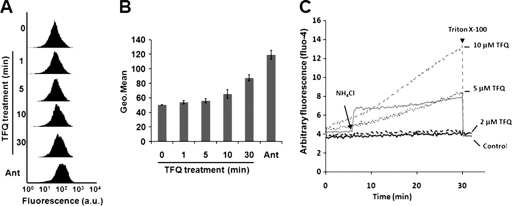
TFQ induces ROS generation and changes in cytosolic Ca2+ levels. ROS levels were measured using the specific fluorescent dye MitoSOX Red. L. donovani promastigotes preloaded with 0.5 μM MitoSOX Red were incubated without (0) and with 5 μM TFQ at the time points indicated. Antimycin A (Ant) (0.3 μg/ml, 30 min) was used as the control of ROS generation. Fluorescence intensity (arbitrary units [a.u.]) was determined by flow cytometry analysis, as described in Materials and Methods. (A) Histogram of a representative experiment. (B) Geometrical (Geo.) mean channel fluorescence values ± SD of three experiments were significantly different versus control by Student's t test (P < 0.05), except for parasites treated for 1 min. (C) Variation in cytosolic Ca2+ levels of L. donovani promastigotes. Fluo4-preloaded parasites were treated with different concentrations of TFQ as indicated and then analyzed for increasing fluorescence over a period of 30 min at 28°C using an Aminco-Bowman series 2 spectrometer. The experiments were assessed in the presence of Ca2+ chelator EGTA. The arrow indicates the addition of NH4Cl, taken as positive control. The arrowhead (t = 30 min) indicates the addition of 0.05% Triton X-100 to assess complete permeabilization of parasites. The trace “Control” represents TFQ-untreated parasites. Similar results were obtained in three independent experiments.
FIG. 6.
FIG. 6.
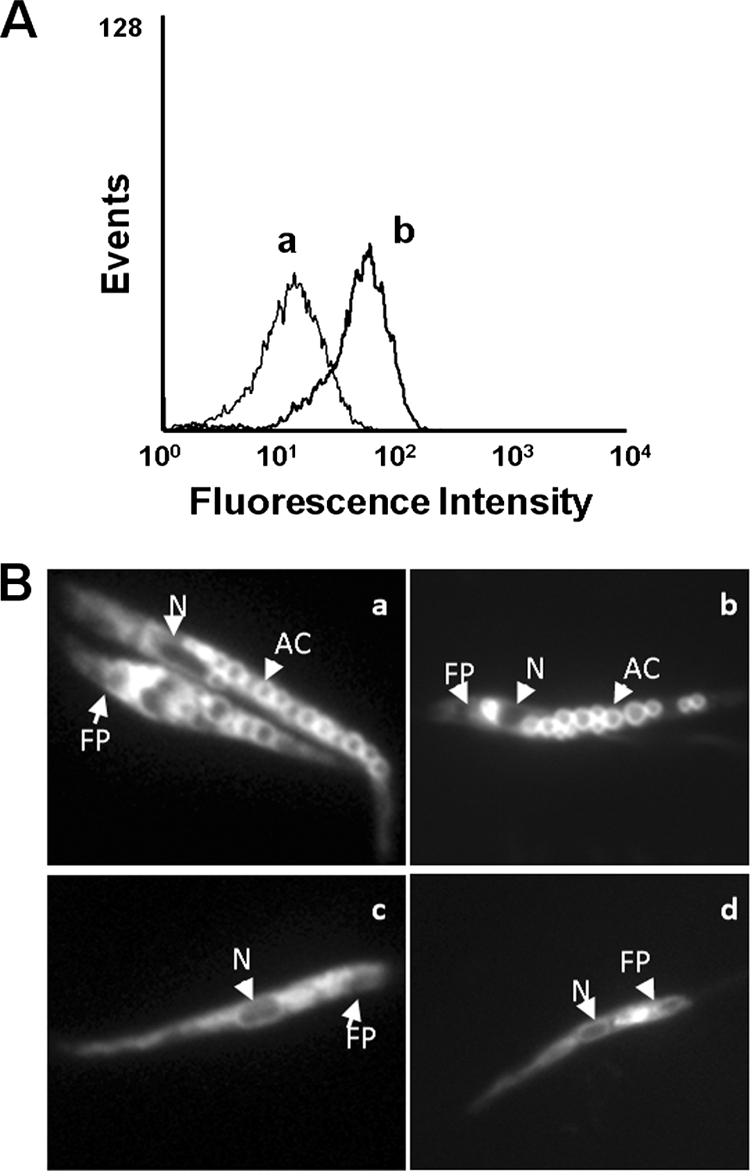
Intracellular localization of TFQ in Leishmania. (A) L. donovani promastigotes were pretreated with (a) and without (b) 5 μM TFQ for 10 min at 28°C and then labeled with 100 nM Lysotracker Green DND-26 for 10 min. Fluorescence was analyzed by flow cytometry as described in Materials and Methods. Representative histograms of three independent experiments are shown. (B) Intracellular localization of TFQ and Lysotracker Green in the control (a and b, respectively) and ΔAP3 (c and d, respectively) L. major promastigote lines were visualized by fluorescence microscopy after incubation with 5 μM TFQ or 100 nM Lysotracker Green DND-26 for 10 min at 28°C, as described in Materials and Methods. AC, acidocalcisome; N, nucleus; FP, flagellar pocket.
FIG. 7.
FIG. 7.
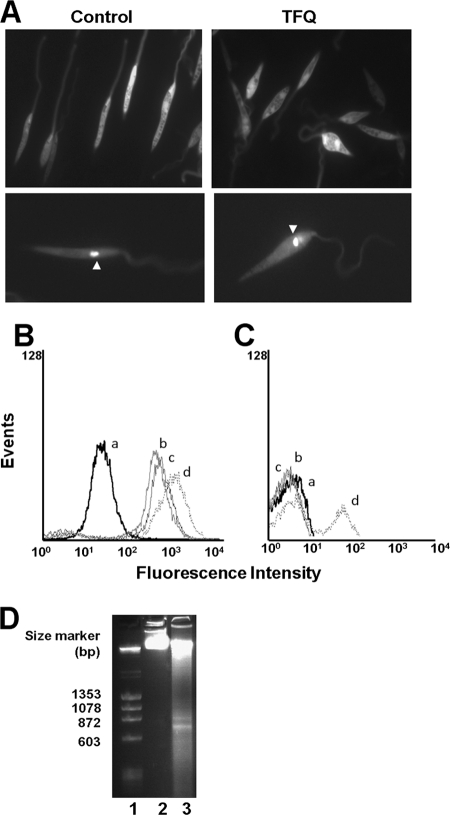
TFQ induces programmed cell death in Leishmania. (A) Autophagosome formation in L. donovani promastigotes. (Upper panel) Distribution of GFP-ATG8 in L. donovani promastigotes untreated or treated with 5 μM TFQ. (Lower panel) Autophagosomes could be identified as punctate structures clearly observable in the cytoplasm (arrowhead). (B and C) Representative histogram of TUNEL analysis and PI labeling, respectively, of L. donovani promastigotes treated with TFQ. Parasites were treated with different concentrations of TFQ: 5 (b), 10 (c) and 20 (d) μM for 4 h at 28°C, using untreated parasites (a) as controls. Fluorescein-dUTP and PI nucleic acid labeling were analyzed by flow cytometry as described in Materials and Methods. PI was used as the control of necrosis. Histograms are representative of three independent experiments with 10,000 parasites analyzed per group. (D) DNA fragmentation in L. donovani promastigotes. Genomic DNAs were isolated from parasites either untreated (lane 2) or treated for 4 h with 5 μM TFQ in HBS (lane 3), run through a 2% agarose gel, and visualized by ethidium bromide as described in Materials and Methods. DNA size markers (lane 1) are shown in base pairs (bp).

References

    1. Alvarez-Fortes, E., L. M. Ruiz-Perez, F. Bouillaud, E. Rial, and L. Rivas. 1998. Expression and regulation of mitochondrial uncoupling protein 1 from brown adipose tissue in Leishmania major promastigotes. Mol. Biochem. Parasitol. 93:191-202. - PubMed
    1. Besteiro, S., D. Tonn, L. Tetley, G. H. Coombs, and J. C. Mottram. 2008. The AP3 adaptor is involved in the transport of membrane proteins to acidocalcisomes of Leishmania. J. Cell Sci. 121:561-570. - PubMed
    1. Besteiro, S., R. A. Williams, L. S. Morrison, G. H. Coombs, and J. C. Mottram. 2006. Endosome sorting and autophagy are essential for differentiation and virulence of Leishmania major. J. Biol. Chem. 281:11384-11396. - PubMed
    1. Chappuis, F., S. Sundar, A. Hailu, H. Ghalib, S. Rijal, R. W. Peeling, J. Alvar, and M. Boelaert. 2007. Visceral leishmaniasis: what are the needs for diagnosis, treatment and control? Nat. Rev. Microbiol. 5:873-882. - PubMed
    1. Chen, M., L. Zhai, S. B. Christensen, T. G. Theander, and A. Kharazmi. 2001. Inhibition of fumarate reductase in Leishmania major and L. donovani by chalcones. Antimicrob. Agents Chemother. 45:2023-2029. - PMC - PubMed

Publication types

MeSH terms

LinkOut - more resources