


Lung cancer incidence and mortality among HIV-infected and HIV-uninfected injection drug users
- PMID: 20838223
- PMCID: PMC2974802
- DOI: 10.1097/QAI.0b013e3181f53783
Lung cancer incidence and mortality among HIV-infected and HIV-uninfected injection drug users
Abstract
Objectives: To examine the impact of HIV on lung cancer incidence and survival.
Design: : Prospective study of 2495 HIV-infected and HIV-uninfected injection drug users in Baltimore, MD.
Methods: Cancer data were obtained from the Maryland Cancer Registry. We estimated hazard ratios (HRs) and 95% confidence intervals (CIs) for lung cancer in 2 strata of packs of cigarettes smoked per day by HIV serostatus, and for mortality by HIV serostatus.
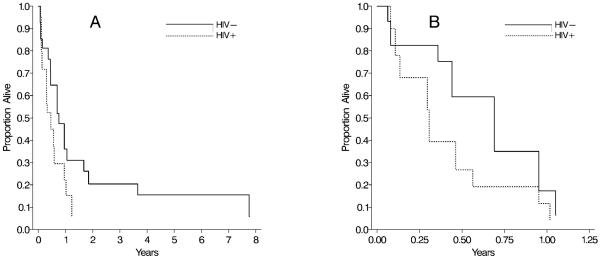
Results: HIV-infected participants had twice the risk (HR = 2.3; 95% CI: 1.1 to 5.1) of lung cancer. There was no evidence of an interaction between HIV and packs of cigarettes smoked per day (P interaction = 0.18). Compared with participants who smoked <1.43 packs per day, among HIV-uninfected individuals lung cancer risk was 6 times greater (HR = 5.9; 95% CI: 2.1 to 17) and among HIV-infected individuals lung cancer risk was doubled (HR = 2.1; 95% CI: 0.63 to 6.8) in persons who smoked ≥1.43 per day. Additionally, HIV was associated with 4 times the risk of death (HR = 3.8; 95% CI: 0.92 to 15) in lung cancer cases.
Conclusions: HIV was associated with increased risk of lung cancer, after adjusting for smoking. However, no evidence was observed for synergistic effects of HIV and smoking. Further, HIV was associated with poorer lung cancer survival after accounting for cancer stage.
Figures
References
-
- Engels EA, Pfeiffer RM, Goedert JJ, Virgo P, McNeel TS, Scoppa SM, Biggar RJ. Trends in cancer risk among people with AIDS in the United States 1980-2002. AIDS. 2006;20:1645–54. - PubMed
-
- Engels EA, Biggar RJ, Hall HI, Cross H, Crutchfield A, Finch JL, Grigg R, Hylton T, Pawlish KS, McNeel TS, Goedert JJ. Cancer risk in people infected with human immunodeficiency virus in the United States. Int J Cancer. 2008;123:187–94. - PubMed
-
- Grulich AE, van Leeuwen MT, Falster MO, Vajdic CM. Incidence of cancers in people with HIV/AIDS compared with immunosuppressed transplant recipients: a meta-analysis. Lancet. 2007;370:59–67. - PubMed
-
- Tesoriero JM, Gieryic SM, Carrascal A, Lavigne HE. Smoking Among HIV Positive New Yorkers: Prevalence, Frequency, and Opportunities for Cessation. AIDS and Behavior. 2008 - PubMed
Publication types
MeSH terms
Grants and funding
LinkOut - more resources
Full Text Sources
Medical
