


A chasm between injury and care: experiences of black male victims of violence
- PMID: 20838259
- PMCID: PMC3005415
- DOI: 10.1097/TA.0b013e3181e74fcf
A chasm between injury and care: experiences of black male victims of violence
Abstract
Background: Despite higher rates of stabbing and shooting violence among black men, healthcare systems have not demonstrated an efficacious response to these patients. This study describes challenges and promotive factors for engaging black male violence victims of violence with medical and mental healthcare.
Methods: Black male victims of stabbings and shootings were recruited through fliers and word of mouth, and were interviewed individually (n = 12) or in pairs (n = 4) using a semistructured guide. A racially diverse multidisciplinary team analyzed the data using Grounded Theory methods.
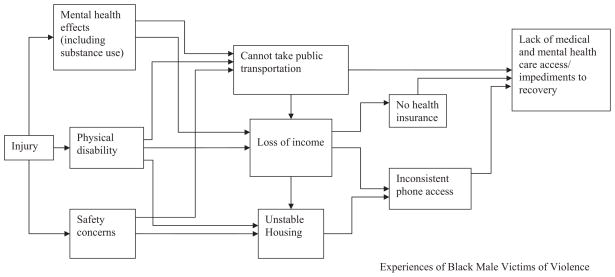
Results: Challenges to engagement with healthcare included the following: (1) Disconnect in the aftermath; e.g. participants reported not realizing they were seriously injured ("just a scratch" "poke"), were disoriented ("did not know where I was"), or were consumed with anger. (2) Institutional mistrust: blurred lines between healthcare and police, money-motivated care. (3) Foreshortened future: expectations they would die young. (4) Self-reliance: fix mental and substance abuse issues on their own. (5) Logistical issues: postinjury mental health symptoms, disability, and safety concerns created structural barriers to recovery and engagement with healthcare. Promotive factors included the following: (1) desire professionalism, open personality, and shared experience from clinicians; (2) turning points: injury or birth of a child serve as a "wake up call"; and (3) positive people, future-oriented friends and family.
Conclusions: For black male violence victims, medical treatment did not address circumstances of and reactions to injury. Policies delineating boundaries between medical care and law enforcement and addressing postinjury mental health symptoms, disability, and safety concerns may improve the recovery process.
Figures
References
-
- National Center for Injury Prevention and Control. Leading Causes of Death Reports. Atlanta, GA: Center for Disease Control and Prevention; 2005.
-
- Fox J, Swatt M. The Recent Surge in Homicides involving Young Black Males and Guns: Time to Reinvest in Prevention and Crime Control. Boston, MA: Northeastern University; 2008. pp. 1–8.
-
- Holbrook TL, Hoyt DB, Coimbra R, Potenza B, Sise M, Anderson JP. Long-term posttraumatic stress disorder persists after major trauma in adolescents: new data on risk factors and functional outcome. J Trauma. 2005;58:764–769. discussion 769–771. - PubMed
-
- Adesanya AA, da Rocha-Afodu JT, Ekanem EE, Afolabi IR. Factors affecting mortality and morbidity in patients with abdominal gunshot wounds. Injury. 2000;31:397–404. - PubMed
-
- Becker MG, Hall JS, Ursic CM, Jain S, Calhoun D. Caught in the Crossfire: the effects of a peer-based intervention program for violently injured youth. J Adolesc Health. 2004;34:177–183. - PubMed
MeSH terms
Grants and funding
LinkOut - more resources
Full Text Sources
Medical
Miscellaneous
