


Prevalence of monoclonal B-cell lymphocytosis: a systematic review
- PMID: 20839330
- PMCID: PMC2963430
- DOI: 10.1002/cyto.b.20538
Prevalence of monoclonal B-cell lymphocytosis: a systematic review
Abstract
Background: Individuals with monoclonal B-cell lymphocytosis (MBL) have been identified in clinic outpatients, in unaffected relatives of patients with chronic lymphocytic leukemia (CLL), and in general populations. MBL and its relationship with CLL have been actively investigated over the last decade. This report systematically reviews the prevalence of MBL in the context of the populations studied and the evolution of laboratory methods used to define MBL.
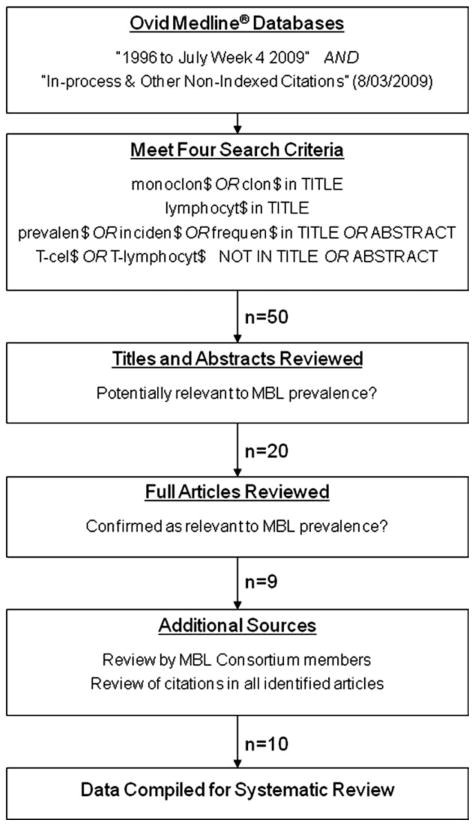
Methods: To identify published studies that have assessed the prevalence of MBL, we systematically searched the MEDLINE databases and consulted with members of the International MBL Study Group. We reviewed the 10 articles that were identified by this process. We abstracted information on study populations, laboratory tests, criteria for designating MBL, and the reported frequencies.
Results: Three of the ten studies were published in 2009, three between 2007 and 2008, and four between 2002 and 2004. Reported prevalences varied widely, ranging from 0.12 to 18.2%. This variability was clearly associated with both the laboratory methods and the populations studied. MBL was more common among older individuals and kindred of persons with CLL. The most common MBL subtype was CLL-like MBL.
Conclusions: Large population-based studies of MBL that employ standardized laboratory methods with a consensus case definition are needed to assess prevalence and establish risk factors. These studies should include prospective follow-up of MBL cases to determine the relationship between MBL and CLL. Data from original studies should be reported in sufficient detail to allow future synthesis of information from multiple studies, such as meta-analysis.
Published 2010 Wiley-Liss, Inc.
Figures
References
-
- Marti GE, Rawstron AC, Ghia P, Hillmen P, Houlston RS, Kay N, Aurran-Schleinitz T. Caporaso N on behalf of The International Familial CLL Consortium. Diagnostic criteria for monoclonal B-cell lymphocytosis (MBL) Br J Haematol. 2005;130:325–332. - PubMed
-
- Rawstron AC, Bennett FL, O’Connor SJ, Kwok M, Fenton JA, Plummer M, de Tute R, Owen RG, Richards SJ, Jack AS, Hillmen P. Monoclonal B-cell lymphocytosis and chronic lymphocytic leukemia. N Engl J Med. 2008;359:575–583. - PubMed
-
- Shanafelt TD, Kay NE, Rabe KG, Call TG, Zent CS, Maddocks K, Jenkins G, Jelinek DF, Morice WG, Boysen J, Schwager S, Bowen D, Slager SL, Hanson CA. Brief Report: Natural history of individuals with clinically recognized monoclonal B-cell lymphocytosis compared with patients with Rai 0 chronic lymphocytic leukemia. J Clin Orthod. 2009;27:3959–3963. - PMC - PubMed
-
- Linet MS, Devesa SS, Morgan GJ. The leukemias. In: Schottenfeld D, Fraumeni JF, editors. Cancer Epidemiology and Prevention. 3. New York: Oxford University Press; 2006. pp. 841–871.
Publication types
MeSH terms
Grants and funding
LinkOut - more resources
Full Text Sources
Other Literature Sources
Miscellaneous
