. 2011 Jan;162(1):42-53.
doi: 10.1111/j.1476-5381.2010.01027.x.

Expression and function of the K+ channel KCNQ genes in human arteries

Affiliations

Expression and function of the K+ channel KCNQ genes in human arteries

Fu Liang Ng et al. Br J Pharmacol. 2011 Jan.

Abstract

Background and purpose: KCNQ-encoded voltage-gated potassium channels (K(v) 7) have recently been identified as important anti-constrictor elements in rodent blood vessels but the role of these channels and the effects of their modulation in human arteries remain unknown. Here, we have assessed KCNQ gene expression and function in human arteries ex vivo.

Experimental approach: Fifty arteries (41 from visceral adipose tissue, 9 mesenteric arteries) were obtained from subjects undergoing elective surgery. Quantitative RT-PCR experiments using primers specific for all known KCNQ genes and immunohistochemsitry were used to show K(v) 7 channel expression. Wire myography and single cell electrophysiology assessed the function of these channels.

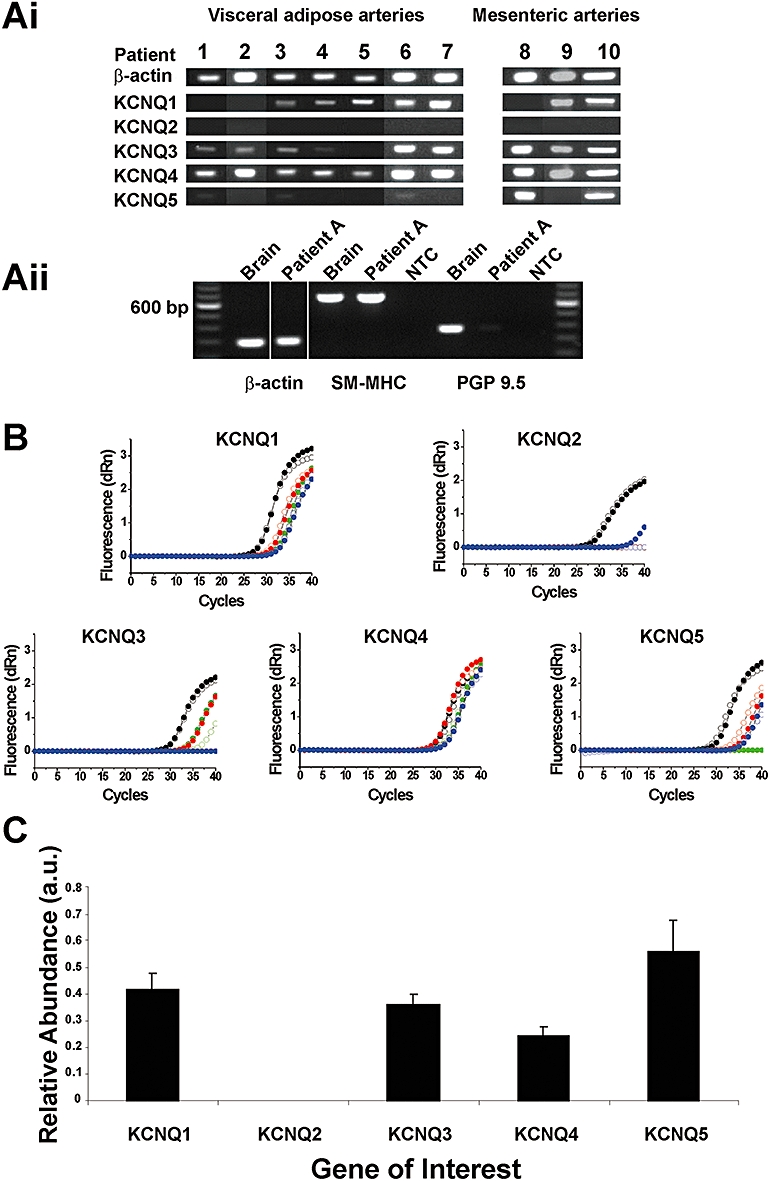
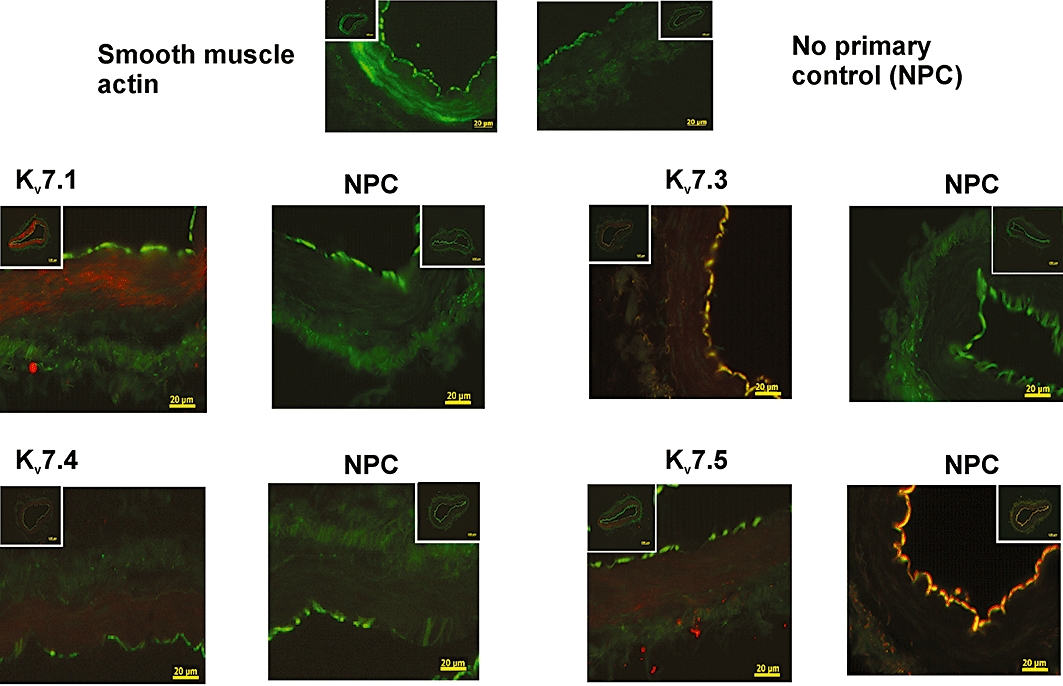
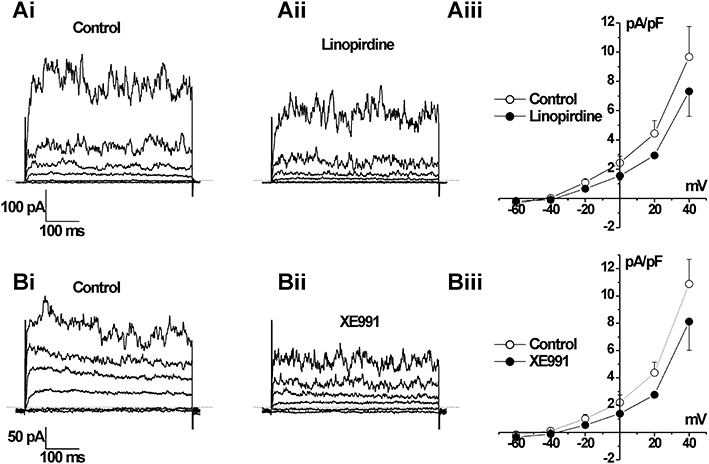
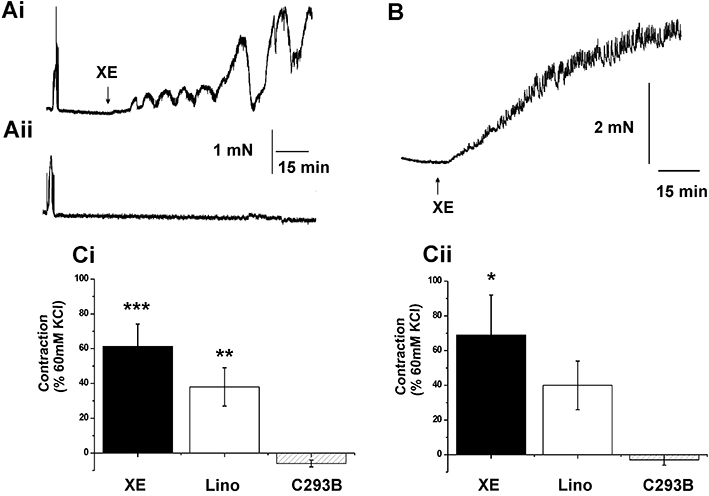
Key results: KCNQ4 was expressed in all arteries assessed, with variable contributions from KCNQ1, 3 and 5. KCNQ2 was not detected. K(v) 7 channel isoform-dependent staining was revealed in the smooth muscle layer. In functional studies, the K(v) 7 channel blockers, XE991 and linopirdine increased isometric tension and inhibited K(+) currents. In contrast, the K(v) 7.1-specific blocker chromanol 293B did not affect vascular tone. Two K(v) 7 channel activators, retigabine and acrylamide S-1, relaxed preconstricted arteries, actions reversed by XE991. K(v) 7 channel activators also suppressed spontaneous contractile activity in seven arteries, reversible by XE991.

Conclusions and implications: This is the first study to demonstrate not only the presence of KCNQ gene products in human arteries but also their contribution to vascular tone ex vivo.

Linked article: This article is commented on by Mani and Byron, pp. 38-41 of this issue. To view this commentary visit http://dx.doi.org/10.1111/j.1476-5381.2010.01065.x.


Figures

Figure 1
Figure 1
Expression of KCNQ genes in human arteries. (Ai) Conventional endpoint RT-PCR experiments demonstrating variable expression of KCNQ genes in 10 human arteries, grouped by source of artery. (Aii) Endpoint RT-PCR comparing neuronal and smooth muscle markers in human brain and artery. (B) Amplification plots for KCNQ primers with cDNA from positive controls (heart for KCNQ1 and brain for KCNQ2–5, black open and closed symbols) and arteries from three patients, randomly chosen from samples 1–7 in Ai (red, green and blue open and closed symbols, respectively). (C) Quantitative PCR analysis of relative abundance of KCNQ genes, normalized to mean of β-actin and L19 housekeeper genes. Values were corrected for differences in primer efficiencies. Reactions were performed with three different patients (B–D), randomly chosen from samples 1–7, each in duplicate. Data represent the mean ± SEM.
Figure 2
Figure 2
Identification of Kv7 channel proteins in human arteries. Representative fluorescence images from sections (10 µm) of visceral adipose arteries, using primary antibodies against smooth muscle actin, Kv7.1, Kv7.3, Kv7.4 and Kv7.5 taken at ×40 magnification. Inserts show same slice at ×10 magnification. Presence of protein identified by the intensity of the red colouring in the case of the Kv7 antibodies and green colouring for actin. NPC, no primary control.
Figure 4
Figure 4
Effect of Kv7 channel blockers on K+ currents in human visceral artery myocytes. Representative whole cell K+ currents recorded using the perforated patch technique evoked by voltage steps between −80 and +40 mV from −50 mV in the absence (Ai or Bi) or presence of 10 µM linopirdine (Aii) and 10 µM XE991 (Bii). Aiii and Biii show mean current normalized to cell capacitance from three such experiments ± SEM.
Figure 3
Figure 3
Effect of Kv7 channel blockers on arterial tone. (A) Representative traces from paired segments of visceral adipose artery where either 10 µmol·L−1 XE991 (XE; Ai) or equivalent vehicle (Aii) were applied. (B) Representative contraction produced by application of 10 µmol·L−1 XE991 in a human mesenteric artery. The mean data from similar experiments using also linopirdine (Lino) or chromanol 293B (C293B) in (Ci) visceral adipose tissue artery and (Cii) mesenteric artery are shown (visceral adipose tissue artery n= 31, 23 and 19, mesenteric artery n= 9, 7 and 5, respectively). *P < 0.05; **P < 0.01; ***P < 0.001, significantly different from C293B.
Figure 5
Figure 5
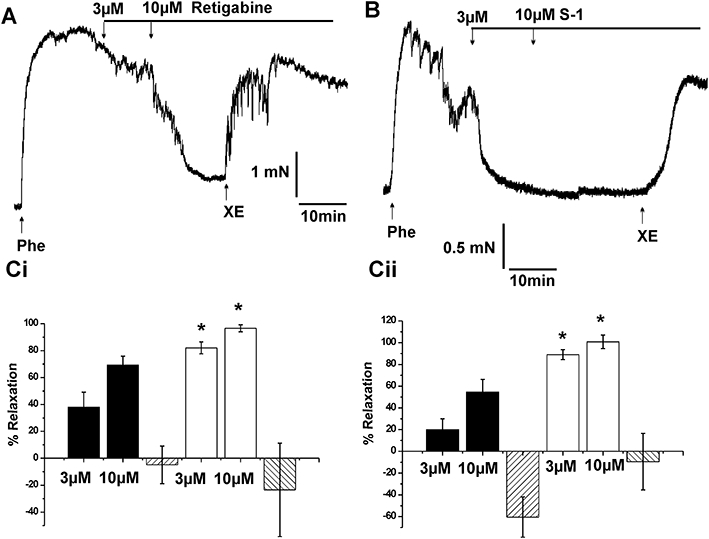
Effect of Kv7 channel activators on vasoconstrictor tone. Representative traces showing the response of paired arterial segments from one visceral adipose tissue artery to (A) retigabine and (B) acrylamide S-1 respectively. 10 µmol·L−1 phenylephrine (Phe) was used to contract the vessels. C shows the summary data of the Kv7 channel activators in (Ci) visceral adipose tissue artery and (Cii) mesenteric arteries; retigabine (black columns, visceral adipose tissue artery, n= 13; mesenteric artery, n= 6), acrylamide S-1 (open columns, visceral adipose tissue artery, n= 15; mesenteric artery, n= 6). Relaxant effects of both channel activators were reversed by the application of 10 µmol·L−1 XE991. Each column represents mean ± SEM. *P < 0.05 significantly different from corresponding doses of retigabine.
Figure 6
Figure 6
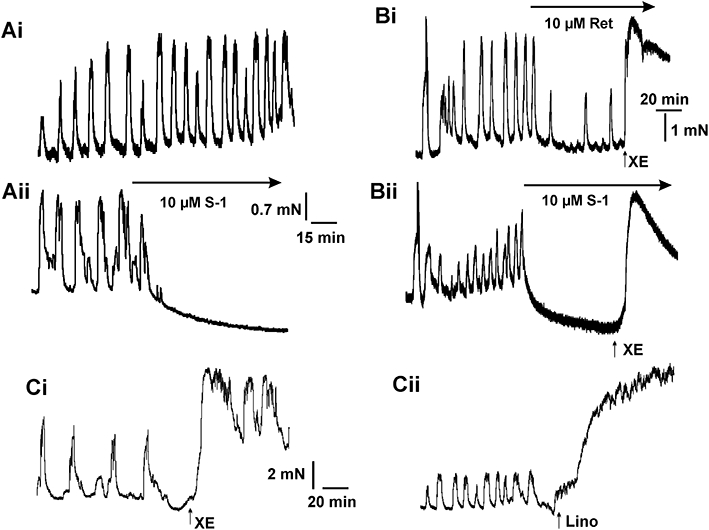
Effect of Kv7 channel activators on spontaneous contractions. A shows examples of contractile activity recorded in contiguous segments of human visceral adipose artery in the (Ai) absence and presence (Aii) of acrylamide S-1. B shows the effect of 10 µmol·L−1 retigabine (Ret; Bi) and 10 µmol·L−1 acrylamide S-1 (S1: Bii) on spontaneous contractions of a human mesenteric artery. Panels in C show the effect of 3 µmol·L−1 XE991 (XE; Ci) and 10 µmol·L−1 linopirdine (Lino; Cii) in segments of the same mesenteric artery shown in B that exhibited spontaneous contractions, representative of three such experiments.

Comment in

References

    1. Alexander SPH, Mathie A, Peters JA. Guide to receptors and channels (GRAC), 4th edn. Br J Pharmacol. 2009;158(Suppl. 1):S1–S254. - PMC - PubMed
    1. Bentzen BH, Schmitt N, Calloe K, Dalby Brown W, Grunnet M, Olesen SP. The acrylamide (S)-1 differentially affects Kv7 (KCNQ) potassium channels. Neuropharmacology. 2006;51:1068–1077. - PubMed
    1. Bett GC, Morales MJ, Beahm DL, Duffey ME, Rasmusson RL. Ancillary subunits and stimulation frequency determine the potency of chromanol 293B block of the KCNQ1 potassium channel. J Physiol. 2006;576:755–767. - PMC - PubMed
    1. Blackburn-Munro G, Dalby-Brown W, Mirza NR, Mikkelsen JD, Blackburn-Munro RE. Retigabine: chemical synthesis to clinical application. CNS Drug Rev. 2005;11:1–20. - PMC - PubMed
    1. Brueggemann LI, Mackie AR, Mani BK, Cribbs LL, Byron KL. Differential effects of selective cyclooxygenase-2 inhibitors on vascular smooth muscle ion channels may account for differences in cardiovascular risk profiles. Mol Pharmacol. 2009;76:1053–1061. - PMC - PubMed

Publication types

LinkOut - more resources