


Mono-hydroxy methoxychlor alters levels of key sex steroids and steroidogenic enzymes in cultured mouse antral follicles
- PMID: 20840852
- PMCID: PMC2976486
- DOI: 10.1016/j.taap.2010.09.001
Mono-hydroxy methoxychlor alters levels of key sex steroids and steroidogenic enzymes in cultured mouse antral follicles
Abstract
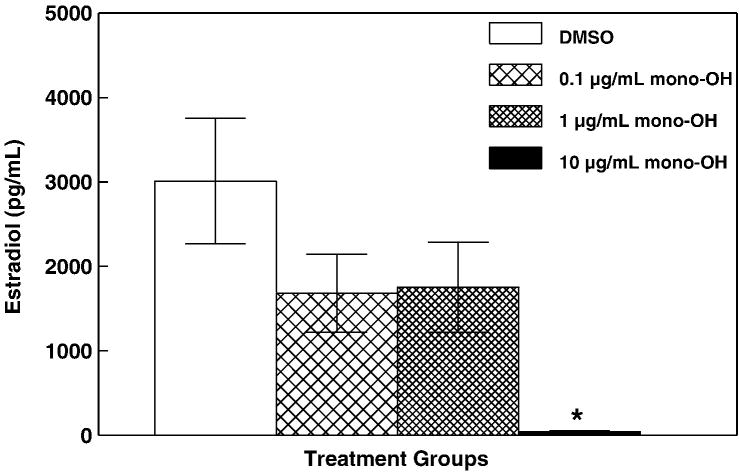
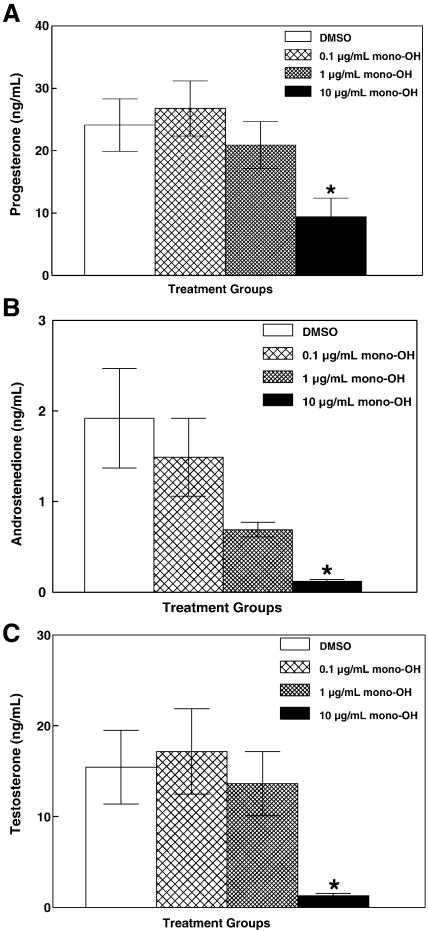
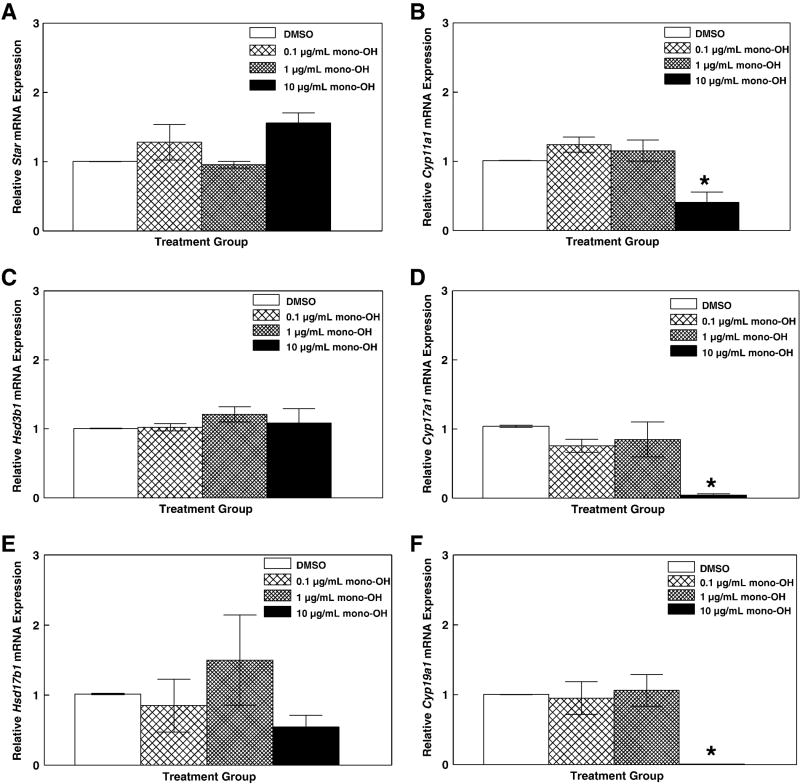
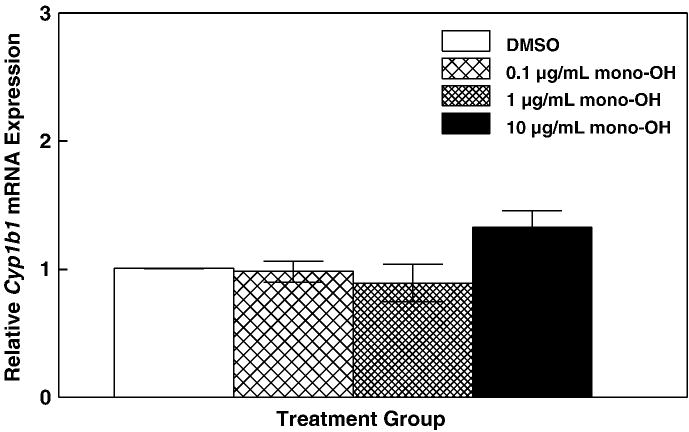
Methoxychlor (MXC) is an organochlorine pesticide that reduces fertility in female rodents by decreasing antral follicle numbers and increasing follicular death. MXC is metabolized in the body to mono-hydroxy MXC (mono-OH). Little is known about the effects of mono-OH on the ovary. Thus, this work tested the hypothesis that mono-OH exposure decreases production of 17β-estradiol (E₂) by cultured mouse antral follicles. Antral follicles were isolated from CD-1 mice (age 35-39 days) and exposed to dimethylsulfoxide (DMSO), or mono-OH (0.1-10 μg/mL) for 96 h. Media and follicles were collected for analysis of sex steroid levels and mRNA expression, respectively. Mono-OH treatment (10 μg/mL) decreased E(2) (DMSO: 3009.72±744.99 ng/mL; mono-OH 0.1 μg/mL: 1679.66±461.99 ng/mL; 1 μg/mL: 1752.72±532.41 ng/mL; 10 μg/mL: 45.89±33.83 ng/mL), testosterone (DMSO: 15.43±2.86 ng/mL; mono-OH 0.1μg/mL: 17.17±4.71 ng/mL; 1 μg/mL: 13.64±3.53 ng/mL; 10 μg/mL: 1.29±0.23 ng/mL), androstenedione (DMSO: 1.92±0.34 ng/mL; mono-OH 0.1 μg/mL: 1.49±0.43ng/mL; 1 μg/mL: 0.64±0.31 ng/mL; 10 μg/mL: 0.12±0.06 ng/mL) and progesterone (DMSO: 24.11±4.21 ng/mL; mono-OH 0.1μg/mL: 26.77±4.41 ng/mL; 1 μg/mL: 20.90±3.75 ng/mL; 10 μg/mL: 9.44±2.97 ng/mL) levels. Mono-OH did not alter expression of Star, Hsd3b1, Hsd17b1 and Cyp1b1, but it did reduce levels of Cyp11a1, Cyp17a1 and Cyp19a1 mRNA. Collectively, these data suggest that mono-OH significantly decreases levels of key sex steroid hormones and the expression of enzymes required for steroidogenesis.
Copyright © 2010 Elsevier Inc. All rights reserved.
Conflict of interest statement
The authors have no conflicts to disclose.
Figures
References
-
- Agency for Toxic Substances and Disease Registry. Toxicological Profile for Methoxychlor. U.S. Department of Health and Human Services Public Health Service; Atlanta, GA: 2002. - PubMed
-
- Akgul Y, Derk R, Meighan T, Rao K, Murono E. The methoxychlor metabolite, HPTE, directly inhibits the catalytic activity of cholesterol side-chain cleavage (P450scc) in cultured rat ovarian cells. Reprod Toxicol. 2008;25:67–75. - PubMed
-
- Altschul SF, Gish W, Miller W, Myers E, Lipman D. Basic local alignment search tool. J Mol Biol. 1990;215:403–410. - PubMed
-
- Bagur AC, Mautzlen CA. Risk for developing osteoporosis in untreated premature menopause. Calcif Tiss Int. 1992;51:4–7. Ref Type: Journal (Full) - PubMed
Publication types
MeSH terms
Substances
Grants and funding
LinkOut - more resources
Full Text Sources
