Review
. 2011 May;46(5):355-62.
doi: 10.1016/j.exger.2010.09.002. Epub 2010 Sep 16.

Heat shock proteins and Drosophila aging

Affiliations
Review

Heat shock proteins and Drosophila aging

John Tower. Exp Gerontol. 2011 May.

Abstract

Since their discovery in Drosophila, the heat shock proteins (Hsps) have been shown to regulate both stress resistance and life-span. Aging is characterized by increased oxidative stress and the accumulation of abnormal (malfolded) proteins, and these stresses induce Hsp gene expression through the transcription factor HSF. In addition, a subset of Hsps is induced by oxidative stress through the JNK signaling pathway and the transcription factor Foxo. The Hsps counteract the toxicity of abnormal proteins by facilitating protein refolding and turnover, and through other mechanisms including inhibition of apoptosis. The Hsps are up-regulated in tissue-specific patterns during aging, and their expression correlates with, and sometimes predicts, life span, making them ideal biomarkers of aging. The tools available for experimentally manipulating gene function and assaying healthspan in Drosophila provides an unparalleled opportunity to further study the role of Hsps in aging.


Figures

Figure 1
Figure 1
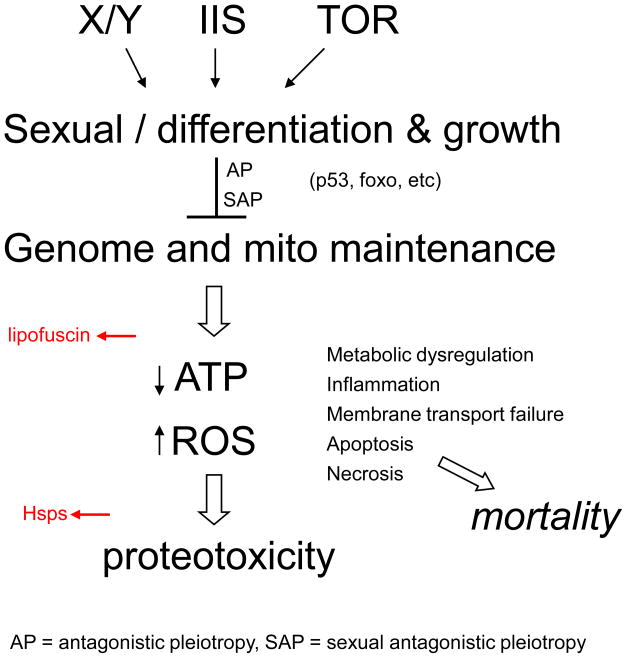
Over-view of aging, proteotoxicity and Hsps. Three pathways, the sex-determination pathway (X/Y), the insulin/IGF1-like signaling pathway (IIS), and the target of rapamycin pathway (TOR) promote differentiation, sexual differentiation and growth. This differentiation and growth is epistatic to the antagonistic pleiotropic activities of numerous genes, thereby inhibiting optimal maintenance of the genome and mitochondria. Mitochondrial failure results in decreased production of ATP and increased production of ROS, resulting in the accumulation of abnormal proteins and proteotoxicity. Denatured proteins and ROS cause chronic induction of Hsp genes (indicated in red) providing one predictive biomarker of aging. Lipids, proteins and carbohydrates undergo complex cross-linking and biochemical changes to produce the autofluorescent age pigment called lipofuscin (indicated in red), another biomarker of aging. Normally regulated expression of Hsps can favor longevity by counteracting proteotoxicity, inhibiting apoptosis, and possibly other mechanisms.
Figure 2
Figure 2
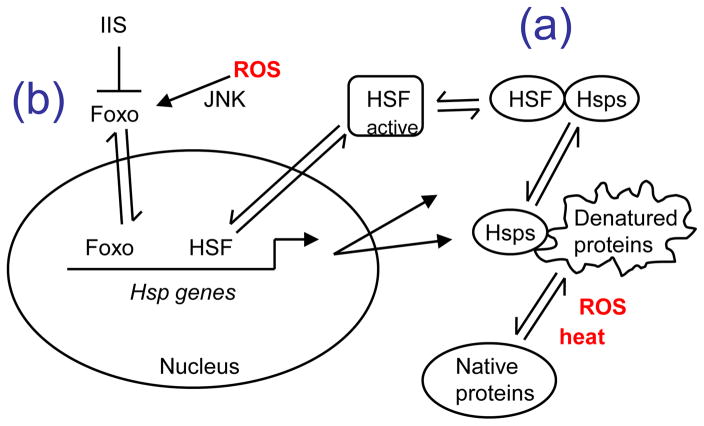
Hsp gene induction by ROS and denatured proteins. Reactive oxygen species (ROS, shown in red) and denatured proteins induce Hsp gene expression through at least two pathways, involving the transcription factors HSF (a) and Foxo (b). (a) Denatured proteins activate all Hsp genes through the transcription factor HSF. HSF is constitutively expressed, and under normal conditions HSF is present in the cytoplasm in a complex with several Hsps (including Hsp90, Hsp70 and Hsp40), that sequester the HSF protein in an inactive, monomeric form. The induction of Hsp genes by denatured proteins involves activation of HSF, and a negative feed-back loop that limits the response. Heat stress, ROS damage and other protein-denaturing stresses cause the unfolding of proteins and the exposure of hydrophobic residues in the denatured proteins. The exposed hydrophobic residues bind to Hsps, and these interactions inhibit aggregation, and facilitate re-folding or turnover, thereby reducing toxic effects on the cell. The binding of Hsps to denatured proteins titrates the Hsps away from HSF transcription factor, allowing HSF to assume an active trimeric form and translocate to the nucleus. In the nucleus, HSF binds to heat shock response elements (HSEs) in the promoters of the Hsp genes, and activates high-level Hsp gene expression. Once Hsp protein levels increase sufficiently they saturate the denatured proteins and titrate HSF back to the inactive Hsp-bound form, thereby limiting the response. The Hsps bind to a variety of clients, including inhibitory interactions with the tumor-suppressor (and senescence-regulatory protein) p53. In this way, stresses such as heat or oxidative stress that cause the denaturation of proteins can coordinately affect a variety of pathways by sequestering the Hsps away from their multiple regulatory-protein clients. (b) ROS also activates a subset of Hsp genes through the JNK signaling pathway and the transcription factor Foxo. JNK signaling activates Foxo in the cytoplasm, allowing Foxo to translocate to the nucleus where it binds to motifs in the promoters of a subset of Hsp genes and activates their expression, for example, the sHsp gene l(2)efl. The insulin/IGF1-like signaling (IIS) pathway negatively regulates Foxo activity by phosphorylating sites on Foxo that favor its retention in the cytoplasm. Therefore, decreased IIS can favor the expression of specific genes, such as l(2)efl, through increased activity of Foxo. Key: HSF, heat shock factor; IIS, insulin/IGF1-like signaling pathway; JNK, Jun N-terminal kinase. Solid arrowheads indicate activation or production. T-bar indicates inhibition. Single-side arrowheads indicate partitioning between two subcellular compartments or states.

References

    1. Agoff SN, Hou J, Linzer DI, Wu B. Regulation of the human hsp70 promoter by p53. Science. 1993;259:84–7. - PubMed
    1. Arndt V, Dick N, Tawo R, Dreiseidler M, Wenzel D, Hesse M, Furst DO, Saftig P, Saint R, Fleischmann BK, Hoch M, Hohfeld J. Chaperone-assisted selective autophagy is essential for muscle maintenance. Curr Biol. 2010;20:143–8. - PubMed
    1. Auluck PK, Meulener MC, Bonini NM. Mechanisms of Suppression of {alpha}-Synuclein Neurotoxicity by Geldanamycin in Drosophila. J Biol Chem. 2005;280:2873–8. - PubMed
    1. Ayyadevara S, Alla R, Thaden JJ, Shmookler Reis RJ. Remarkable longevity and stress resistance of nematode PI3K-null mutants. Aging Cell. 2008;7:13–22. - PubMed
    1. Beaulieu JF, Arrigo AP, Tanguay RM. Interaction of Drosophila 27,000 Mr heat-shock protein with the nucleus of heat-shocked and ecdysone-stimulated culture cells. J Cell Sci. 1989;92 ( Pt 1):29–36. - PubMed

Publication types

Substances