Longitudinal adherence with fecal occult blood test screening in community practice
- PMID: 20843880
- PMCID: PMC2939414
- DOI: 10.1370/afm.1133
Longitudinal adherence with fecal occult blood test screening in community practice
Abstract
Purpose: Although screening with fecal occult blood testing (FOBT) reduces colorectal cancer (CRC) mortality, its effectiveness may diminish if patients do not adhere with repeated screenings. Among patients who had previously engaged in FOBT screening, we assessed subsequent adherence with FOBT screening.
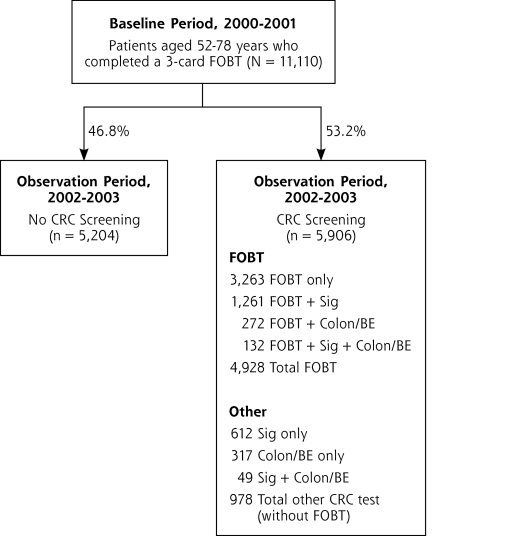
Methods: We assessed longitudinal adherence with biennial FOBT screening (every other year) within a cohort of patients enrolled in an integrated Washington State health plan. Among 11,110 patients who participated in FOBT screening during a 2-year baseline period (2000-2001), we ascertained CRC screening use during a subsequent 2-year observation period (2002-2003). We used multinomial logistic regression to identify patient characteristics associated with higher incidence of repeat CRC screening (with or without FOBT) relative to patients who received no CRC screening.
Results: Despite prior participation in FOBT screening, less than one-half of patients (44.4%; 95% CI, 42.9%-45.8%) completed FOBT screening during the 2-year observation period. Although 8.8% of patients (95% CI, 8.0%-9.7%) received other CRC tests without FOBT during the observation period, nearly one-half, 46.8% (95% CI, 45.3%-48.4%), received no CRC screening. After adjustment for other patient characteristics, receipt of a preventive health examination was strongly associated with FOBT adherence relative to no CRC screening (adjusted relative rate ratio = 11.16; 95% CI, 9.61-12.96).
Conclusions: Longitudinal adherence with FOBT screening was low in this insured population, potentially compromising its effectiveness in population CRC mortality reduction. Interventions to promote adherence may be necessary to achieve high effectiveness in population-based FOBT screening programs.
Figures
References
-
- Mandel JS, Bond JH, Church TR, et al. Reducing mortality from colorectal cancer by screening for fecal occult blood. Minnesota Colon Cancer Control Study. N Engl J Med. 1993;328(19):1365–1371. - PubMed
-
- Mandel JS, Church TR, Bond JH, et al. The effect of fecal occult-blood screening on the incidence of colorectal cancer. N Engl J Med. 2000;343(22):1603–1607. - PubMed
-
- Hardcastle JD, Chamberlain JO, Robinson MH, et al. Randomised controlled trial of faecal-occult-blood screening for colorectal cancer. Lancet. 1996;348(9040):1472–1477. - PubMed
-
- Kronborg O, Fenger C, Olsen J, Jørgensen OD, Søndergaard O. Randomised study of screening for colorectal cancer with faecal-occult-blood test. Lancet. 1996;348(9040):1467–1471. - PubMed
-
- Inventory of Colorectal Cancer Screening Activities in International Cancer Screening Network (ICSN) Countries. May 2008. National Cancer Institute Web Site. http://appliedresearch.cancer.gov/icsn/colorectal/screening.html. Accessed Jun 1, 2009.
Publication types
MeSH terms
Grants and funding
LinkOut - more resources
Full Text Sources
Medical